Special Discount Price For New and Renewing ICSA Members
This important collection includes
• Introduction: ICSA’s Recovery Focus—Michael D.
Langone, PhD
• Helping Families and Loved Ones—William
Goldberg, LCSW, PsyA
• Exit Counseling—Carol Giambalvo
• Cults: A Natural Disaster—Looking at Cult
Involvement Through a Trauma Lens—Shelly Rosen,
LCSW
• Counseling Former Cultists: The Brief Intermittent
Developmental Therapy (BIDT) Approach—Steve K.
D. Eichel, PhD, ABPP, CST
• Mentalization Attachment Approach to Cult
Recovery—Rosanne Henry, MA, LPC
• EMDR—Overview and Application With First- and
Second-Generation Former Group Members—Leona
Furnari, MSW, LCSW
• A Modern Psychodynamic Approach With First-
Generation Former Cult Members—Doni Whitsett,
PhD, LCSW
• The Role of Self-Care in Cult Recovery: Issues for
Practitioners, Members, and Former Members of
Cultic Groups and Their Families—Linda Dubrow-
Marshall, PhD, Reg. MBACP (Accred.) and Rod
Dubrow-Marshall, PhD, MBPsS
• Helping First-Generation Parents and Second-
Generation Children Heal the Impact of Cult Harm—
Lorna Goldberg, LCSW, PsyA
• Support Group for Former Cult Members—William
Goldberg, LCSW, PsyA and Lorna Goldberg, LCSW,
PsyA
• An Independent Faith-Based Approach to Support
and Recovery Groups for Those Affected by Harmful
Religious Environments—Patrick J. Knapp, MA, PhD
candidate
• The Colorado Model Recovery Workshop—Carol
Giambalvo and Nancy Miquelon, LPCC
• The Wellspring Program—Donna Adams-Weiss,
PhD, LPC Ron Burks, MA, MDiv, PhD, LMHC Greg
Sammons, MEd, LPC and Lois Svoboda, MD, LMFT
• Relational Psychoeducational Intensive—Time Away
for Postcult Counselling—Gillie Jenkinson, PhD, MA,
UKCP-accredited
• Residential Treatment Modality for Cult Trauma
Survivors—Robert Pardon, MDiv, ThM and Judy
Pardon, MEd
• The Relational System of the Traumatizing
Narcissist—Daniel Shaw, LCSW
• How to Approach Cultic Studies Research—Lois
Kendall, PhD
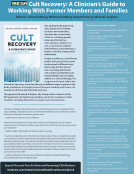
Cult Recovery: A Clinician’s Guide to
Working With Former Members and Families
icsahome.com/networks/mentalhealth/cultrecoverybook
This landmark 500-page book,
with chapters from leading
clinicians and researchers,
describes the current state
of the art in helping people
adversely affected by a
cultic dynamic, whether in a
cult, a mainstream religious
denomination, psychotherapy, a
family, or another interpersonal
relationship.
People are different, and different
people will respond to the same
environment in different ways.
That is why the first clinical
rule in working with former
cult members and families is to
remain flexible and not rigidly
adhere to a clinical ideology. The
chapters in this book reflect this
attitude of openness, while describing how different experts approach the
kinds of problems that might confront therapists working with former cult
members and those with affected loved ones.
Though primarily aimed at helpers, the clearly written chapters of this
500-page book can help family members and former members of cultic
situations, including those born or raised in such environments.
“Decades of valuable and useful research and treatment experience are contained in these
essays. Nothing comparable exists in current mental health literature. It will be the standard
reference for treating cult victims for years to come.”
—Stephen Kent, PhD, University of Alberta
“Never before has there been so instructive a collection of information on cult-relevant
treatment issues. This book should be in easy reach on the shelf of any clinician who provides
such treatment.”
—Robert Cialdini, PhD, Author of Influence and Pre-Suasion
“I have been looking forward to this book becoming a reality. At last, a comprehensive guide
to recommend to students and professionals wishing to learn more about how to help those
affected by abusive groups. Through the contributions of leading experts dedicated over the
years to helping those harmed by a cult experience, the editors have done an outstanding
job of bringing together accumulated knowledge and new insights on cult recovery. A must-
read for students and mental health professionals interested in setting a high bar for further
work with those who suffer.”
—Carmen Almendros, PhD, Associate Professor in Clinical and Health Psychology,
Universidad Autónoma de Madrid, Spain
Editors: Lorna Goldberg, William Goldberg, Rosanne Henry, Michael Langone
This important collection includes
• Introduction: ICSA’s Recovery Focus—Michael D.
Langone, PhD
• Helping Families and Loved Ones—William
Goldberg, LCSW, PsyA
• Exit Counseling—Carol Giambalvo
• Cults: A Natural Disaster—Looking at Cult
Involvement Through a Trauma Lens—Shelly Rosen,
LCSW
• Counseling Former Cultists: The Brief Intermittent
Developmental Therapy (BIDT) Approach—Steve K.
D. Eichel, PhD, ABPP, CST
• Mentalization Attachment Approach to Cult
Recovery—Rosanne Henry, MA, LPC
• EMDR—Overview and Application With First- and
Second-Generation Former Group Members—Leona
Furnari, MSW, LCSW
• A Modern Psychodynamic Approach With First-
Generation Former Cult Members—Doni Whitsett,
PhD, LCSW
• The Role of Self-Care in Cult Recovery: Issues for
Practitioners, Members, and Former Members of
Cultic Groups and Their Families—Linda Dubrow-
Marshall, PhD, Reg. MBACP (Accred.) and Rod
Dubrow-Marshall, PhD, MBPsS
• Helping First-Generation Parents and Second-
Generation Children Heal the Impact of Cult Harm—
Lorna Goldberg, LCSW, PsyA
• Support Group for Former Cult Members—William
Goldberg, LCSW, PsyA and Lorna Goldberg, LCSW,
PsyA
• An Independent Faith-Based Approach to Support
and Recovery Groups for Those Affected by Harmful
Religious Environments—Patrick J. Knapp, MA, PhD
candidate
• The Colorado Model Recovery Workshop—Carol
Giambalvo and Nancy Miquelon, LPCC
• The Wellspring Program—Donna Adams-Weiss,
PhD, LPC Ron Burks, MA, MDiv, PhD, LMHC Greg
Sammons, MEd, LPC and Lois Svoboda, MD, LMFT
• Relational Psychoeducational Intensive—Time Away
for Postcult Counselling—Gillie Jenkinson, PhD, MA,
UKCP-accredited
• Residential Treatment Modality for Cult Trauma
Survivors—Robert Pardon, MDiv, ThM and Judy
Pardon, MEd
• The Relational System of the Traumatizing
Narcissist—Daniel Shaw, LCSW
• How to Approach Cultic Studies Research—Lois
Kendall, PhD
Cult Recovery: A Clinician’s Guide to
Working With Former Members and Families
icsahome.com/networks/mentalhealth/cultrecoverybook
This landmark 500-page book,
with chapters from leading
clinicians and researchers,
describes the current state
of the art in helping people
adversely affected by a
cultic dynamic, whether in a
cult, a mainstream religious
denomination, psychotherapy, a
family, or another interpersonal
relationship.
People are different, and different
people will respond to the same
environment in different ways.
That is why the first clinical
rule in working with former
cult members and families is to
remain flexible and not rigidly
adhere to a clinical ideology. The
chapters in this book reflect this
attitude of openness, while describing how different experts approach the
kinds of problems that might confront therapists working with former cult
members and those with affected loved ones.
Though primarily aimed at helpers, the clearly written chapters of this
500-page book can help family members and former members of cultic
situations, including those born or raised in such environments.
“Decades of valuable and useful research and treatment experience are contained in these
essays. Nothing comparable exists in current mental health literature. It will be the standard
reference for treating cult victims for years to come.”
—Stephen Kent, PhD, University of Alberta
“Never before has there been so instructive a collection of information on cult-relevant
treatment issues. This book should be in easy reach on the shelf of any clinician who provides
such treatment.”
—Robert Cialdini, PhD, Author of Influence and Pre-Suasion
“I have been looking forward to this book becoming a reality. At last, a comprehensive guide
to recommend to students and professionals wishing to learn more about how to help those
affected by abusive groups. Through the contributions of leading experts dedicated over the
years to helping those harmed by a cult experience, the editors have done an outstanding
job of bringing together accumulated knowledge and new insights on cult recovery. A must-
read for students and mental health professionals interested in setting a high bar for further
work with those who suffer.”
—Carmen Almendros, PhD, Associate Professor in Clinical and Health Psychology,
Universidad Autónoma de Madrid, Spain
Editors: Lorna Goldberg, William Goldberg, Rosanne Henry, Michael Langone