VOLUME 9 |ISSUE 2 |2018
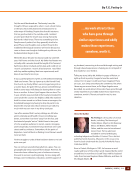
Recovery Workshops, Intensive Programs, and Residential
Treatment are the topics of section 4. These options are “more time
limited, focused, and didactic” than the support groups described
earlier in the book (p. 299). Models for these programs are
described, such as the Colorado Model Recovery Workshop (Carol
Giambalvo and Nancy Miquelon, Chapter 14) and the Wellspring
program (Donna Adams-Weiss, Ron Burks, Greg Sammons, and
Lois Svoboda, Chapter 15). “…Time Away for Postcult Counseling”
(Gillie Jenkinson, Chapter 16) and “Residential Treatment Modality
for Survivors” (Robert Pardon and Judy Pardon, Chapter 17) are
additional topics of chapters in this section.
The final section of this collection pertains to Special Issues and
Research. Daniel Shaw focuses on the personality of the narcissist
(Chapter 18). Lois Kendall contributes two chapters—one on “How
to Approach Cultic Studies Research” (Chapter 19) and the other
on “What the Research Tells Clinicians...” (Chapter 20). At the end of
the book, Kristine Langone provides a comprehensive and useful
bibliography of related papers and books.
In summary, Cult Recovery: A Clinician’s Guide… is a significant
contribution to our collective understanding of counseling
cult members, former cult members, and their families. It is
understandable to lay persons and offers a variety of insights and
models. Most cult members eventually leave their groups, and this
book summarizes what experts have learned about treating these
former members and their families. This book should serve as useful
resource for years to come. n
2319
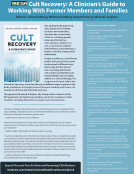
This timely collection of essays
provides an overview of current
approaches to understanding
and treating cultic trauma.
About the Author
Robin Boyle, JD, Professor of Legal Writing at St. John’s University
School of Law, lectures on topics concerning cults and the law.
Her articles include “Staying Safe: Observing Warning Signs of
a Dangerous Liaison,” coauthored with Andrea Laisure (ICSA
Today, volume 8, no. 3, 2017) “Employing Trafficking Laws to
Capture Elusive Leaders of Destructive Cults” (Oregon Review of
International Law, 2016) “Current Status of Federal Law Concerning
Violent Crimes Against Women and Children: Implications for
Cult Victims” (Cultic Studies Review, 2002) “How Children in Cults
May Use Emancipation Laws to Free Themselves” (Cultic Studies
Journal, 1999) and “Women, the Law, and Cults: Three Avenues of
Legal Recourse—New Rape Laws, Violence Against Women Act,
and Antistalking Laws” (Cultic Studies Journal, 1998). In 2005, she
received the Faculty Outstanding Achievement award from the
President of St. John’s University, and she is on the Editorial Board
of ICSA’s International Journal of Cultic Studies. n
Recovery Workshops, Intensive Programs, and Residential
Treatment are the topics of section 4. These options are “more time
limited, focused, and didactic” than the support groups described
earlier in the book (p. 299). Models for these programs are
described, such as the Colorado Model Recovery Workshop (Carol
Giambalvo and Nancy Miquelon, Chapter 14) and the Wellspring
program (Donna Adams-Weiss, Ron Burks, Greg Sammons, and
Lois Svoboda, Chapter 15). “…Time Away for Postcult Counseling”
(Gillie Jenkinson, Chapter 16) and “Residential Treatment Modality
for Survivors” (Robert Pardon and Judy Pardon, Chapter 17) are
additional topics of chapters in this section.
The final section of this collection pertains to Special Issues and
Research. Daniel Shaw focuses on the personality of the narcissist
(Chapter 18). Lois Kendall contributes two chapters—one on “How
to Approach Cultic Studies Research” (Chapter 19) and the other
on “What the Research Tells Clinicians...” (Chapter 20). At the end of
the book, Kristine Langone provides a comprehensive and useful
bibliography of related papers and books.
In summary, Cult Recovery: A Clinician’s Guide… is a significant
contribution to our collective understanding of counseling
cult members, former cult members, and their families. It is
understandable to lay persons and offers a variety of insights and
models. Most cult members eventually leave their groups, and this
book summarizes what experts have learned about treating these
former members and their families. This book should serve as useful
resource for years to come. n
2319
This timely collection of essays
provides an overview of current
approaches to understanding
and treating cultic trauma.
About the Author
Robin Boyle, JD, Professor of Legal Writing at St. John’s University
School of Law, lectures on topics concerning cults and the law.
Her articles include “Staying Safe: Observing Warning Signs of
a Dangerous Liaison,” coauthored with Andrea Laisure (ICSA
Today, volume 8, no. 3, 2017) “Employing Trafficking Laws to
Capture Elusive Leaders of Destructive Cults” (Oregon Review of
International Law, 2016) “Current Status of Federal Law Concerning
Violent Crimes Against Women and Children: Implications for
Cult Victims” (Cultic Studies Review, 2002) “How Children in Cults
May Use Emancipation Laws to Free Themselves” (Cultic Studies
Journal, 1999) and “Women, the Law, and Cults: Three Avenues of
Legal Recourse—New Rape Laws, Violence Against Women Act,
and Antistalking Laws” (Cultic Studies Journal, 1998). In 2005, she
received the Faculty Outstanding Achievement award from the
President of St. John’s University, and she is on the Editorial Board
of ICSA’s International Journal of Cultic Studies. n