12 ICSA TODAY 13 VOLUME 10 |ISSUE 3 |2019
or relationships. In recent years, ICSA has recognized that there is actually a
significant population of multigenerational families, with not only children but
parents and sometimes grandparents themselves born or raised in their groups.
The subgroup of people born or raised in cultic groups has become an
increasingly important part of the ICSA network. Twenty four percent of the
attendees at the 2018 annual conference in Philadelphia, for example, were from
this population. (Fifty-eight percent of attendees were former members, with
41% of those being born or raised in a group.) Attendees at the 2019 annual
conference in Manchester, UK, showed even larger percentages. Sixty-eight
percent were former members 54% of these former members had been born or
raised in groups.
The new Board also solidified ICSA’s international dimension, holding ICSA’s
first annual conference outside the United States at the Autonomous University
of Madrid in 2005. Annual conferences have been held in Europe every other
year since then: Brussels (2007), Geneva (2009), Barcelona (2011), Trieste (2013),
Stockholm (2015), Bordeaux (2017), and Manchester, UK (2019). Info-Cult/Info-
Secte in Montreal, directed by Mike Kropveld, who has been involved since
AFF’s early years, has been a vital partner in international outreach during the
past few decades and also cosponsors all annual conferences.
The annual conference has been the conference to attend in the cultic-studies
field for many years, with from 200 to 250 people attending each conference.
Because not all interested persons can make the annual conference, the Board
also has scheduled regional events and a special assistance-focused conference
in Santa Fe in odd years since 2013. In coming years, the Board plans to address
the geographical dispersal of the ICSA network by holding more virtual events,
including some that would give CE units to mental health professionals.
In 2006, Diana Pletts organized ICSA’s first Phoenix Project exhibit of art and
literary works at the annual conference in Denver. Through the Phoenix Project,
ICSA affirmed the proposition that art can capture or reveal subtleties that elude
analytic writing and can serve a therapeutic function for the artists. ICSA is
currently developing a special website that will be devoted solely to artistic and
literary expressions of cult experience and recovery.
In 2010, the Board decided to split Cultic Studies Review (CSR) into two periodicals.
International Journal of Cultic Studies a peer-reviewed, scholarly journal, and ICSA
Today, a full-color magazine aimed at the educated layperson, with articles, book
reviews, personal narratives, news, and art and literary works. The latter reflects
the importance ICSA has attached to artistic expression since the first Phoenix
Project exhibit of 2006.
The Board underscored ICSA’s emphasis on dialogue, which Herb Rosedale had
championed, by collaborating on an article published in ICSA Today in 2013:
“Dialogue and Cultic Studies: Why Dialogue Benefits the Cultic Studies Field.”
An important ICSA goal that emerged from the emphasis on former members
and recovery issues is to expand the network of knowledgeable mental health
professionals so that ultimately there will be at least one such professional in
every major metropolitan area in the United States and, ideally, other countries.
Related to this goal is the need to provide training and supervision for interested
mental health professionals.
To further this objective, the ICSA Mental Health Committee began work on a
book project at its 2013 Santa Fe conference, where professionals presented on
topics that would eventually become book chapters. In 2017, a 499-page book
was published—Cult Recovery: A Clinician’s Guide to Working With Former Members
and Families.
The Board also worked to increase the membership level of ICSA and the number
of members who volunteered time and expertise to conferences, workshops,
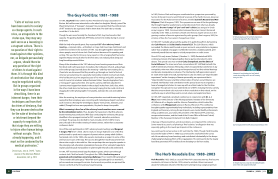
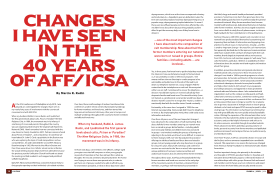
“In many instances the legal
system comes up short of
being just. It is hobbled
by the economic cost of
enforcing legal rights....
[Nevertheless] The legal
system provides some aid
to those in the process of
recovery and disengagement
from totalistic groups. ...over
a period of time it has enabled
people who left totalistic
groups to at least partly
pull themselves out of the
morass that they have entered
into, to readjust their family
relationships, to complete
their severance, and to impose
upon the totalistic groups
a degree of accountability
previously unknown. In this,
the system has performed a
useful function, provided its
limitations are acknowledged
and understood.”
[From Rosedale, H. L. (1993). “Legal
Considerations: Regaining Independence
and Initiative.” In M. D. Langone (Ed.),
Recovery From Cults: Help for Victims of
Psychological and Spiritual Abuse (pp.
392–393). New York, NY: W. W. Norton.]
publications, committees, and other endeavors. Mental health outreach was part
of the membership expansion effort, in part because Edward Lottick’s survey of
Pennsylvania psychologists (2008) indicated that about 50% had had experience
treating former cult members and 13% had had personal experience with cults,
with a quarter of those (about 3.5% of the total) having been in a cult.
Another ICSA survey (Dowhower, 2013) collected data from 224 respondents.
Forty-two percent of former members sought help from mainline religious
organizations. Thirty-two persons (40%) found these services not at all helpful.
This survey suggested that churches and other religious organizations are
important gatekeepers because former cult members seek help from them.
But the survey also suggested that religious organizations are not effective at
helping these victims. Hence, the Board has encouraged the development of the
Spiritual Safe Haven Network and the website, SpiritualAbuseResources.com,
as an outreach mechanism to religious organizations.
The Board has also encouraged the continued development of ICSA websites,
including outreach through social media and the posting of videos (mostly from
conferences) on ICSA’s YouTube channel. The ICSA E-Newsletter helps members
keep abreast of what other members are doing.
In recent years, the Board of Directors founded an advisory council, which
offers feedback on issues confronting ICSA, helps facilitate communication
with ICSA’s wider membership and constituencies, and, importantly, provides a
pool of people for future leadership. ICSA has arrived at a point of maturity and
relevance that suggests even greater growth and impact in future years. We are
both proud of this growth, and aware that strategic planning is necessary to
preserve and expand our achievements.
From the earliest days of the organization, leaders of AFF/ICSA realized that the
unethical influence they had observed in cultic groups occurred in other areas of
life, and that the organization’s work had relevance to other areas. Over the years,
AFF/ICSA has published articles relating cultic dynamics to domestic violence,
gangs, terrorism, sex trafficking, and spiritual abuse. ICSA has also organized
special conferences designed to illuminate the commonalities in such fields. We
have expanded our understanding of cultic groups and dynamics to include
one-on-one relationships.
In 2017, a law on coercive control in the United Kingdom underscored the need
to elucidate and illuminate the common dynamics observed in cults, domestic
violence, and other influence situations. Director Rod Dubrow-Marshall’s
plenary talk at the 2018 annual conference was entitled “The Spectrum of
Coercive Control.” In this talk, he elaborates upon the connections between
cultic dynamics and other areas of coercion, manipulation, and abuse. In future
years, ICSA will surely engage in more deliberate and vigorous outreach and
dialogue with experts from these other areas, providing a growing resource
for researchers, mental health professionals, families and people who have
experienced cultic involvement in any of its many forms. n
2019 CT Workshop Facilitators
(Upper left to right) Nitai Joseph, Lorna Goldberg,
Ann Stamler, William Goldberg, Ck Rardin, Elizabeth
Blackwell, Leona Furnari, Rosanne Henry, and Eva
Macky facilitated ICSA’s 2019 Connecticut Workshop for
Those Born or Raised in Cultic Groups or Relationships.
Marcia Rudin launched and ran AFF’s
ICEP program.
The Phoenix Project displays art and literature by former members.
Patrick Ryan created the original AFF
website.
or relationships. In recent years, ICSA has recognized that there is actually a
significant population of multigenerational families, with not only children but
parents and sometimes grandparents themselves born or raised in their groups.
The subgroup of people born or raised in cultic groups has become an
increasingly important part of the ICSA network. Twenty four percent of the
attendees at the 2018 annual conference in Philadelphia, for example, were from
this population. (Fifty-eight percent of attendees were former members, with
41% of those being born or raised in a group.) Attendees at the 2019 annual
conference in Manchester, UK, showed even larger percentages. Sixty-eight
percent were former members 54% of these former members had been born or
raised in groups.
The new Board also solidified ICSA’s international dimension, holding ICSA’s
first annual conference outside the United States at the Autonomous University
of Madrid in 2005. Annual conferences have been held in Europe every other
year since then: Brussels (2007), Geneva (2009), Barcelona (2011), Trieste (2013),
Stockholm (2015), Bordeaux (2017), and Manchester, UK (2019). Info-Cult/Info-
Secte in Montreal, directed by Mike Kropveld, who has been involved since
AFF’s early years, has been a vital partner in international outreach during the
past few decades and also cosponsors all annual conferences.
The annual conference has been the conference to attend in the cultic-studies
field for many years, with from 200 to 250 people attending each conference.
Because not all interested persons can make the annual conference, the Board
also has scheduled regional events and a special assistance-focused conference
in Santa Fe in odd years since 2013. In coming years, the Board plans to address
the geographical dispersal of the ICSA network by holding more virtual events,
including some that would give CE units to mental health professionals.
In 2006, Diana Pletts organized ICSA’s first Phoenix Project exhibit of art and
literary works at the annual conference in Denver. Through the Phoenix Project,
ICSA affirmed the proposition that art can capture or reveal subtleties that elude
analytic writing and can serve a therapeutic function for the artists. ICSA is
currently developing a special website that will be devoted solely to artistic and
literary expressions of cult experience and recovery.
In 2010, the Board decided to split Cultic Studies Review (CSR) into two periodicals.
International Journal of Cultic Studies a peer-reviewed, scholarly journal, and ICSA
Today, a full-color magazine aimed at the educated layperson, with articles, book
reviews, personal narratives, news, and art and literary works. The latter reflects
the importance ICSA has attached to artistic expression since the first Phoenix
Project exhibit of 2006.
The Board underscored ICSA’s emphasis on dialogue, which Herb Rosedale had
championed, by collaborating on an article published in ICSA Today in 2013:
“Dialogue and Cultic Studies: Why Dialogue Benefits the Cultic Studies Field.”
An important ICSA goal that emerged from the emphasis on former members
and recovery issues is to expand the network of knowledgeable mental health
professionals so that ultimately there will be at least one such professional in
every major metropolitan area in the United States and, ideally, other countries.
Related to this goal is the need to provide training and supervision for interested
mental health professionals.
To further this objective, the ICSA Mental Health Committee began work on a
book project at its 2013 Santa Fe conference, where professionals presented on
topics that would eventually become book chapters. In 2017, a 499-page book
was published—Cult Recovery: A Clinician’s Guide to Working With Former Members
and Families.
The Board also worked to increase the membership level of ICSA and the number
of members who volunteered time and expertise to conferences, workshops,
“In many instances the legal
system comes up short of
being just. It is hobbled
by the economic cost of
enforcing legal rights....
[Nevertheless] The legal
system provides some aid
to those in the process of
recovery and disengagement
from totalistic groups. ...over
a period of time it has enabled
people who left totalistic
groups to at least partly
pull themselves out of the
morass that they have entered
into, to readjust their family
relationships, to complete
their severance, and to impose
upon the totalistic groups
a degree of accountability
previously unknown. In this,
the system has performed a
useful function, provided its
limitations are acknowledged
and understood.”
[From Rosedale, H. L. (1993). “Legal
Considerations: Regaining Independence
and Initiative.” In M. D. Langone (Ed.),
Recovery From Cults: Help for Victims of
Psychological and Spiritual Abuse (pp.
392–393). New York, NY: W. W. Norton.]
publications, committees, and other endeavors. Mental health outreach was part
of the membership expansion effort, in part because Edward Lottick’s survey of
Pennsylvania psychologists (2008) indicated that about 50% had had experience
treating former cult members and 13% had had personal experience with cults,
with a quarter of those (about 3.5% of the total) having been in a cult.
Another ICSA survey (Dowhower, 2013) collected data from 224 respondents.
Forty-two percent of former members sought help from mainline religious
organizations. Thirty-two persons (40%) found these services not at all helpful.
This survey suggested that churches and other religious organizations are
important gatekeepers because former cult members seek help from them.
But the survey also suggested that religious organizations are not effective at
helping these victims. Hence, the Board has encouraged the development of the
Spiritual Safe Haven Network and the website, SpiritualAbuseResources.com,
as an outreach mechanism to religious organizations.
The Board has also encouraged the continued development of ICSA websites,
including outreach through social media and the posting of videos (mostly from
conferences) on ICSA’s YouTube channel. The ICSA E-Newsletter helps members
keep abreast of what other members are doing.
In recent years, the Board of Directors founded an advisory council, which
offers feedback on issues confronting ICSA, helps facilitate communication
with ICSA’s wider membership and constituencies, and, importantly, provides a
pool of people for future leadership. ICSA has arrived at a point of maturity and
relevance that suggests even greater growth and impact in future years. We are
both proud of this growth, and aware that strategic planning is necessary to
preserve and expand our achievements.
From the earliest days of the organization, leaders of AFF/ICSA realized that the
unethical influence they had observed in cultic groups occurred in other areas of
life, and that the organization’s work had relevance to other areas. Over the years,
AFF/ICSA has published articles relating cultic dynamics to domestic violence,
gangs, terrorism, sex trafficking, and spiritual abuse. ICSA has also organized
special conferences designed to illuminate the commonalities in such fields. We
have expanded our understanding of cultic groups and dynamics to include
one-on-one relationships.
In 2017, a law on coercive control in the United Kingdom underscored the need
to elucidate and illuminate the common dynamics observed in cults, domestic
violence, and other influence situations. Director Rod Dubrow-Marshall’s
plenary talk at the 2018 annual conference was entitled “The Spectrum of
Coercive Control.” In this talk, he elaborates upon the connections between
cultic dynamics and other areas of coercion, manipulation, and abuse. In future
years, ICSA will surely engage in more deliberate and vigorous outreach and
dialogue with experts from these other areas, providing a growing resource
for researchers, mental health professionals, families and people who have
experienced cultic involvement in any of its many forms. n
2019 CT Workshop Facilitators
(Upper left to right) Nitai Joseph, Lorna Goldberg,
Ann Stamler, William Goldberg, Ck Rardin, Elizabeth
Blackwell, Leona Furnari, Rosanne Henry, and Eva
Macky facilitated ICSA’s 2019 Connecticut Workshop for
Those Born or Raised in Cultic Groups or Relationships.
Marcia Rudin launched and ran AFF’s
ICEP program.
The Phoenix Project displays art and literature by former members.
Patrick Ryan created the original AFF
website.