Dear Friends,
As President of the Board of ICSA, it is my great honor to introduce this
special edition of ICSA Today celebrating the 40th anniversary of the
founding of ICSA (formerly AFF).
I remember meeting Michael Langone at the first American Family
foundation (AFF) conference I attended, probably in 1982 or ’83. Two things
immediately struck me. First, AFF seemed fairly open. This was important to
me, because I had a not-so-hidden agenda: I needed to find deprogrammers for my research
and doctoral dissertation. Prior to attending my first Cult Awareness Network (CAN) meeting
in 1981, I was vetted for a good 2 hours or so by a CAN official, partially as the result of my
explanation that I wanted to find people for my research. There was no such vetting process at
my first AFF conference. In fact, the AFF leaders seemed to welcome me as a researcher.
The second thing I noticed was Michael’s time-management skills, in which he used a pre-
Internet binder with pages containing pockets for organizing dozens of tasks. I immediately
knew (perhaps because his organizational skills were clearly so much better than mine!)
Michael would have an important impact on the cultic-studies field. Boy, was I right! It was at
this meeting (or maybe the year after) that I also met the AFF leading lights: Jack Clark, Lorna
and Bill Goldberg, Margaret Singer et. al.
My involvement with AFF took off from there. I attended many (but not all!) conferences, wrote
some articles for the Cultic Studies Journal, including one that was coauthored by Michael, me,
and my mentor, Dr. Arthur Dole. I was invited to join the ICSA Board in 2011 and was elected
President of the Board the following year. What I find interesting is the fact that I still usually
feel “new,” in large measure because the membership of ICSA is ever-evolving. Among former
cultists who are active in ICSA, for example, there remains a vibrant cadre of first-generation
original supporters but the trend is clear: We are now getting more and more second- and
even third-generation former members. The term SGA (second-generation adult) is being
replaced by MGA (multiple-generations adult).
It is impossible to provide a detailed accounting of ICSA’s first 40 years in anything under
1,000 pages. But the contributors to this issue come very close. Dr. Michael Langone, AFF/
ICSA’s long-serving Executive Director, gives us an intimate portrait of the early AFF leadership,
replete with anecdotes that illustrate the pathos, courage, and at times humor of our founders’
encounters with cults and their defenders. Langone does not fail to mention our most
productive and important intergroup relationship since our inception: our close connection
with the Canadian, Montreal-based organization Info-Cult/Info-Secte and its Executive
Director, Mike Kropveld. Michael pays particular attention to past-President Herbert Rosedale,
who passed away in 2003. His role in the development of ICSA’s general philosophy toward
cults (which I have referred to as “open and cult-critical” rather than “anti-“ or “countercult”)
remains a cornerstone of our ongoing ability to operate in highly challenging circumstances
and occasionally under significant pressure from both cultic groups and hard-core anticultists.
Finally, Dr. Langone summarizes the milestones in ICSA’s history, including the succession of
presidents from Herb Rosedale forward, and the expansion of our Board to better address our
increasing international presence and diversity of membership.
Marcia Rudin, who along with her husband Rabbi James Rudin wrote Prison or Paradise: The
New Religious Cults, one of the earliest books about cults, represents ICSA’s groundbreaking
role in education on cultic issues. In her article, she describes the changes we have seen in
both those involved with cults and those who work toward extricating them. As cults aged,
so did their members, and some began having children and even grandchildren born in the
group. Unlike those recruited (usually in early adulthood), these members had no “precult
personality” to return to when they left their groups. Marcia also discusses the growing
sophistication of researchers and helping professionals within the AFF network and the
growing importance of the Internet to its work.
About ICSA Today
ICSA Today (IT) serves ICSA members by
providing information that enhances
understanding of all aspects of the cult
phenomenon, including how groups
function, how they affect members,
techniques of influence, dealing with
harmful effects, educational and legal
implications, and other subjects.
ICSA Today issues may include
• practical articles for former
members, families, helping
professionals, researchers,
and others
• opinion essays
• theoretical articles
• reports on research
• summaries of news reports on
groups
• information on books, articles, links
• information on ICSA members
• biographical profiles on selected
members
• personal accounts
• art work
• poetry
• short stories and other literary
articles
• special reports from correspondents
around the world
ICSA Today is published three times a
year.
Regular ICSA members receive the
print edition of ICSA Today and have
access to its Web edition. Students
and other special members gain
access to the online edition only.
Nonmember print subscriptions are
available. Submissions to the magazine
should be sent to the Editor-in-Chief,
Michael Langone, PhD:
mail@icsamail.com
We prefer Microsoft Word or a program
compatible with Word. Articles should
be no more than 2,500 words. Please
include a jpeg photo (no less than 360
dpi) and biographical sketch (less than
150 words) with your submission.
Appropriate submissions are reviewed
by the relevant section editor and,
when appropriate, editorial review
advisors.
International Cultic Studies Association
P.O. Box 2265 • Bonita Springs, FL 34133
Phone: 239.514.3081
Email: mail@icsamail.com
Website: icsahome.com The views expressed in ICSA Today are solely those of the authors and do not necessarily reflect
the views of ICSA Today’s editors or editorial boards or of ICSA’s directors, advisors, or staff. Groups
analyzed or mentioned in ICSA Today are not necessarily cults, nor are they necessarily harmful.
Note to our readers regarding website addresses (URLs): For all http website addresses, such as
http://www.icsahome.com, ICSA Today uses only the shortened address form (icsahome.com). In
all instances when the basic address is other than http, such as https or ftp, we give the full
address. Please keep this in mind when exploring sites mentioned in ICSA Today.
16
Changes I Have Seen in the
40 Years of AFF/ICSA
Marcia R. Rudin
30
News Desk
2
ICSA: The First 40 Years
Michael D. Langone
ICSA Today, Volume 10, No. 3, 2019
Editor-in-Chief
Michael D. Langone, PhD
Associate Editor
Ann Stamler, MA, MPhil
Family Editor
Lois Svoboda, MD, LMFT
Member Profiles Editor
Mary O’Connell
Mental Health Editor
Gillie Jenkinson, PhD
Research Coeditors
Linda Dubrow-Marshall, PhD
Rod Dubrow-Marshall, PhD
Point of View -Q&A
William Goldberg, MSW, LCSW
Correspondents
Austria/Germany
Friedrich Griess
Eastern Europe
Piotr T. Nowakowski, PhD
French-Speaking Countries
Catherine Perry, PhD
Italy
Dr. Cristina Caparesi
Nordic Countries
Joni Valkila, PhD
Håkan Järvå, MSc Psych
Spain and Latin America
Luis Santamaria, SThL
Erika Toren, MSEd
Paul Lennon
News Desk
Ana Rodriguez
Patrick Ryan
Writing Consultant
Sharon Hamm
Bios of ICSA Today editors can be found at
icsahome.com/elibrary/people-profiles
International Cultic Studies Association
P.O. Box 2265 • Bonita Springs, FL 34133
Website: icsahome.com
Email: mail@icsamail.com
Phone: 239.514.3081
Fax: 305.393.8193
ISSN: 2154-820X
Printed in the USA
Artists and poets retain copyright
of their works and grant ICSA permission
to reproduce them. Unless otherwise
indicated, all other material copyright
International Cultic Studies Association.
25
Arts: Poetry
Lilia Volodina
28
Profile On...
Cynthia Lilley
22
Book Reviews
Diana Pletts, Gina Catena
18
Growing Up in the Culture
of a Cult
Lorna Goldberg
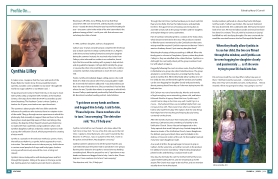
This issue of ICSA Today also features a close-up profile of another long-term ICSA
member, Cynthia Lilley. I had the pleasure of first meeting Cynthia and her daughter,
former Unificationist member Cathryn, when we all testified on behalf of a former
member in a custody battle in Florida. Cynthia’s struggle to free her daughter was both
a highly personal and well-covered (by media) event. Cynthia exemplifies the dedication
and perseverance of so many ICSA supporters, the people who have brought us to
where we are today.
Finally, Diana Pletts reviews a unique book by a unique author, Stephen Martin, MDiv.,
who was instrumental in the development of the well-regarded Wellspring residential
inpatient (and now outpatient) program for former cult members. In The Heresy of Mind
Control..., Martin applies Robert Jay Lifton’s theory of thought reform to the misuse of
the Bible by aberrant and cultic Christian groups. Diana refers to her own experience in
a Bible-based cult to point out the value in examining Lifton’s criteria using scriptural
references. She notes how valuable this book would have been had it been available
when she left her own group.
Enjoy this issue of ICSA Today as we move steadily toward our next 40 years!
Steve K. D. Eichel, PhD, ABPP, CST, ICSA President, was honored with
AFF’s 1990 John G. Clark Award for Distinguished Scholarship in Cultic Studies for his
doctoral dissertation on a deprogramming, which was published as a special issue of
the Cultic Studies Journal and has been translated into several foreign languages. Dr.
Eichel is active in a range of professional associations. He has coauthored several articles
and book reviews on cult-related topics for ICSA publications. For further details, see
icsahome.com/elibrary/people-profiles n
Table of Contents
Note: Contributing ICSA Today designer Jude Iannelli created the special
40th anniversary graphics appearing in this issue.
As President of the Board of ICSA, it is my great honor to introduce this
special edition of ICSA Today celebrating the 40th anniversary of the
founding of ICSA (formerly AFF).
I remember meeting Michael Langone at the first American Family
foundation (AFF) conference I attended, probably in 1982 or ’83. Two things
immediately struck me. First, AFF seemed fairly open. This was important to
me, because I had a not-so-hidden agenda: I needed to find deprogrammers for my research
and doctoral dissertation. Prior to attending my first Cult Awareness Network (CAN) meeting
in 1981, I was vetted for a good 2 hours or so by a CAN official, partially as the result of my
explanation that I wanted to find people for my research. There was no such vetting process at
my first AFF conference. In fact, the AFF leaders seemed to welcome me as a researcher.
The second thing I noticed was Michael’s time-management skills, in which he used a pre-
Internet binder with pages containing pockets for organizing dozens of tasks. I immediately
knew (perhaps because his organizational skills were clearly so much better than mine!)
Michael would have an important impact on the cultic-studies field. Boy, was I right! It was at
this meeting (or maybe the year after) that I also met the AFF leading lights: Jack Clark, Lorna
and Bill Goldberg, Margaret Singer et. al.
My involvement with AFF took off from there. I attended many (but not all!) conferences, wrote
some articles for the Cultic Studies Journal, including one that was coauthored by Michael, me,
and my mentor, Dr. Arthur Dole. I was invited to join the ICSA Board in 2011 and was elected
President of the Board the following year. What I find interesting is the fact that I still usually
feel “new,” in large measure because the membership of ICSA is ever-evolving. Among former
cultists who are active in ICSA, for example, there remains a vibrant cadre of first-generation
original supporters but the trend is clear: We are now getting more and more second- and
even third-generation former members. The term SGA (second-generation adult) is being
replaced by MGA (multiple-generations adult).
It is impossible to provide a detailed accounting of ICSA’s first 40 years in anything under
1,000 pages. But the contributors to this issue come very close. Dr. Michael Langone, AFF/
ICSA’s long-serving Executive Director, gives us an intimate portrait of the early AFF leadership,
replete with anecdotes that illustrate the pathos, courage, and at times humor of our founders’
encounters with cults and their defenders. Langone does not fail to mention our most
productive and important intergroup relationship since our inception: our close connection
with the Canadian, Montreal-based organization Info-Cult/Info-Secte and its Executive
Director, Mike Kropveld. Michael pays particular attention to past-President Herbert Rosedale,
who passed away in 2003. His role in the development of ICSA’s general philosophy toward
cults (which I have referred to as “open and cult-critical” rather than “anti-“ or “countercult”)
remains a cornerstone of our ongoing ability to operate in highly challenging circumstances
and occasionally under significant pressure from both cultic groups and hard-core anticultists.
Finally, Dr. Langone summarizes the milestones in ICSA’s history, including the succession of
presidents from Herb Rosedale forward, and the expansion of our Board to better address our
increasing international presence and diversity of membership.
Marcia Rudin, who along with her husband Rabbi James Rudin wrote Prison or Paradise: The
New Religious Cults, one of the earliest books about cults, represents ICSA’s groundbreaking
role in education on cultic issues. In her article, she describes the changes we have seen in
both those involved with cults and those who work toward extricating them. As cults aged,
so did their members, and some began having children and even grandchildren born in the
group. Unlike those recruited (usually in early adulthood), these members had no “precult
personality” to return to when they left their groups. Marcia also discusses the growing
sophistication of researchers and helping professionals within the AFF network and the
growing importance of the Internet to its work.
About ICSA Today
ICSA Today (IT) serves ICSA members by
providing information that enhances
understanding of all aspects of the cult
phenomenon, including how groups
function, how they affect members,
techniques of influence, dealing with
harmful effects, educational and legal
implications, and other subjects.
ICSA Today issues may include
• practical articles for former
members, families, helping
professionals, researchers,
and others
• opinion essays
• theoretical articles
• reports on research
• summaries of news reports on
groups
• information on books, articles, links
• information on ICSA members
• biographical profiles on selected
members
• personal accounts
• art work
• poetry
• short stories and other literary
articles
• special reports from correspondents
around the world
ICSA Today is published three times a
year.
Regular ICSA members receive the
print edition of ICSA Today and have
access to its Web edition. Students
and other special members gain
access to the online edition only.
Nonmember print subscriptions are
available. Submissions to the magazine
should be sent to the Editor-in-Chief,
Michael Langone, PhD:
mail@icsamail.com
We prefer Microsoft Word or a program
compatible with Word. Articles should
be no more than 2,500 words. Please
include a jpeg photo (no less than 360
dpi) and biographical sketch (less than
150 words) with your submission.
Appropriate submissions are reviewed
by the relevant section editor and,
when appropriate, editorial review
advisors.
International Cultic Studies Association
P.O. Box 2265 • Bonita Springs, FL 34133
Phone: 239.514.3081
Email: mail@icsamail.com
Website: icsahome.com The views expressed in ICSA Today are solely those of the authors and do not necessarily reflect
the views of ICSA Today’s editors or editorial boards or of ICSA’s directors, advisors, or staff. Groups
analyzed or mentioned in ICSA Today are not necessarily cults, nor are they necessarily harmful.
Note to our readers regarding website addresses (URLs): For all http website addresses, such as
http://www.icsahome.com, ICSA Today uses only the shortened address form (icsahome.com). In
all instances when the basic address is other than http, such as https or ftp, we give the full
address. Please keep this in mind when exploring sites mentioned in ICSA Today.
16
Changes I Have Seen in the
40 Years of AFF/ICSA
Marcia R. Rudin
30
News Desk
2
ICSA: The First 40 Years
Michael D. Langone
ICSA Today, Volume 10, No. 3, 2019
Editor-in-Chief
Michael D. Langone, PhD
Associate Editor
Ann Stamler, MA, MPhil
Family Editor
Lois Svoboda, MD, LMFT
Member Profiles Editor
Mary O’Connell
Mental Health Editor
Gillie Jenkinson, PhD
Research Coeditors
Linda Dubrow-Marshall, PhD
Rod Dubrow-Marshall, PhD
Point of View -Q&A
William Goldberg, MSW, LCSW
Correspondents
Austria/Germany
Friedrich Griess
Eastern Europe
Piotr T. Nowakowski, PhD
French-Speaking Countries
Catherine Perry, PhD
Italy
Dr. Cristina Caparesi
Nordic Countries
Joni Valkila, PhD
Håkan Järvå, MSc Psych
Spain and Latin America
Luis Santamaria, SThL
Erika Toren, MSEd
Paul Lennon
News Desk
Ana Rodriguez
Patrick Ryan
Writing Consultant
Sharon Hamm
Bios of ICSA Today editors can be found at
icsahome.com/elibrary/people-profiles
International Cultic Studies Association
P.O. Box 2265 • Bonita Springs, FL 34133
Website: icsahome.com
Email: mail@icsamail.com
Phone: 239.514.3081
Fax: 305.393.8193
ISSN: 2154-820X
Printed in the USA
Artists and poets retain copyright
of their works and grant ICSA permission
to reproduce them. Unless otherwise
indicated, all other material copyright
International Cultic Studies Association.
25
Arts: Poetry
Lilia Volodina
28
Profile On...
Cynthia Lilley
22
Book Reviews
Diana Pletts, Gina Catena
18
Growing Up in the Culture
of a Cult
Lorna Goldberg
This issue of ICSA Today also features a close-up profile of another long-term ICSA
member, Cynthia Lilley. I had the pleasure of first meeting Cynthia and her daughter,
former Unificationist member Cathryn, when we all testified on behalf of a former
member in a custody battle in Florida. Cynthia’s struggle to free her daughter was both
a highly personal and well-covered (by media) event. Cynthia exemplifies the dedication
and perseverance of so many ICSA supporters, the people who have brought us to
where we are today.
Finally, Diana Pletts reviews a unique book by a unique author, Stephen Martin, MDiv.,
who was instrumental in the development of the well-regarded Wellspring residential
inpatient (and now outpatient) program for former cult members. In The Heresy of Mind
Control..., Martin applies Robert Jay Lifton’s theory of thought reform to the misuse of
the Bible by aberrant and cultic Christian groups. Diana refers to her own experience in
a Bible-based cult to point out the value in examining Lifton’s criteria using scriptural
references. She notes how valuable this book would have been had it been available
when she left her own group.
Enjoy this issue of ICSA Today as we move steadily toward our next 40 years!
Steve K. D. Eichel, PhD, ABPP, CST, ICSA President, was honored with
AFF’s 1990 John G. Clark Award for Distinguished Scholarship in Cultic Studies for his
doctoral dissertation on a deprogramming, which was published as a special issue of
the Cultic Studies Journal and has been translated into several foreign languages. Dr.
Eichel is active in a range of professional associations. He has coauthored several articles
and book reviews on cult-related topics for ICSA publications. For further details, see
icsahome.com/elibrary/people-profiles n
Table of Contents
Note: Contributing ICSA Today designer Jude Iannelli created the special
40th anniversary graphics appearing in this issue.