6 ICSA TODAY 7 VOLUME 10 |ISSUE 3 |2019 4
In 1983, Doctors Clark and Langone contributed to a symposium sponsored by
Section K (Social, Economic and Political Sciences) of the Pacific Division, American
Association for the Advancement of Science, entitled Scientific Research and New
Religions (Clark &Langone, 1985). This symposium was one of the few gatherings
that brought together academicians and professionals from what was already
viewed as the two “camps” of “pro” and “anti” cultists (see tongue-in-cheek
essay, Langone, 1983). Communication between these two “camps” decreased
markedly in the 1980s as members of both were hired as expert witnesses in the
growing number of lawsuits against and by cultic groups. (See Langone, 2005, for
a history of how the “two camps” changed over time.)
In 1984, AFF markedly advanced the quality of its publishing efforts by founding
the Cult Observer and Cultic Studies Journal (CSJ). The Cult Observer, which
succeeded The Advisor and focused on press accounts, was printed as a magazine,
rather than a tabloid newspaper. CSJ filled the need for a multidisciplined, peer-
reviewed journal that was open to critical perspectives on cultic issues.
One of CSJ’s early issues (Volume 2, Number 2—1985) illustrated well AFF’s
continuing mission of bringing together diverse parties interested in cultic
abuses. This special issue was entitled Cults, Evangelicals, and the Ethics of
Social Influence. The issue arose from conversations AFF staff had had with the
staff of InterVarsity Christian Fellowship, which recognized that sometimes its lay
evangelists, who were often young and inexperienced, lost their ethical bearings
and became manipulative or abusive. The InterVarsity staff appreciated a point
Dr. Clark often made in his talk, namely that in cults we witness an “impermissible
experiment” on the changing of human personality, an experiment that is
“impermissible” because unwritten ethical codes of human social influence are
violated. InterVarsity’s vital contribution to this special issue was to organize a
team of evangelical scholars to come up with an ethical code for the Christian
evangelist. This special CSJ issue underlined one of AFF’s enduring themes namely,
that the concern about cults rests not on their creeds but on their deeds, on the
unethical ways in which they seek to recruit, retain, and exploit members.
In 1985, AFF organized a landmark conference in conjunction with Dr. L. J.
West (1925-1999), Director of the Neuropsychiatric Institute of the University
of California at Los Angeles and the Johnson Foundation, which hosted the
conference at its Wingspread campus in Racine, Wisconsin. This conference
brought together approximately forty individuals, including representatives from
England and Germany. Among the participants were mental health professionals,
clergy, academicians, journalists, the president of the National PTA, attorneys,
campus administrators, and the Head of the Private Office of Richard Cottrell,
Member of the European Parliament from Bath, England.
A barrage of harassing letters, and also picketers, accompanied this conference.
Some material accused us of plotting a “final solution,” an allegation that was
especially galling to the Jewish participants at the conference.
Guy continued to remain active in AFF well into the 1990s. Though Herb Rosedale
became the leader of AFF in 1988, Guy continued his vital behind-the-scenes
role. He ran advisory board meetings and contributed substantially to the always-
challenging fundraising efforts of the organization. He continued to be the steady
hand that prevented AFF’s intellects from deviating too far from reality.
The Herb Rosedale Era: 1988–2003
Herb Rosedale (1932–2003), a successful New York corporate attorney, first became
involved in cult issues in the late 1970s, when he assisted citizens concerned
about the Unification Church’s (“the Moonies”) attempt to buy a large property in
The Guy Ford Era: 1981–1988
In 1981, Guy Ford (1922–2007) was Vice President of a large corporation in
Boston. He had become interested in cults when his daughter, Wendy, joined The
Way International. A “manager’s manager,” Guy recognized that the professionals
of AFF needed to be organized. And he knew that if he didn’t do it, nobody
would do it. So he did it.
Though he was never formally the President of AFF, Guy functioned in that
capacity. His guiding hand kept AFF firmly anchored to reality during its crucial
early years.
With the help of a special grant, Guy organized AFF’s first advisory board
meeting—corporate style—at Dunfey’s on Cape Cod (now Cape Cod Resort and
Conference Center) in the summer of 1981. Guy brought together about three
dozen people, most of whom Jack Clark had met because of his speaking and
writing. This was the first time so many experts in this emerging field had come
together. Many met each other for the first time, not realizing what deep and
long friendships would follow.
Many of the attendees at the 1981 advisory board meeting experienced their
first brush with cult harassment. Somehow, the Unification Church, and perhaps
a few other groups, learned about the meeting—and they were waiting for us.
(Years later we discovered that they used to go through our trash to find out
what we were planning.) An especially memorable incident involved Jack Clark,
who had become a prime target because of his writings and public testimony
and, of course, his academic and professional status. Two photographers from
a “newspaper” approached him. One put his camera with flash attachment
(cameras were bigger than books in those days!) inches from Jack’s face, while
the other stood about six feet away, obviously hoping that he could catch Jack
slugging the other photographer. Fortunately, Jack kept his cool and walked
away.
After the meeting, the employers of many attendees received threatening letters
saying that their employee was consorting with “antireligious bigots” and other
such nonsense. (Among the “antireligious bigots” were priests, ministers, and
rabbis!) Though his boss was sympathetic, Guy had to keep a low profile.
What is amazing is how few of the advisory board members were cowered
by the intimidation tactics. Thus, despite the harassment, that first advisory
board meeting was productive. With Guy conducting the orchestra, the group
identified a four-pronged mission for AFF: research, education, assistance,
and legal. The group also decided to meet annually, which it did for many
years, though in the modest setting of retreat centers, rather than a corporate
conference hotel.
One of the early participants in AFF’s advisory board meetings was Margaret
T. Singer, PhD (1921–2003). Like Dr. Clark, Dr. Singer had been one of the first
professionals to speak out in support of parents whose young-adult children
had joined cults. In the 1980s, she was also involved as an expert in some of the
seminal court cases of the day. Her success brought her much harassment from
those who sought to discredit her. She was perhaps the most popular speaker in
the emerging cult-education organizations because of her unrivaled capacity to
explain psychological manipulation in plain English that all could understand.
In 1981, AFF received several large foundation grants, which came through
contacts Jack Clark had made. Throughout the 1980s, fund-raising was a
perpetual and sometimes unnerving challenge (“Two months till bankruptcy!”
“Three months till bankruptcy.” “Wow! We won’t go bankrupt for six months!”)
yet we somehow managed to survive. And as much as possible, we pursued the
mission set forth at the first advisory board meeting.
“Cults of various sorts
have been useful to society
as change agents. In such
roles, as antagonists to the
status quo, they may very
well serve as a leavening in
a stagnant culture. There is
no question of their right to
stand against other opinions,
nor, as Delgado persuasively
argues, should there be
any question of the right
of others to stand against
them. It is through this kind
of confrontation that change
may be negotiated safely.
But in groups organized
in the ways I have been
describing, there is an
inherent danger, from their
techniques and from their
doctrines of deviancy, that
they can become destructive
for the sake of destruction
or intolerant beyond the
capacity to negotiate. At
that stage they are willing
to injure other human beings
without scruple. This is
already happening, and it
must not be condoned by the
medical profession.”
[From Clark, John G. (1979). “Cults,”
Journal of the American Medical
Association, 242, p. 281.]
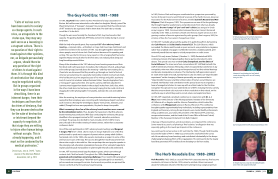
Volunteer Dr. Sandy Andron gives Carol Turnbull
a much-deserved hug and kiss at an AFF meeting
during the 1980s.
Guy Ford organized the first AFF advisory board meeting in 1981.
Dr. Michael Langone, part of Jack Clark’s original team,
worked at the original AFF office in Weston, MA.
Dr. Margret Singer was a major force for making the public
aware of how cultic groups harmed people.
In 1983, Doctors Clark and Langone contributed to a symposium sponsored by
Section K (Social, Economic and Political Sciences) of the Pacific Division, American
Association for the Advancement of Science, entitled Scientific Research and New
Religions (Clark &Langone, 1985). This symposium was one of the few gatherings
that brought together academicians and professionals from what was already
viewed as the two “camps” of “pro” and “anti” cultists (see tongue-in-cheek
essay, Langone, 1983). Communication between these two “camps” decreased
markedly in the 1980s as members of both were hired as expert witnesses in the
growing number of lawsuits against and by cultic groups. (See Langone, 2005, for
a history of how the “two camps” changed over time.)
In 1984, AFF markedly advanced the quality of its publishing efforts by founding
the Cult Observer and Cultic Studies Journal (CSJ). The Cult Observer, which
succeeded The Advisor and focused on press accounts, was printed as a magazine,
rather than a tabloid newspaper. CSJ filled the need for a multidisciplined, peer-
reviewed journal that was open to critical perspectives on cultic issues.
One of CSJ’s early issues (Volume 2, Number 2—1985) illustrated well AFF’s
continuing mission of bringing together diverse parties interested in cultic
abuses. This special issue was entitled Cults, Evangelicals, and the Ethics of
Social Influence. The issue arose from conversations AFF staff had had with the
staff of InterVarsity Christian Fellowship, which recognized that sometimes its lay
evangelists, who were often young and inexperienced, lost their ethical bearings
and became manipulative or abusive. The InterVarsity staff appreciated a point
Dr. Clark often made in his talk, namely that in cults we witness an “impermissible
experiment” on the changing of human personality, an experiment that is
“impermissible” because unwritten ethical codes of human social influence are
violated. InterVarsity’s vital contribution to this special issue was to organize a
team of evangelical scholars to come up with an ethical code for the Christian
evangelist. This special CSJ issue underlined one of AFF’s enduring themes namely,
that the concern about cults rests not on their creeds but on their deeds, on the
unethical ways in which they seek to recruit, retain, and exploit members.
In 1985, AFF organized a landmark conference in conjunction with Dr. L. J.
West (1925-1999), Director of the Neuropsychiatric Institute of the University
of California at Los Angeles and the Johnson Foundation, which hosted the
conference at its Wingspread campus in Racine, Wisconsin. This conference
brought together approximately forty individuals, including representatives from
England and Germany. Among the participants were mental health professionals,
clergy, academicians, journalists, the president of the National PTA, attorneys,
campus administrators, and the Head of the Private Office of Richard Cottrell,
Member of the European Parliament from Bath, England.
A barrage of harassing letters, and also picketers, accompanied this conference.
Some material accused us of plotting a “final solution,” an allegation that was
especially galling to the Jewish participants at the conference.
Guy continued to remain active in AFF well into the 1990s. Though Herb Rosedale
became the leader of AFF in 1988, Guy continued his vital behind-the-scenes
role. He ran advisory board meetings and contributed substantially to the always-
challenging fundraising efforts of the organization. He continued to be the steady
hand that prevented AFF’s intellects from deviating too far from reality.
The Herb Rosedale Era: 1988–2003
Herb Rosedale (1932–2003), a successful New York corporate attorney, first became
involved in cult issues in the late 1970s, when he assisted citizens concerned
about the Unification Church’s (“the Moonies”) attempt to buy a large property in
The Guy Ford Era: 1981–1988
In 1981, Guy Ford (1922–2007) was Vice President of a large corporation in
Boston. He had become interested in cults when his daughter, Wendy, joined The
Way International. A “manager’s manager,” Guy recognized that the professionals
of AFF needed to be organized. And he knew that if he didn’t do it, nobody
would do it. So he did it.
Though he was never formally the President of AFF, Guy functioned in that
capacity. His guiding hand kept AFF firmly anchored to reality during its crucial
early years.
With the help of a special grant, Guy organized AFF’s first advisory board
meeting—corporate style—at Dunfey’s on Cape Cod (now Cape Cod Resort and
Conference Center) in the summer of 1981. Guy brought together about three
dozen people, most of whom Jack Clark had met because of his speaking and
writing. This was the first time so many experts in this emerging field had come
together. Many met each other for the first time, not realizing what deep and
long friendships would follow.
Many of the attendees at the 1981 advisory board meeting experienced their
first brush with cult harassment. Somehow, the Unification Church, and perhaps
a few other groups, learned about the meeting—and they were waiting for us.
(Years later we discovered that they used to go through our trash to find out
what we were planning.) An especially memorable incident involved Jack Clark,
who had become a prime target because of his writings and public testimony
and, of course, his academic and professional status. Two photographers from
a “newspaper” approached him. One put his camera with flash attachment
(cameras were bigger than books in those days!) inches from Jack’s face, while
the other stood about six feet away, obviously hoping that he could catch Jack
slugging the other photographer. Fortunately, Jack kept his cool and walked
away.
After the meeting, the employers of many attendees received threatening letters
saying that their employee was consorting with “antireligious bigots” and other
such nonsense. (Among the “antireligious bigots” were priests, ministers, and
rabbis!) Though his boss was sympathetic, Guy had to keep a low profile.
What is amazing is how few of the advisory board members were cowered
by the intimidation tactics. Thus, despite the harassment, that first advisory
board meeting was productive. With Guy conducting the orchestra, the group
identified a four-pronged mission for AFF: research, education, assistance,
and legal. The group also decided to meet annually, which it did for many
years, though in the modest setting of retreat centers, rather than a corporate
conference hotel.
One of the early participants in AFF’s advisory board meetings was Margaret
T. Singer, PhD (1921–2003). Like Dr. Clark, Dr. Singer had been one of the first
professionals to speak out in support of parents whose young-adult children
had joined cults. In the 1980s, she was also involved as an expert in some of the
seminal court cases of the day. Her success brought her much harassment from
those who sought to discredit her. She was perhaps the most popular speaker in
the emerging cult-education organizations because of her unrivaled capacity to
explain psychological manipulation in plain English that all could understand.
In 1981, AFF received several large foundation grants, which came through
contacts Jack Clark had made. Throughout the 1980s, fund-raising was a
perpetual and sometimes unnerving challenge (“Two months till bankruptcy!”
“Three months till bankruptcy.” “Wow! We won’t go bankrupt for six months!”)
yet we somehow managed to survive. And as much as possible, we pursued the
mission set forth at the first advisory board meeting.
“Cults of various sorts
have been useful to society
as change agents. In such
roles, as antagonists to the
status quo, they may very
well serve as a leavening in
a stagnant culture. There is
no question of their right to
stand against other opinions,
nor, as Delgado persuasively
argues, should there be
any question of the right
of others to stand against
them. It is through this kind
of confrontation that change
may be negotiated safely.
But in groups organized
in the ways I have been
describing, there is an
inherent danger, from their
techniques and from their
doctrines of deviancy, that
they can become destructive
for the sake of destruction
or intolerant beyond the
capacity to negotiate. At
that stage they are willing
to injure other human beings
without scruple. This is
already happening, and it
must not be condoned by the
medical profession.”
[From Clark, John G. (1979). “Cults,”
Journal of the American Medical
Association, 242, p. 281.]
Volunteer Dr. Sandy Andron gives Carol Turnbull
a much-deserved hug and kiss at an AFF meeting
during the 1980s.
Guy Ford organized the first AFF advisory board meeting in 1981.
Dr. Michael Langone, part of Jack Clark’s original team,
worked at the original AFF office in Weston, MA.
Dr. Margret Singer was a major force for making the public
aware of how cultic groups harmed people.