18 ICSA TODAY 19 VOLUME 10 |ISSUE 3 |2019
O
n April 7, 2019, in Teaneck, New Jersey, the Institute
for Psychoanalytic Studies (IPS), along with the
International Cultic Studies Association (ICSA)
and the New Jersey Society of Clinical Social Workers
(NJSCSW), hosted a panel discussion of a spellbinding book
entitled Whispering in the Daylight: The Children of Tony Alamo
and Their Journey to Freedom, about an abusive cult. We heard
from author Debby Schriver and three young women who
had grown up in the Tony Alamo Christian Ministries. They
brought this book to life by telling their stories. We felt
heartened from hearing about the courage and resilience
of these three women after they had left an abusive
environment.
Debby shared how she had become involved in writing
Whispering in the Daylight…, and then she asked questions
of the other speakers, inquiring about their everyday life in
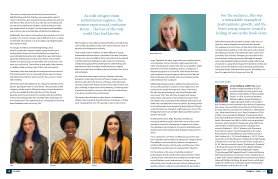
the cult. Vanessa, Alsandria, and Ange reported that their
education, focused upon Bible study, was secondary to
Alamo’s demand that they work long hours in cult-owned
factories. They described sewing denim jackets to be sold
to boutiques. Sometimes they had to work with dangerous
chemicals. For example, the cult would receive donations of
outdated cans of fruits and vegetables. The children would
then use acid to erase the sell-by dates, and the cans would
be sold in the cult’s grocery stores. Frequently, the children
would travel to other cities, where they would hand out
leaflets to recruit new members.
Audience members next joined the author in asking
questions of the young women, who now were in their
twenties. Alsandria, Ange, and Vanessa described the severe
beatings that they received if they broke the rules, which
Alamo could capriciously change from day to day. When
they were chosen to live in Alamo’s house, they feared the
looming potential of becoming one of his “brides.” They
received little protection from parental figures, who were
held in thrall by Alamo. This existence suddenly ended
on Friday, September 19, 2008, when the FBI, responding
to charges of cult child abuse, tax evasion, and economic
exploitation, raided the compound and took the children to
the outside world.
The audience, mostly comprising therapists, gained firsthand
knowledge of the particular issues that confront those
who leave a highly restrictive and traumatic environment
and must face the challenges of making their way into
mainstream culture. The shift to a completely new culture
had a destabilizing effect on their identity. As with refugees
from authoritarian regimes, the women experienced
confusion about the new cultural behaviors and expectations
they encountered, and the loss of the only world they had
known. It became clear as the discussion continued that
postcult therapy needs to provide practical information
about the bewildering mainstream world in addition to
helping former members deal with many issues, including
the guilt that new pleasures in their postcult life may inspire.
By Lorna Goldberg
An earlier version of this article was published in the spring 2019 edition of the IPS Newsletter, a quarterly newsletter for members of the
Institute of Psychoanalytic Studies and the mental health community at large. Throughout the academic year, IPS, a postgraduate training
institute for mental health professionals, provides a variety of programs of interest to this population.
About the Author
Marcia R. Rudin received a joint MA Degree
in Religion from Columbia University and
Union Theological Seminary, specializing in
Philosophy of Religion. She studied for a PhD
in Philosophy at the New School for Social
Research. She taught at William Paterson
College in New Jersey.
Ms. Rudin is the author of two novels, Hear My Voice, and Flower
Toward the Sun. She is coauthor with Rabbis A. James Rudin
and Hirshel Jaffe of Why Me? Why Anyone? (1986, St. Martin’s
Press 1994, Jason Aronson, Inc.), and with Rabbi Rudin of Prison
or Paradise? The New Religious Cults (1980, Fortress Press). She
edited and contributed to the anthology Cults on Campus:
Continuing Challenge (1991, 1996, International Cult Education
Program [ICEP]).
She has published articles and book reviews about destructive
cults, women rabbis, black Jews, genetic engineering, Nazi
war criminals, Holocaust refugees, and Jewish feminism at
ReformJudiaism.org, and in The New York Times The New York
Daily News The Congressional Quarterly Researcher Encyclopedia
Judaica Present Tense Fifty Plus Worldview The New Leader
Catholic Digest Our Town Religious Education P.S.: The Intelligent
Guide to Jewish Affairs The New York University Review of Law
and Social Change PTA Today National Association of Secondary
School Principals’ Bulletin Campus Law Enforcement Journal
Dialogue The Antigonish Review Keeping Posted The Cult
Observer The Advisor Cultic Studies Journal and Boston University
Alumni Magazine.
She has written widely about cults and psychological
manipulation, appeared at conferences and panel discussions,
and lectured throughout the United States, and in Canada and
Poland. She has been cited as a cult expert in such publications
as The New York Times, Newsweek, The Washington Post, The
Philadelphia Enquirer, The Los Angeles Times, Modern Maturity, The
Chicago Sun Times, The Portland Oregonian, The Austin-American
Statesman, and Woman’s Day. She has also been interviewed on
many TV and radio programs.
Between 1987 and 1997, Ms. Rudin directed ICEP wrote and
helped produce ICEP’s Cults: Saying No Under Pressure, featuring
Charlton Heston wrote and produced After the Cult: Recovering
Together edited and produced Blessed Child: An Interview
with Donna Collins (videos) and edited ICEP’s newsletter and
authored its lesson plan for secondary students. n
(he even sometimes invited them to participate in formal
conference programs), it became more difficult for them to
look upon us as “The Evil Enemy.” Today it is not unusual to
find current cult members attending and participating in our
conferences. I believe this change underlines the fact that we
have always reflected a nuanced view of cults. The organization’s
lay leadership also has changed. Originally, parents of former
members guided us. Then, although he had no personal cult
involvement himself, Herb Rosedale served as president for
15 years until his death in 2003. A brilliant attorney, he kept us
out of legal trouble (in contrast, the original CAN was driven
into bankruptcy in the 1990s by a spate of lawsuits). Herb
frequently journeyed into his Manhattan law firm office on
nights and weekends to meet with cult-affected families or
former members. He provided them with emotional support and
guidance, and sometimes, free legal services. Now, outstanding
psychologist Dr. Steve K.D. Eichel leads ICSA, with a Board
of Directors and Advisory Board including qualified helping
professionals and academicians. And, as the result of better
recovery help for former members—or at least those former
members who have been able to contact us and manage a
good outcome, an important change in ICSA is the increasing
participation by former members, including those born or raised
in cultic groups, in our organizational and decision-making
structure.
My daughters aged 12 and 10 at the time, who stayed with
friends in Boston while Jim and I attended our first AFF Advisory
Board Meeting in 1982, are now middle-aged women wearing
bifocals. I am nearing 80, and I realize the 2018 Philadelphia
conference might be my last. I am sad because even though I
welcome the way ICSA has adapted its operations to changing
needs and methods of communication, I sort of miss “the good
old days.” And I really miss those giant personalities such as
Drs. Margaret Singer, John G. Clark, Louis Jolyon West, and
Paul Martin Herb Rosedale Professor Arthur Dole and others
prominent in the movement who have died or for other reasons
ceased working in the field. They were all dear friends and
colleagues with whom I shared many moments of love and
laughter even as we pursued our grim mission.
However, I am also happy and proud when I think of the
advances we have made in the important movement I helped to
shape. n
Throughout these years, ICSA has
professionalized the help former
members and loved ones receive. …
ICSA has also encouraged researchers
from various fields to study the
cult phenomenon, insisting on high
standards for their contributions to
ICSA publications.
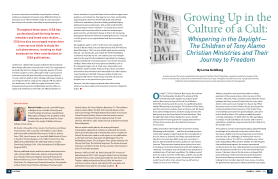
Growing Up in the
Culture of a Cult:
Whispering in the Daylight—
The Children of Tony Alamo
Christian Ministries and Their
Journey to Freedom
O
n April 7, 2019, in Teaneck, New Jersey, the Institute
for Psychoanalytic Studies (IPS), along with the
International Cultic Studies Association (ICSA)
and the New Jersey Society of Clinical Social Workers
(NJSCSW), hosted a panel discussion of a spellbinding book
entitled Whispering in the Daylight: The Children of Tony Alamo
and Their Journey to Freedom, about an abusive cult. We heard
from author Debby Schriver and three young women who
had grown up in the Tony Alamo Christian Ministries. They
brought this book to life by telling their stories. We felt
heartened from hearing about the courage and resilience
of these three women after they had left an abusive
environment.
Debby shared how she had become involved in writing
Whispering in the Daylight…, and then she asked questions
of the other speakers, inquiring about their everyday life in
the cult. Vanessa, Alsandria, and Ange reported that their
education, focused upon Bible study, was secondary to
Alamo’s demand that they work long hours in cult-owned
factories. They described sewing denim jackets to be sold
to boutiques. Sometimes they had to work with dangerous
chemicals. For example, the cult would receive donations of
outdated cans of fruits and vegetables. The children would
then use acid to erase the sell-by dates, and the cans would
be sold in the cult’s grocery stores. Frequently, the children
would travel to other cities, where they would hand out
leaflets to recruit new members.
Audience members next joined the author in asking
questions of the young women, who now were in their
twenties. Alsandria, Ange, and Vanessa described the severe
beatings that they received if they broke the rules, which
Alamo could capriciously change from day to day. When
they were chosen to live in Alamo’s house, they feared the
looming potential of becoming one of his “brides.” They
received little protection from parental figures, who were
held in thrall by Alamo. This existence suddenly ended
on Friday, September 19, 2008, when the FBI, responding
to charges of cult child abuse, tax evasion, and economic
exploitation, raided the compound and took the children to
the outside world.
The audience, mostly comprising therapists, gained firsthand
knowledge of the particular issues that confront those
who leave a highly restrictive and traumatic environment
and must face the challenges of making their way into
mainstream culture. The shift to a completely new culture
had a destabilizing effect on their identity. As with refugees
from authoritarian regimes, the women experienced
confusion about the new cultural behaviors and expectations
they encountered, and the loss of the only world they had
known. It became clear as the discussion continued that
postcult therapy needs to provide practical information
about the bewildering mainstream world in addition to
helping former members deal with many issues, including
the guilt that new pleasures in their postcult life may inspire.
By Lorna Goldberg
An earlier version of this article was published in the spring 2019 edition of the IPS Newsletter, a quarterly newsletter for members of the
Institute of Psychoanalytic Studies and the mental health community at large. Throughout the academic year, IPS, a postgraduate training
institute for mental health professionals, provides a variety of programs of interest to this population.
About the Author
Marcia R. Rudin received a joint MA Degree
in Religion from Columbia University and
Union Theological Seminary, specializing in
Philosophy of Religion. She studied for a PhD
in Philosophy at the New School for Social
Research. She taught at William Paterson
College in New Jersey.
Ms. Rudin is the author of two novels, Hear My Voice, and Flower
Toward the Sun. She is coauthor with Rabbis A. James Rudin
and Hirshel Jaffe of Why Me? Why Anyone? (1986, St. Martin’s
Press 1994, Jason Aronson, Inc.), and with Rabbi Rudin of Prison
or Paradise? The New Religious Cults (1980, Fortress Press). She
edited and contributed to the anthology Cults on Campus:
Continuing Challenge (1991, 1996, International Cult Education
Program [ICEP]).
She has published articles and book reviews about destructive
cults, women rabbis, black Jews, genetic engineering, Nazi
war criminals, Holocaust refugees, and Jewish feminism at
ReformJudiaism.org, and in The New York Times The New York
Daily News The Congressional Quarterly Researcher Encyclopedia
Judaica Present Tense Fifty Plus Worldview The New Leader
Catholic Digest Our Town Religious Education P.S.: The Intelligent
Guide to Jewish Affairs The New York University Review of Law
and Social Change PTA Today National Association of Secondary
School Principals’ Bulletin Campus Law Enforcement Journal
Dialogue The Antigonish Review Keeping Posted The Cult
Observer The Advisor Cultic Studies Journal and Boston University
Alumni Magazine.
She has written widely about cults and psychological
manipulation, appeared at conferences and panel discussions,
and lectured throughout the United States, and in Canada and
Poland. She has been cited as a cult expert in such publications
as The New York Times, Newsweek, The Washington Post, The
Philadelphia Enquirer, The Los Angeles Times, Modern Maturity, The
Chicago Sun Times, The Portland Oregonian, The Austin-American
Statesman, and Woman’s Day. She has also been interviewed on
many TV and radio programs.
Between 1987 and 1997, Ms. Rudin directed ICEP wrote and
helped produce ICEP’s Cults: Saying No Under Pressure, featuring
Charlton Heston wrote and produced After the Cult: Recovering
Together edited and produced Blessed Child: An Interview
with Donna Collins (videos) and edited ICEP’s newsletter and
authored its lesson plan for secondary students. n
(he even sometimes invited them to participate in formal
conference programs), it became more difficult for them to
look upon us as “The Evil Enemy.” Today it is not unusual to
find current cult members attending and participating in our
conferences. I believe this change underlines the fact that we
have always reflected a nuanced view of cults. The organization’s
lay leadership also has changed. Originally, parents of former
members guided us. Then, although he had no personal cult
involvement himself, Herb Rosedale served as president for
15 years until his death in 2003. A brilliant attorney, he kept us
out of legal trouble (in contrast, the original CAN was driven
into bankruptcy in the 1990s by a spate of lawsuits). Herb
frequently journeyed into his Manhattan law firm office on
nights and weekends to meet with cult-affected families or
former members. He provided them with emotional support and
guidance, and sometimes, free legal services. Now, outstanding
psychologist Dr. Steve K.D. Eichel leads ICSA, with a Board
of Directors and Advisory Board including qualified helping
professionals and academicians. And, as the result of better
recovery help for former members—or at least those former
members who have been able to contact us and manage a
good outcome, an important change in ICSA is the increasing
participation by former members, including those born or raised
in cultic groups, in our organizational and decision-making
structure.
My daughters aged 12 and 10 at the time, who stayed with
friends in Boston while Jim and I attended our first AFF Advisory
Board Meeting in 1982, are now middle-aged women wearing
bifocals. I am nearing 80, and I realize the 2018 Philadelphia
conference might be my last. I am sad because even though I
welcome the way ICSA has adapted its operations to changing
needs and methods of communication, I sort of miss “the good
old days.” And I really miss those giant personalities such as
Drs. Margaret Singer, John G. Clark, Louis Jolyon West, and
Paul Martin Herb Rosedale Professor Arthur Dole and others
prominent in the movement who have died or for other reasons
ceased working in the field. They were all dear friends and
colleagues with whom I shared many moments of love and
laughter even as we pursued our grim mission.
However, I am also happy and proud when I think of the
advances we have made in the important movement I helped to
shape. n
Throughout these years, ICSA has
professionalized the help former
members and loved ones receive. …
ICSA has also encouraged researchers
from various fields to study the
cult phenomenon, insisting on high
standards for their contributions to
ICSA publications.
Growing Up in the
Culture of a Cult:
Whispering in the Daylight—
The Children of Tony Alamo
Christian Ministries and Their
Journey to Freedom