Cultic Studies Review, Vol. 5, No. 6, 2006, Page 26
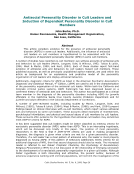
Antisocial Personality Disorder in Cult Leaders and
Induction of Dependent Personality Disorder in Cult
Members
John Burke, Ph.D.
Kaiser Permanente, Health Management Organization,
San Jose, California
Abstract
This article considers evidence for the presence of antisocial personality
disorder (ASPD) in some cult leaders. Additionally, the influence of antisocial
cult leaders on cult members is hypothesized to be associated with the
emergence of dependent personality disorder (DPD) in some cult members.
A number of studies have reported ex-cult members‘ eye-witness accounts of antisocial acts
and behaviors by cult leaders (Martin, Langone, Dole, &Wiltrout, 1992 Tobias &Lalich,
1994 West &Martin, 1999 and Kent, 2004). Each of these studies report first-hand
evidence of antisocial acts and behaviors by cult leaders toward cult members. These
published accounts, as well as previously unpublished author material, are used within this
article as background for an explanatory and predictive model of the personality
organization of cult leaders who display antisocial behaviors.
Additionally, diagnostic criteria for ASPD as listed in the American Psychiatric Association‘s
Diagnostic and Statistical Manual, 4th Edition, (1994) are used to aid in the characterization
of the personality organization of the antisocial cult leader. Within both the California and
Colorado criminal justice systems, ASPD historically has been diagnosed based on a
confirmed history of antisocial acts and behaviors. The author has participated as a clinical
team member in the diagnosis of the personality disorders including ASPD for juvenile
offenders in the California Santa Cruz County Juvenile Probation Department and for
juvenile and adult offenders in the Colorado Department of Corrections.
A number of peer-reviewed studies, including studies by Martin, Langone, Dole, and
Wiltrout, (1992) Tobias &Lalich, (1994) West &Martin, (1996) and Kent, (2004) present
findings based on clinical interviews with ex-cult members, which report various antisocial
acts and behaviors by some cult leaders. These accounts detail examples of mistreatment,
psychological intimidation, and physical and sexual abuse of cult members by cult leaders.
These accounts offer evidence for the hypothesis that antisocial cult leaders may sometimes
meet DSM-IV criteria for ASPD.
It has been suggested that cult leaders might be better classified as meeting criteria for
narcissistic personality disorder (NPD) rather than ASPD. This is an interesting hypothesis,
which will be discussed only briefly in this paper. The position of most personality
researchers in the field is that if DSM-IV-TR criteria are used in making prospective
diagnoses, the diagnosis is given when criteria are met for a given personality disorder.
Therefore, if a cult leader has a clear pattern of antisocial acts, the leader is most properly
diagnosed as having ASPD. If this pattern of behaviors additionally meets criteria for an
additional diagnosis of NPD, then that second diagnosis should also be made. The interested
reader is referred to Len Oakes‘ Prophetic Charisma, the Psychology of Revolutionary
Religious Personalities (1997) for a full discussion of the relationship of emerging narcissism
to the development of a narcissistic personality organization in a given cult leader. Although
Oates‘ hypothesis is both interesting and attractive, the present author, because of
extensive experience working with criminal populations, will not limit the investigation of the
Antisocial Personality Disorder in Cult Leaders and
Induction of Dependent Personality Disorder in Cult
Members
John Burke, Ph.D.
Kaiser Permanente, Health Management Organization,
San Jose, California
Abstract
This article considers evidence for the presence of antisocial personality
disorder (ASPD) in some cult leaders. Additionally, the influence of antisocial
cult leaders on cult members is hypothesized to be associated with the
emergence of dependent personality disorder (DPD) in some cult members.
A number of studies have reported ex-cult members‘ eye-witness accounts of antisocial acts
and behaviors by cult leaders (Martin, Langone, Dole, &Wiltrout, 1992 Tobias &Lalich,
1994 West &Martin, 1999 and Kent, 2004). Each of these studies report first-hand
evidence of antisocial acts and behaviors by cult leaders toward cult members. These
published accounts, as well as previously unpublished author material, are used within this
article as background for an explanatory and predictive model of the personality
organization of cult leaders who display antisocial behaviors.
Additionally, diagnostic criteria for ASPD as listed in the American Psychiatric Association‘s
Diagnostic and Statistical Manual, 4th Edition, (1994) are used to aid in the characterization
of the personality organization of the antisocial cult leader. Within both the California and
Colorado criminal justice systems, ASPD historically has been diagnosed based on a
confirmed history of antisocial acts and behaviors. The author has participated as a clinical
team member in the diagnosis of the personality disorders including ASPD for juvenile
offenders in the California Santa Cruz County Juvenile Probation Department and for
juvenile and adult offenders in the Colorado Department of Corrections.
A number of peer-reviewed studies, including studies by Martin, Langone, Dole, and
Wiltrout, (1992) Tobias &Lalich, (1994) West &Martin, (1996) and Kent, (2004) present
findings based on clinical interviews with ex-cult members, which report various antisocial
acts and behaviors by some cult leaders. These accounts detail examples of mistreatment,
psychological intimidation, and physical and sexual abuse of cult members by cult leaders.
These accounts offer evidence for the hypothesis that antisocial cult leaders may sometimes
meet DSM-IV criteria for ASPD.
It has been suggested that cult leaders might be better classified as meeting criteria for
narcissistic personality disorder (NPD) rather than ASPD. This is an interesting hypothesis,
which will be discussed only briefly in this paper. The position of most personality
researchers in the field is that if DSM-IV-TR criteria are used in making prospective
diagnoses, the diagnosis is given when criteria are met for a given personality disorder.
Therefore, if a cult leader has a clear pattern of antisocial acts, the leader is most properly
diagnosed as having ASPD. If this pattern of behaviors additionally meets criteria for an
additional diagnosis of NPD, then that second diagnosis should also be made. The interested
reader is referred to Len Oakes‘ Prophetic Charisma, the Psychology of Revolutionary
Religious Personalities (1997) for a full discussion of the relationship of emerging narcissism
to the development of a narcissistic personality organization in a given cult leader. Although
Oates‘ hypothesis is both interesting and attractive, the present author, because of
extensive experience working with criminal populations, will not limit the investigation of the