5 VOLUME 5 |ISSUE 3 |2014
I
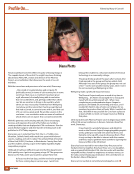
first discovered the world of cults when my younger
brother became involved in a cultic group in the early
1970s. My husband Bill and I were young social workers at
that time. At first, we weren’t particularly alarmed when we
discovered that my brother joined what appeared to be a
communal group in California. We were naïve and idealistic—
and we believed that he was levelheaded enough to leave the
group if he felt there was anything wrong with his experience.
We knew that he had met a young woman on the UC Berkeley
campus while he was traveling between terms. However, when
he eventually returned home for a visit, we were shocked by
the drastic changes in his appearance, values, and interests.
No one seemed able to explain how a young man of 19 who
previously wore long hair, flannel shirts, jeans, and work
boots had transformed into a person with a crew cut and an
ill-fitting second-hand suit. Even more alarming to us than
his outer appearance was the dramatic transformation of his
personality. Although he still spoke English, his words and
phrases were unnatural and confusing.
This brother was a stranger. Instead of discussing his
previously held passions—civil rights, ending the Vietnamese
War, love of rock music—he was actively supporting a pro-
war President Nixon and proselytizing about his newfound
religion. Bill and I found it impossible to make a personal
connection with the young man we loved and with whom I
had shared a childhood. My alarm and despair at the striking
changes in my brother’s appearance and personality began
a continuing education that has become the most important
aspect of my professional life.
What I Learned From My Brother’s Entrance Into a
Cult
What have I learned from my brother’s entrance into a
cult? I’ve learned that, at a time in their lives in which
they are open to new ideas, in transition, or feeling more
vulnerable than at other times, innocent people can fall
prey to controlling and manipulative groups. My friend
and colleague Shelly Rosen has labeled involvement
in a cult as similar to involvement in a natural disaster.
Viewing their cultic participation in this way helps former
members to better accept the notion that their becoming
involved is not indicative of some pathology on their part.
During my brother’s 5 and one-half years in the cult, Bill
and I had the gratifying and humbling experience of
giving birth to a child, and I became aware of how loving
parents can only try their best to give their children a
positive childhood. In contrast to our freedom to parent
as best we could, I began to learn that the children of first-
generation recruits, similar to children who experience
natural disasters, could be the most vulnerable cult
members of all. Early on in my career, when I was working
with an 8-year-old child whose father had rescued her
from an abusive, cult-run boarding school, I began to
see how cult leaders who need to make all a group’s
childrearing decisions often prevent potentially loving
parents in the cult from giving their children the love and
protection they require.
While I was in social-work school, I read about how
Anna Freud researched the impact of the Blitz on the
children of London in 1940. The children who remained in
London and received reassurance and support from their
mothers fared better than those who were sent away to
the countryside to be safe. Children in cults, who often
are separated from their parents, are more at risk than
noncult children for being neglected and/or abused. As
a result of such treatment, too many of these children
incorporate the attitude that they are unworthy of care
and love, which has a devastating consequence on their
lives. However, those who have the courage to leave
often show the determination and resilience to eventually
understand that what happened to them was not because
of their own inadequacies.
What I Learned From Becoming a Psychoanalyst
About the time that my brother was rescued from the
cult, I began my postgraduate education to become
a psychoanalyst. I already had begun therapy to deal
I
first discovered the world of cults when my younger
brother became involved in a cultic group in the early
1970s. My husband Bill and I were young social workers at
that time. At first, we weren’t particularly alarmed when we
discovered that my brother joined what appeared to be a
communal group in California. We were naïve and idealistic—
and we believed that he was levelheaded enough to leave the
group if he felt there was anything wrong with his experience.
We knew that he had met a young woman on the UC Berkeley
campus while he was traveling between terms. However, when
he eventually returned home for a visit, we were shocked by
the drastic changes in his appearance, values, and interests.
No one seemed able to explain how a young man of 19 who
previously wore long hair, flannel shirts, jeans, and work
boots had transformed into a person with a crew cut and an
ill-fitting second-hand suit. Even more alarming to us than
his outer appearance was the dramatic transformation of his
personality. Although he still spoke English, his words and
phrases were unnatural and confusing.
This brother was a stranger. Instead of discussing his
previously held passions—civil rights, ending the Vietnamese
War, love of rock music—he was actively supporting a pro-
war President Nixon and proselytizing about his newfound
religion. Bill and I found it impossible to make a personal
connection with the young man we loved and with whom I
had shared a childhood. My alarm and despair at the striking
changes in my brother’s appearance and personality began
a continuing education that has become the most important
aspect of my professional life.
What I Learned From My Brother’s Entrance Into a
Cult
What have I learned from my brother’s entrance into a
cult? I’ve learned that, at a time in their lives in which
they are open to new ideas, in transition, or feeling more
vulnerable than at other times, innocent people can fall
prey to controlling and manipulative groups. My friend
and colleague Shelly Rosen has labeled involvement
in a cult as similar to involvement in a natural disaster.
Viewing their cultic participation in this way helps former
members to better accept the notion that their becoming
involved is not indicative of some pathology on their part.
During my brother’s 5 and one-half years in the cult, Bill
and I had the gratifying and humbling experience of
giving birth to a child, and I became aware of how loving
parents can only try their best to give their children a
positive childhood. In contrast to our freedom to parent
as best we could, I began to learn that the children of first-
generation recruits, similar to children who experience
natural disasters, could be the most vulnerable cult
members of all. Early on in my career, when I was working
with an 8-year-old child whose father had rescued her
from an abusive, cult-run boarding school, I began to
see how cult leaders who need to make all a group’s
childrearing decisions often prevent potentially loving
parents in the cult from giving their children the love and
protection they require.
While I was in social-work school, I read about how
Anna Freud researched the impact of the Blitz on the
children of London in 1940. The children who remained in
London and received reassurance and support from their
mothers fared better than those who were sent away to
the countryside to be safe. Children in cults, who often
are separated from their parents, are more at risk than
noncult children for being neglected and/or abused. As
a result of such treatment, too many of these children
incorporate the attitude that they are unworthy of care
and love, which has a devastating consequence on their
lives. However, those who have the courage to leave
often show the determination and resilience to eventually
understand that what happened to them was not because
of their own inadequacies.
What I Learned From Becoming a Psychoanalyst
About the time that my brother was rescued from the
cult, I began my postgraduate education to become
a psychoanalyst. I already had begun therapy to deal