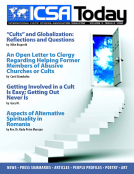
“Cults”and Globalization:
Reflections and
Questions
Revised from a
presentation at the
International Symposium
on Cultic Studies
(Bangkok, Thailand),
organized by Graduate
School of Philosophy and
Religion, Assumption
University, Thailand and
the Institute of Religious
Studies, Shanghai
Academy of Social
Sciences, China,
December 15–16, 2011.
2 ICSA TODAY
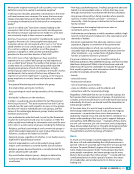
In my presentation today, I will give an overview of
definitions for cult. Then I will briefly discuss harm
and intervention.
Definitions for Cult
A couple of months ago, a media storm occurred after an
American evangelical pastor referred to Mitt Romney, then
a front-running candidate for the leadership of the United
States Republican Party, as a member of a cult because of
his membership in the Church of Jesus Christ of Latter-day
Saints (commonly referred to as Mormons).1 The pastor
later qualified his statement by saying that he viewed the
Mormons as a theological cult.
I have often heard the statement, “We all know what a cult
is.” In my opinion, however, the belief that we all know what
a cult is, is both a presumption and a generalization.
In fact, no one agrees on how to define a cult. For example,
in France, a country that has taken an active approach to
dealing with cults, the president of MILVILUDES, the French
government agency that deals with this issue, recently
stated, “There is no legal definition of a cult in France, not
more than elsewhere in the world. I don't know any country
in the world with a definition for it.”2 The many government
reports that have focused on cults over more than twenty
years confirm this statement.3
The word cult may be one of the most confusing terms to
use. The word is derived from the French word culte, which
comes from the Latin noun cultus, meaning care, labor
cultivation, culture worship, reverence... And so by this
definition we can apply the term cult to any group of
religious believers: Southern Baptists, Mormons, Jehovah’s
Witnesses, Roman Catholics, Hindus, or Muslims. However,
the term has since been assigned very different meanings.
by Mike Kropveld
Reflections and
Questions
Revised from a
presentation at the
International Symposium
on Cultic Studies
(Bangkok, Thailand),
organized by Graduate
School of Philosophy and
Religion, Assumption
University, Thailand and
the Institute of Religious
Studies, Shanghai
Academy of Social
Sciences, China,
December 15–16, 2011.
2 ICSA TODAY
In my presentation today, I will give an overview of
definitions for cult. Then I will briefly discuss harm
and intervention.
Definitions for Cult
A couple of months ago, a media storm occurred after an
American evangelical pastor referred to Mitt Romney, then
a front-running candidate for the leadership of the United
States Republican Party, as a member of a cult because of
his membership in the Church of Jesus Christ of Latter-day
Saints (commonly referred to as Mormons).1 The pastor
later qualified his statement by saying that he viewed the
Mormons as a theological cult.
I have often heard the statement, “We all know what a cult
is.” In my opinion, however, the belief that we all know what
a cult is, is both a presumption and a generalization.
In fact, no one agrees on how to define a cult. For example,
in France, a country that has taken an active approach to
dealing with cults, the president of MILVILUDES, the French
government agency that deals with this issue, recently
stated, “There is no legal definition of a cult in France, not
more than elsewhere in the world. I don't know any country
in the world with a definition for it.”2 The many government
reports that have focused on cults over more than twenty
years confirm this statement.3
The word cult may be one of the most confusing terms to
use. The word is derived from the French word culte, which
comes from the Latin noun cultus, meaning care, labor
cultivation, culture worship, reverence... And so by this
definition we can apply the term cult to any group of
religious believers: Southern Baptists, Mormons, Jehovah’s
Witnesses, Roman Catholics, Hindus, or Muslims. However,
the term has since been assigned very different meanings.
by Mike Kropveld