28 ICSA TODAY
Dear Bill,
I left my cult four months ago, and I’m realizing that my
recovery isn’t going as well as I would have liked. I want to
see a therapist to get help with some of these issues, but
there is no therapist in my area who is a cult expert. I don’t
want to see someone who will think that I joined because I
wanted to be in a cult. What do you advise me to do?
Dear Writer,
The issue when you are working with a therapist is not how
much knowledge the therapist has on a topic, but how
helpful and respectful that therapist is in supporting your
efforts to gain insight and to strengthen your coping skills.
Good therapists should be willing to read an article or a
book that you’ve found to be useful and to discuss that
article or book with you. They should encourage you to
take advantage of other resources that you’ve found,
and they should be willing to acknowledge the gaps in
their knowledge and seek consultation or supervision
themselves.
I understand your desire to work with a therapist who has
worked with former cult members before, who understands
the dynamics of mind control, and who will not “blame” you
or consider your entry into the cult to be a result of your
weakness or pathology. I also understand your desire not
to spend an inordinate amount of time explaining the
dynamics of cultism to a therapist. If you work with
someone who has an expertise and experience in this area,
you may not have to do that. Therapists who have expertise
in this area are also more likely to be able to refer you to
other resources, such as groups, conferences, workshops,
and books that can help you to gain understanding and
find comfort. For those reasons, it’s usually preferable, if
possible, to see a therapist with an expertise in this area.
At the same time, there are many good, competent
therapists who have not worked with former cultists, but
who won't judge you or have preconceived notions of what
your experience was and why you joined the cult. They’ll
listen, ask questions, suggest possibilities, and explore your
situation with you. If they don’t have knowledge of other
resources in this area, you can find them yourself. The
ICSA Web site is a good place to start, as is the magazine
you're now reading.
Another alternative is to see a local therapist on a regular
basis, but consult with a cult-aware therapist around
specific issues that are cult related. Many cult-aware
therapists are willing to provide these consultations via
the telephone or Skype.
Therefore, I recommend that you ask friends for a referral
to a good therapist in your area. If you have the time and
the resources, you can have an initial consultation with
two or three therapists to see whom you feel comfortable
with before you commit to becoming a client. ■
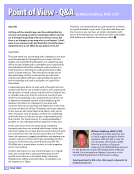
Point of View -Q&A
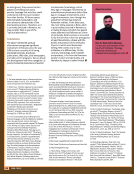
by William Goldberg, MSW, LCSW
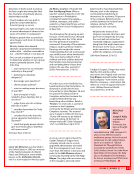
William Goldberg, MSW, LCSW,
a therapist in private practice, has
co-led a support group for former
members with his wife, Lorna, for
over 30 years. He retired in 2008
from his position as Program
Supervisor for Rehabilitative Services
for the Rockland County (NY) Department of Mental
Health. He is presently an Adjunct Instructor in the
Social Work Department of Dominican College.
Send questions for Bill or for other guest columnists to
mail@icsamail.com
Dear Bill,
I left my cult four months ago, and I’m realizing that my
recovery isn’t going as well as I would have liked. I want to
see a therapist to get help with some of these issues, but
there is no therapist in my area who is a cult expert. I don’t
want to see someone who will think that I joined because I
wanted to be in a cult. What do you advise me to do?
Dear Writer,
The issue when you are working with a therapist is not how
much knowledge the therapist has on a topic, but how
helpful and respectful that therapist is in supporting your
efforts to gain insight and to strengthen your coping skills.
Good therapists should be willing to read an article or a
book that you’ve found to be useful and to discuss that
article or book with you. They should encourage you to
take advantage of other resources that you’ve found,
and they should be willing to acknowledge the gaps in
their knowledge and seek consultation or supervision
themselves.
I understand your desire to work with a therapist who has
worked with former cult members before, who understands
the dynamics of mind control, and who will not “blame” you
or consider your entry into the cult to be a result of your
weakness or pathology. I also understand your desire not
to spend an inordinate amount of time explaining the
dynamics of cultism to a therapist. If you work with
someone who has an expertise and experience in this area,
you may not have to do that. Therapists who have expertise
in this area are also more likely to be able to refer you to
other resources, such as groups, conferences, workshops,
and books that can help you to gain understanding and
find comfort. For those reasons, it’s usually preferable, if
possible, to see a therapist with an expertise in this area.
At the same time, there are many good, competent
therapists who have not worked with former cultists, but
who won't judge you or have preconceived notions of what
your experience was and why you joined the cult. They’ll
listen, ask questions, suggest possibilities, and explore your
situation with you. If they don’t have knowledge of other
resources in this area, you can find them yourself. The
ICSA Web site is a good place to start, as is the magazine
you're now reading.
Another alternative is to see a local therapist on a regular
basis, but consult with a cult-aware therapist around
specific issues that are cult related. Many cult-aware
therapists are willing to provide these consultations via
the telephone or Skype.
Therefore, I recommend that you ask friends for a referral
to a good therapist in your area. If you have the time and
the resources, you can have an initial consultation with
two or three therapists to see whom you feel comfortable
with before you commit to becoming a client. ■
Point of View -Q&A
by William Goldberg, MSW, LCSW
William Goldberg, MSW, LCSW,
a therapist in private practice, has
co-led a support group for former
members with his wife, Lorna, for
over 30 years. He retired in 2008
from his position as Program
Supervisor for Rehabilitative Services
for the Rockland County (NY) Department of Mental
Health. He is presently an Adjunct Instructor in the
Social Work Department of Dominican College.
Send questions for Bill or for other guest columnists to
mail@icsamail.com