Cultic Studies Review, Vol. 7, No. 2, 2008, Page 21
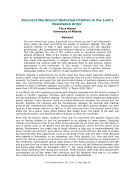
In this article, I identify the resocialization process that the LRA forces onto abducted
children, especially in reference to the group‘s religious rituals, and I argue that some
children participate in atrocities only as a survival technique. I focus on the LRA‘s use of
Acholi beliefs because most (but not all) LRA recruits and victims are Acholi. First, I give a
brief background on Acholi traditional religion and the Ugandan history that led to the
emergence of the LRA. Then I delve into issues of physical, psychological, and spiritual
manipulation to explain how the LRA treats children. Next, I discuss the organization of the
LRA and the advantages for children (regarding their own survival) who advance within the
organization. This information provides a context for understanding why some children obey
their commanders and later escape, and why other children never attempt to leave despite
the fact that they were forcefully and violently recruited.
Acholi Spiritualism
The LRA uses references to Uganda‘s belief systems, especially Acholi beliefs (traditional
religion and Christianity) to aid in recruiting children and terrorizing the northern Ugandans
(including other non-Acholi groups). The Acholi people are diverse descendents of fifteenth-
century migrants who shared a common language (Lwo) and culture (Behrend 1999a, 15
Finnström 2003, 55). Acholi solidarity is a response to the centuries of trauma brought by
invaders, colonialists, and various state regimes. Without a common ethnicity, the Acholi
share common beliefs regarding jogi (spirits, forces, or power), which can possess people,
animals, or objects. Jogi are responsible for the well-being of the people and can legitimate
the ideas of their mediums (Behrend 1999a, 106, 15). The Acholi believe in secular reasons
for the existence of misfortunes in the material world, but that the unseen world determines
who suffers misfortunes (Allen 2006, 31).
Many Acholi believe in other world religions, most often Christianity, along with their
traditional beliefs (such as beliefs in jogi). Christian missionary efforts during the colonial
period resulted in the fusion of Christianity with traditional Ugandan religions, such as the
Acholi traditional religion. This fusion created the Christian-Acholi belief that good spirits
operate for the Holy Spirit (Tipu Maleng)2, and evil spirits operate for Satan (Behrend
1999a, 107, 118). Eventually, the Acholi came to believe that most free jogi (jogi brought
from outside Acholiland since the colonial period [Behrend 1999a, 15]) were evil and Tipu
Maleng was the only spirit that they could be sure was pure (except for other Christian jogi
such as Jok Jesus and Jok Mary [HRW 1997, 65]). With the belief that most jogi were evil,
the Acholi considered many ajwaki (witches possessed by free jogi [Allen 2006, 32]) evil.
Traditionally, ajwaki were women or men with feminine qualities (such as unmarried men
and men living in their fathers‘ homes) who claimed that jogi possessed them (Allen 2006,
32).
The influence of Christianity created concepts of redemption and apocalypse that some
military religious organizations in northern Uganda, including the LRA, use (or used) to
motivate followers (Behrend 1999a, 22). Furthermore, the LRA‘s leader, Joseph Kony,
claims that the jok (singular for jogi) Tipu Maleng and other good jogi possess him. His use
of violence to recruit and terrorize, however, convinces many Acholi and abducted children
that evil jogi possess Kony and, therefore, he is an illegitimate ruler with supernatural
powers.
Historical Background
In the 1850s, industrial nations began to exploit the upper Nile region (including Uganda) in
their search for slaves and ivory (Allen 2006, 25). By 1900, Uganda was a protectorate of
the British Commonwealth and reliant on the King‘s African Rifles, which was a northern
Ugandan army operating under British command, for stability (Allen, 2006:26 Jackson,
2002:36). Most soldiers in the King‘s African Rifles were men from northern Uganda,
especially from the Acholi people—the ―military ethnocracy‖ (Jackson 2002, 36). Britain was
In this article, I identify the resocialization process that the LRA forces onto abducted
children, especially in reference to the group‘s religious rituals, and I argue that some
children participate in atrocities only as a survival technique. I focus on the LRA‘s use of
Acholi beliefs because most (but not all) LRA recruits and victims are Acholi. First, I give a
brief background on Acholi traditional religion and the Ugandan history that led to the
emergence of the LRA. Then I delve into issues of physical, psychological, and spiritual
manipulation to explain how the LRA treats children. Next, I discuss the organization of the
LRA and the advantages for children (regarding their own survival) who advance within the
organization. This information provides a context for understanding why some children obey
their commanders and later escape, and why other children never attempt to leave despite
the fact that they were forcefully and violently recruited.
Acholi Spiritualism
The LRA uses references to Uganda‘s belief systems, especially Acholi beliefs (traditional
religion and Christianity) to aid in recruiting children and terrorizing the northern Ugandans
(including other non-Acholi groups). The Acholi people are diverse descendents of fifteenth-
century migrants who shared a common language (Lwo) and culture (Behrend 1999a, 15
Finnström 2003, 55). Acholi solidarity is a response to the centuries of trauma brought by
invaders, colonialists, and various state regimes. Without a common ethnicity, the Acholi
share common beliefs regarding jogi (spirits, forces, or power), which can possess people,
animals, or objects. Jogi are responsible for the well-being of the people and can legitimate
the ideas of their mediums (Behrend 1999a, 106, 15). The Acholi believe in secular reasons
for the existence of misfortunes in the material world, but that the unseen world determines
who suffers misfortunes (Allen 2006, 31).
Many Acholi believe in other world religions, most often Christianity, along with their
traditional beliefs (such as beliefs in jogi). Christian missionary efforts during the colonial
period resulted in the fusion of Christianity with traditional Ugandan religions, such as the
Acholi traditional religion. This fusion created the Christian-Acholi belief that good spirits
operate for the Holy Spirit (Tipu Maleng)2, and evil spirits operate for Satan (Behrend
1999a, 107, 118). Eventually, the Acholi came to believe that most free jogi (jogi brought
from outside Acholiland since the colonial period [Behrend 1999a, 15]) were evil and Tipu
Maleng was the only spirit that they could be sure was pure (except for other Christian jogi
such as Jok Jesus and Jok Mary [HRW 1997, 65]). With the belief that most jogi were evil,
the Acholi considered many ajwaki (witches possessed by free jogi [Allen 2006, 32]) evil.
Traditionally, ajwaki were women or men with feminine qualities (such as unmarried men
and men living in their fathers‘ homes) who claimed that jogi possessed them (Allen 2006,
32).
The influence of Christianity created concepts of redemption and apocalypse that some
military religious organizations in northern Uganda, including the LRA, use (or used) to
motivate followers (Behrend 1999a, 22). Furthermore, the LRA‘s leader, Joseph Kony,
claims that the jok (singular for jogi) Tipu Maleng and other good jogi possess him. His use
of violence to recruit and terrorize, however, convinces many Acholi and abducted children
that evil jogi possess Kony and, therefore, he is an illegitimate ruler with supernatural
powers.
Historical Background
In the 1850s, industrial nations began to exploit the upper Nile region (including Uganda) in
their search for slaves and ivory (Allen 2006, 25). By 1900, Uganda was a protectorate of
the British Commonwealth and reliant on the King‘s African Rifles, which was a northern
Ugandan army operating under British command, for stability (Allen, 2006:26 Jackson,
2002:36). Most soldiers in the King‘s African Rifles were men from northern Uganda,
especially from the Acholi people—the ―military ethnocracy‖ (Jackson 2002, 36). Britain was