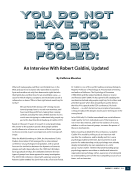
9 VOLUME 7 |ISSUE 3 |2016
in the war zone. Once recruits respond, they are likely to make
later choices that confirm their first one.
CM: If we use scarcity of information, one of the principles from
your book, as an example, how would using that principle be
different in a business setting than in a cultic group?
RC: I will give you an example from one of my clients with an
advertising campaign: BOSE acoustic organization. They had
a new product called BOSE Wave System. They first made a
campaign around the concept of new—new elegance, new
sound, new design, et cetera. They were very proud of their
new product, but the advertising campaign was a disaster. No
one was buying.
So what we did was talk to them about the power of loss
language, which tells people not about what they stand to
gain by moving in the direction of their product, but what
they stand to lose if they don’t, because people are more
motivated to get those things that they can’t have. And loss
is the ultimate form of scarcity. So we had them change just
five words in the advertising campaign. Instead of saying new
at the top of the advertisement, we wrote, “Hear what you
have been missing.” So now, potential customers recognized
that they had been missing new performance, new features,
new simplicity, et cetera and … changing those five words
produced a 45% increase in the market. So it is possible to
take something like the principle of scarcity and incorporate
it into five words of the language that we use and produce
remarkable differences in the way people respond to the very
same item.
CM: How could this principle be used to recruit a cult
member?
RC: What cult leaders often tell new members or prospects is
that
We have the one way, which is available to you to
find true salvation, or true happiness, or the one
route to political freedom, or one route to best
achieve your social goal. And if you don’t come with
us, you will lose that one opportunity.
They will make that claim, that they are the only ones who
possess this information that will allow people to reach their
goals, and that people will lose that chance if they don’t take
that route.
Moestue 2016: Normally, when we try to persuade someone,
we appeal to what they might gain or save by moving in
our direction. But as Cialdini points out, research on social
influence tells us that framing something as a loss will tap
into the principle of scarcity, and that is highly motivating.
Recruiters know this, and it is reported to be a main strategy to
move recruits when they are uncertain.
Steve Jobs is famous for having asked John Scully (CEO of
Coca Cola), ”Do you want to sell sugar water for the rest of
your life, or do you want to come with me and change the
world?” This question was also tapping into the principle of
scarcity, using loss language by pointing to the fact that Scully
might miss out on something important. Needless to say, John
Scully left Coca Cola and followed Jobs into Apple.
The same strategy is evident in many recruitment tactics
online. Recruitment videos appeal by saying, “Give up your fat
car, your family, and come to Jihad for the sake of Allah!” When
people are uncertain, telling them what they will lose if they
fail to move taps into the principle of scarcity in a powerful
way.
CM: Why do we have so much resistance to seeing ourselves as
vulnerable to these influencing tactics?
RC: We don’t want to believe that we are so influenceable, I
think. We have done a study at my university on the extent
to which students were influenced to change their attitudes
by certain kinds of advertising that featured an authority
spokesperson speaking on behalf of some products. Some
of these ads hired an actor to wear a doctor’s coat and a
stethoscope, for example and sometimes they would hire
a celebrity who played the role of a doctor on TV to be a
spokesperson for some kind of pain reliever, and so on.
When we showed students these ads, they were significantly
more persuaded by these phony expert spokespeople than by
ads that didn’t include [them]. But they didn’t want to believe
that they were persuaded by it, … that they were so easily
influenced by weak evidence, by something that was clearly
bogus. If they had just thought about it, they would have
known that this actor doesn’t possess any special medical
knowledge—why should they believe what he says about a
pain reliever? But they did.
Because these principles that we talk about are the shortcuts
that we all are required to use in modern life in order to make
our decisions. We live in what is unquestionably the most
information-overloaded and stimulus-saturated environment
that has ever existed on the planet. We need our shortcuts in
order to make our decisions.
What the cults do is to take that information overload, that
stimulus saturation and cognitive overload, and intensify
it beyond what we normally experience outside of the
cult. And that makes cult members even more susceptible
to these principles because they have to rely on their
shortcuts, because they are not able to think in a concerted,
conscientious, and systematic way.
Moestue 2016: We often avoid the pain of uncertainty by
looking outside of ourselves toward role models (authorities)
We live in what is unquestionably
the most information-overloaded
and stimulus-saturated
environment that has ever existed
on the planet. We need our shortcuts
in order to make our decisions.
in the war zone. Once recruits respond, they are likely to make
later choices that confirm their first one.
CM: If we use scarcity of information, one of the principles from
your book, as an example, how would using that principle be
different in a business setting than in a cultic group?
RC: I will give you an example from one of my clients with an
advertising campaign: BOSE acoustic organization. They had
a new product called BOSE Wave System. They first made a
campaign around the concept of new—new elegance, new
sound, new design, et cetera. They were very proud of their
new product, but the advertising campaign was a disaster. No
one was buying.
So what we did was talk to them about the power of loss
language, which tells people not about what they stand to
gain by moving in the direction of their product, but what
they stand to lose if they don’t, because people are more
motivated to get those things that they can’t have. And loss
is the ultimate form of scarcity. So we had them change just
five words in the advertising campaign. Instead of saying new
at the top of the advertisement, we wrote, “Hear what you
have been missing.” So now, potential customers recognized
that they had been missing new performance, new features,
new simplicity, et cetera and … changing those five words
produced a 45% increase in the market. So it is possible to
take something like the principle of scarcity and incorporate
it into five words of the language that we use and produce
remarkable differences in the way people respond to the very
same item.
CM: How could this principle be used to recruit a cult
member?
RC: What cult leaders often tell new members or prospects is
that
We have the one way, which is available to you to
find true salvation, or true happiness, or the one
route to political freedom, or one route to best
achieve your social goal. And if you don’t come with
us, you will lose that one opportunity.
They will make that claim, that they are the only ones who
possess this information that will allow people to reach their
goals, and that people will lose that chance if they don’t take
that route.
Moestue 2016: Normally, when we try to persuade someone,
we appeal to what they might gain or save by moving in
our direction. But as Cialdini points out, research on social
influence tells us that framing something as a loss will tap
into the principle of scarcity, and that is highly motivating.
Recruiters know this, and it is reported to be a main strategy to
move recruits when they are uncertain.
Steve Jobs is famous for having asked John Scully (CEO of
Coca Cola), ”Do you want to sell sugar water for the rest of
your life, or do you want to come with me and change the
world?” This question was also tapping into the principle of
scarcity, using loss language by pointing to the fact that Scully
might miss out on something important. Needless to say, John
Scully left Coca Cola and followed Jobs into Apple.
The same strategy is evident in many recruitment tactics
online. Recruitment videos appeal by saying, “Give up your fat
car, your family, and come to Jihad for the sake of Allah!” When
people are uncertain, telling them what they will lose if they
fail to move taps into the principle of scarcity in a powerful
way.
CM: Why do we have so much resistance to seeing ourselves as
vulnerable to these influencing tactics?
RC: We don’t want to believe that we are so influenceable, I
think. We have done a study at my university on the extent
to which students were influenced to change their attitudes
by certain kinds of advertising that featured an authority
spokesperson speaking on behalf of some products. Some
of these ads hired an actor to wear a doctor’s coat and a
stethoscope, for example and sometimes they would hire
a celebrity who played the role of a doctor on TV to be a
spokesperson for some kind of pain reliever, and so on.
When we showed students these ads, they were significantly
more persuaded by these phony expert spokespeople than by
ads that didn’t include [them]. But they didn’t want to believe
that they were persuaded by it, … that they were so easily
influenced by weak evidence, by something that was clearly
bogus. If they had just thought about it, they would have
known that this actor doesn’t possess any special medical
knowledge—why should they believe what he says about a
pain reliever? But they did.
Because these principles that we talk about are the shortcuts
that we all are required to use in modern life in order to make
our decisions. We live in what is unquestionably the most
information-overloaded and stimulus-saturated environment
that has ever existed on the planet. We need our shortcuts in
order to make our decisions.
What the cults do is to take that information overload, that
stimulus saturation and cognitive overload, and intensify
it beyond what we normally experience outside of the
cult. And that makes cult members even more susceptible
to these principles because they have to rely on their
shortcuts, because they are not able to think in a concerted,
conscientious, and systematic way.
Moestue 2016: We often avoid the pain of uncertainty by
looking outside of ourselves toward role models (authorities)
We live in what is unquestionably
the most information-overloaded
and stimulus-saturated
environment that has ever existed
on the planet. We need our shortcuts
in order to make our decisions.