VOLUME 7 |ISSUE 3 |2016 2527
Profile On...
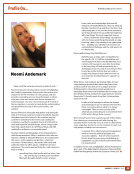
Noomi Andemark
“Have a rich life and many interests outside of work. ..”
Noomi Andemark is the Executive Director of Hjälpkällan,
the Swedish organization that provides information and
support for former members of cultic groups, and also
provides counselling services for professionals or others
who may come into contact with former members of
harmful groups. “Our aim is to communicate the needs of
former members to society, to create better understanding
and possibilities for help in their communities,” she
explains.
Noomi offered her invaluable help before and during the
ICSA 2015 Annual Conference held in Stockholm, Sweden.
Attendees were full of praise for the seamless way the
conference unfolded, for the events surrounding the
conference, and for the excellent choice of hotel with its
sleek and beautiful Swedish design. Noomi’s impeccable
taste had a great deal to do with these things and with
making the conference a memorable event.
Noomi’s wisdom and knowledge of second-generation-
adult former members (SGAs) is authentic. Born into and
raised in a family of Jehovah’s Witnesses, she understands
the issues—both negative and positive—that SGAs
encounter. On that subject, she speaks with clarity and
authority when she offers advice, culled from her own
experience. The most important thing for a cult survivor to
keep in mind is
something that a field worker told me when I was
15 ...she said that up until that point I had been
filled with thoughts, beliefs, events, writings,
music, rules, and relationships that were all
related to Jehovah’s Witnesses. That was what my
identity consisted of, up until then. But now I had
a big empty part in me, and the most important
work I had ahead of me was to fill that emptiness
with new things. The most important choices
...were to determine which things I would fill it
with, to choose good things that would one day
be as big a part of my identity as my upbringing
was. ..Building your identity from scratch is an
overwhelming challenge, and the only way to do
it is day by day.
Noomi walked away from the Witnesses:
My father was an elder, and I was baptized at
the age of 9. At 15, I left the organization and
moved away from home shortly after that. I lost
contact with my parents soon after. According
to the laws, they still had responsibility for a
disengaged minor, but only if I was living in their
house. My mother told me that we could no
longer write letters to each other and sent me
an article from the Watchtower to support her
decision.
While former cult members, particularly SGAs, do have
a big challenge ahead of them when they leave, from
another point of view they are in a unique and even
thrilling position. How many people would love to
disengage themselves from situations that no longer serve
their deepest needs and have the opportunity to reinvent
themselves? A favorite quote from Alan Cohen perhaps
expresses it best:
It takes a lot of courage to release the familiar
and seemingly secure, to embrace the new. But
there is no real security in what is no longer
meaningful. There is more security in the
adventurous and exciting, for in movement there
is life, and in change there is power.
Noomi herself seems to be a good example of this. Rather
than choosing a conventional path after leaving, the
beautiful Noomi eventually chose to work in a field where,
every single day, she has to use her creativity to reach out,
help people, establish new connections:
In general, this is often lonely and marginalized
work, far from the political spotlight and
economic stability. ..But I’ve been involved in
this for about ten years now, and building up
Hjälpkällan is a part of my life achievement that
I’m very proud of.
In addition to her work at Hjälpkällan, Noomi Andemark is
also a part of the Radicalization Awareness Network (RAN
DeRad working group) within the European Union (EU). n
Edited by Mary O’Connell
Profile On...
Noomi Andemark
“Have a rich life and many interests outside of work. ..”
Noomi Andemark is the Executive Director of Hjälpkällan,
the Swedish organization that provides information and
support for former members of cultic groups, and also
provides counselling services for professionals or others
who may come into contact with former members of
harmful groups. “Our aim is to communicate the needs of
former members to society, to create better understanding
and possibilities for help in their communities,” she
explains.
Noomi offered her invaluable help before and during the
ICSA 2015 Annual Conference held in Stockholm, Sweden.
Attendees were full of praise for the seamless way the
conference unfolded, for the events surrounding the
conference, and for the excellent choice of hotel with its
sleek and beautiful Swedish design. Noomi’s impeccable
taste had a great deal to do with these things and with
making the conference a memorable event.
Noomi’s wisdom and knowledge of second-generation-
adult former members (SGAs) is authentic. Born into and
raised in a family of Jehovah’s Witnesses, she understands
the issues—both negative and positive—that SGAs
encounter. On that subject, she speaks with clarity and
authority when she offers advice, culled from her own
experience. The most important thing for a cult survivor to
keep in mind is
something that a field worker told me when I was
15 ...she said that up until that point I had been
filled with thoughts, beliefs, events, writings,
music, rules, and relationships that were all
related to Jehovah’s Witnesses. That was what my
identity consisted of, up until then. But now I had
a big empty part in me, and the most important
work I had ahead of me was to fill that emptiness
with new things. The most important choices
...were to determine which things I would fill it
with, to choose good things that would one day
be as big a part of my identity as my upbringing
was. ..Building your identity from scratch is an
overwhelming challenge, and the only way to do
it is day by day.
Noomi walked away from the Witnesses:
My father was an elder, and I was baptized at
the age of 9. At 15, I left the organization and
moved away from home shortly after that. I lost
contact with my parents soon after. According
to the laws, they still had responsibility for a
disengaged minor, but only if I was living in their
house. My mother told me that we could no
longer write letters to each other and sent me
an article from the Watchtower to support her
decision.
While former cult members, particularly SGAs, do have
a big challenge ahead of them when they leave, from
another point of view they are in a unique and even
thrilling position. How many people would love to
disengage themselves from situations that no longer serve
their deepest needs and have the opportunity to reinvent
themselves? A favorite quote from Alan Cohen perhaps
expresses it best:
It takes a lot of courage to release the familiar
and seemingly secure, to embrace the new. But
there is no real security in what is no longer
meaningful. There is more security in the
adventurous and exciting, for in movement there
is life, and in change there is power.
Noomi herself seems to be a good example of this. Rather
than choosing a conventional path after leaving, the
beautiful Noomi eventually chose to work in a field where,
every single day, she has to use her creativity to reach out,
help people, establish new connections:
In general, this is often lonely and marginalized
work, far from the political spotlight and
economic stability. ..But I’ve been involved in
this for about ten years now, and building up
Hjälpkällan is a part of my life achievement that
I’m very proud of.
In addition to her work at Hjälpkällan, Noomi Andemark is
also a part of the Radicalization Awareness Network (RAN
DeRad working group) within the European Union (EU). n
Edited by Mary O’Connell