5 VOLUME 7 |ISSUE 3 |2016
What will make people yield their comfortable lives in the
West and say Yes to recruiters who want them to travel to
Syria and sacrifice not only their democratic rights but also
their family ties and their lives for an unverifiable cause—a
cause for which religious scriptures are twisted and suicide is
reframed as an honor? Who in their right minds would say Yes
to that?
We can think of the obvious self–serving reasons
terrorist groups have to recruit new members, and
how much they profit from making them comply,
conform and obey the rules of their doctrine. So it is
much more intriguing to understand why people say
yes to this deal. (Kendrick, Neuberg, &Cialdini, 2015)
Based on the past 70 years of research in social psychology,
the answer to the question posed is that people yield to
social influence to achieve one or more of three basic goals:
to choose correctly, to gain social approval, and to manage self-
image.
After the Madrid bombings in 2004, the International Cultic
Studies Association (ICSA) arranged for an international
conference on psychological manipulation, with a special
focus on the similarities between the dynamics of terrorist
groups and cults. Especially since the 1995 Aum Shinrikyo
Sarin gas attack in Tokyo, the similarities between the two
types of groups have been apparent to many investigators.
The 2005 ICSA conference closed with a plenary session by
Robert Cialdini entitled You Don’t Have to Be a Fool to Be Fooled.
Dr. Cialdini is one of the world’s leading social psychologists,
Regents’ Professor of Psychology at Arizona State University,
and author of Influence: The Psychology of Persuasion
(1984/2006) and the related textbook, Infuence: Science
and Practice (2001/2009). He has spent his life studying the
mechanisms behind why people might say Yes to others and
yield their power when they should have said No (hence,
the title of his speech at the ICSA conference). His book
Influence…, in which he laid out six principles of persuasion,
is eloquent about the dangers of persuasive techniques in the
wrong hands.
In his 2005 talk, Dr. Cialdini normalized how social influence
might yield a Yes from individuals even if that response is
not in their best interest, and how the isolation of recruits,
whether in cults or terrorist groups, increases the power of
these six mechanisms.
Before traveling to Madrid for the conference, I asked Dr.
Cialdini if he would be willing to do an interview with
me after the conference, and he kindly said Yes. I was a
psychology student at the time, but my interest in and
passion for understanding social psychology were already
deeply motivated by my own experience in a cultic
group 12 years earlier. I believe that understanding group
psychology requires more than an intellectual interest in
organizational psychology rather, awareness is fundamental
to understanding some of the most compelling issues of our
times, such as terrorism.
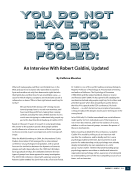
By Cathrine Moestue
An Interview With Robert Cialdini, Updated
You Do Not
Have to
Be a Fool
to Be
Fooled:
What will make people yield their comfortable lives in the
West and say Yes to recruiters who want them to travel to
Syria and sacrifice not only their democratic rights but also
their family ties and their lives for an unverifiable cause—a
cause for which religious scriptures are twisted and suicide is
reframed as an honor? Who in their right minds would say Yes
to that?
We can think of the obvious self–serving reasons
terrorist groups have to recruit new members, and
how much they profit from making them comply,
conform and obey the rules of their doctrine. So it is
much more intriguing to understand why people say
yes to this deal. (Kendrick, Neuberg, &Cialdini, 2015)
Based on the past 70 years of research in social psychology,
the answer to the question posed is that people yield to
social influence to achieve one or more of three basic goals:
to choose correctly, to gain social approval, and to manage self-
image.
After the Madrid bombings in 2004, the International Cultic
Studies Association (ICSA) arranged for an international
conference on psychological manipulation, with a special
focus on the similarities between the dynamics of terrorist
groups and cults. Especially since the 1995 Aum Shinrikyo
Sarin gas attack in Tokyo, the similarities between the two
types of groups have been apparent to many investigators.
The 2005 ICSA conference closed with a plenary session by
Robert Cialdini entitled You Don’t Have to Be a Fool to Be Fooled.
Dr. Cialdini is one of the world’s leading social psychologists,
Regents’ Professor of Psychology at Arizona State University,
and author of Influence: The Psychology of Persuasion
(1984/2006) and the related textbook, Infuence: Science
and Practice (2001/2009). He has spent his life studying the
mechanisms behind why people might say Yes to others and
yield their power when they should have said No (hence,
the title of his speech at the ICSA conference). His book
Influence…, in which he laid out six principles of persuasion,
is eloquent about the dangers of persuasive techniques in the
wrong hands.
In his 2005 talk, Dr. Cialdini normalized how social influence
might yield a Yes from individuals even if that response is
not in their best interest, and how the isolation of recruits,
whether in cults or terrorist groups, increases the power of
these six mechanisms.
Before traveling to Madrid for the conference, I asked Dr.
Cialdini if he would be willing to do an interview with
me after the conference, and he kindly said Yes. I was a
psychology student at the time, but my interest in and
passion for understanding social psychology were already
deeply motivated by my own experience in a cultic
group 12 years earlier. I believe that understanding group
psychology requires more than an intellectual interest in
organizational psychology rather, awareness is fundamental
to understanding some of the most compelling issues of our
times, such as terrorism.
By Cathrine Moestue
An Interview With Robert Cialdini, Updated
You Do Not
Have to
Be a Fool
to Be
Fooled: