VOLUME 8 |ISSUE 2 |2017 1517
Arts: Paintings By Joe Szimhart
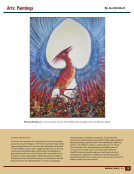
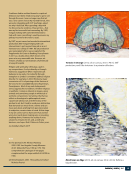
Phoenix Rising (2015, oil on canvas, 48 in x 36 in): When we rise again, even our demons dance.
Comment by the Artist
Art theory was my path into cult activity. My choice to formally
pursue an art career began in 1967 when I switched majors from
engineering to fine arts in my junior year. My grades were good
in math and the sciences, but a nagging drive to try art won out.
I minored in both philosophy and theology. The fledgling art
department at the University of Dayton was in transition with a
new director who emphasized a Modernist approach. Modern
Art pioneers in the early 20th century, as I soon discovered, had
deep interests in new developments in science, psychology,
and spirituality, in addition to aesthetics. To represent the
unconscious and spiritual directly, the first historically significant
abstract paintings appeared after 1910 with Wassily Kandinsky
and his circle. While in college, I read Kandinsky’s 1912 book,
On the Spiritual in Art, which mentioned a hidden realm of
consciousness and an “inner sound” that artists believed
could find more immediate expression with pure color and
nonobjective compositions. In that book, Kandinsky praised
Helena Blavatsky for her contributions to human gnosis from the
hidden worlds of ancient wisdom.
Arts: Paintings By Joe Szimhart
Phoenix Rising (2015, oil on canvas, 48 in x 36 in): When we rise again, even our demons dance.
Comment by the Artist
Art theory was my path into cult activity. My choice to formally
pursue an art career began in 1967 when I switched majors from
engineering to fine arts in my junior year. My grades were good
in math and the sciences, but a nagging drive to try art won out.
I minored in both philosophy and theology. The fledgling art
department at the University of Dayton was in transition with a
new director who emphasized a Modernist approach. Modern
Art pioneers in the early 20th century, as I soon discovered, had
deep interests in new developments in science, psychology,
and spirituality, in addition to aesthetics. To represent the
unconscious and spiritual directly, the first historically significant
abstract paintings appeared after 1910 with Wassily Kandinsky
and his circle. While in college, I read Kandinsky’s 1912 book,
On the Spiritual in Art, which mentioned a hidden realm of
consciousness and an “inner sound” that artists believed
could find more immediate expression with pure color and
nonobjective compositions. In that book, Kandinsky praised
Helena Blavatsky for her contributions to human gnosis from the
hidden worlds of ancient wisdom.