18 ICSA TODAY
• Application: All drivers have a duty of care to other
drivers and pedestrians. The driver breached that duty
of care when he was using his mobile phone while
driving. However, according to established facts, the
driver’s breach did not cause the accident because
even if the driver had not been using his phone, his
window of reaction time was still so limited that,
when the child ran into the street, the driver would
still have hit the pedestrian.
• Conclusion: The driver is not liable for negligence to
the pedestrian because his use of the mobile device
did not cause him to hit the pedestrian.
You can use the same process of analysis with the issue of
whether the child’s parents were negligent, and again with
the pedestrian, for what is known as contributory negligence.
Most cases have multiple issues because each set of facts will
lend itself to multiple legal claims or differing questions to
accommodate the possible variances of the facts that would
ultimately be established.
Another tool of legal analysis is the legal defense. There are
two methods by which a defendant (the accused) can defeat
the claim of a plaintiff (the accuser) in the legal system.
A defendant can (a) demonstrate that a plaintiff cannot
prove all the elements of the claim, or (b) come forth with
affirmative defenses, by which a defendant admits to the claim
but presents a new set of facts that mitigates or defeats the
claim. For example, “Yes, I punched him in the face, but it was
in self-defense.” The defendant admits to punching, but not
the circumstances of the punch presented by the plaintiff.
Affirmative defenses will vary by the claim but generally,
examples include statute of limitations, self-defense, unclean
hands (that the plaintiff also acted unethically), and insanity.
Application of Legal Analysis in Cases of Spiritual
Abuse Outside the Legal System
In the Muslim community, particularly the Western Muslim
community, when cases of spiritual abuse come to the surface,
the allegations are often vague, and a clear standard of conduct
is not established. Allegations often are along the lines of
“inappropriate interactions,” “harassment,” or “violence.” In
turn, in their defense those accused refer to the accusers as
“feminists,” “modernists,” or “liberals.”
In a recent case in the Muslim community with which I am
familiar, several women alleged that they had been abused by
a very public religious figure. Community leaders referred on
social media to this religious leader having what they described
as inappropriate interactions with various women, which raises
the following questions: What is the definition of inappropriate?
What is the definition of interaction? Specifically, what facts and
evidence were used to determine whether an interaction was
inappropriate? Even if the accused engaged in inappropriate
interactions, do his actions fall within the framework of spiritual
abuse? In the case to which I refer, this analysis was, as of the
writing of this article, completely lacking. As a result of the
vagueness of the accusation, commentators conflated and
obfuscated issues and matched the wrong set of facts to the
claims of abuse.
The defenses of those accused are frequently equally lacking
and flawed. Two defenses I read in the case I have mentioned
were that the accused was getting to know the women
for marriage, and that the women bringing the accusation
consented (also known as the “it takes two to tango” defense).
Before one even entertains the factual question regarding
whether the accused was in fact getting to know the women
for marriage, one must consider whether that is even relevant.
Getting to know someone for marriage is not mutually
exclusive from abusing one’s authority and ultimately is a
nonissue when the question of abusing one’s authority is
present. As such, this is why it is important to state the elements
of each action upfront, to determine what is relevant as to the
exact issue at hand.
Although not everyone will fully understand the issues, and,
especially when the case involves a public figure, a segment of
the Muslim community will engage in mental gymnastics and
speculation to defend or indict the accused, it is still important
for those presenting the case to be as clear and accurate as
possible in their presentation of the issues and the particular
violations alleged. Whether or not public opinion matters, or
such cases should be tried in the court of public opinion are
separate issues and beyond the scope of this paper.
So what would a clear analysis look like in our context of
spiritual abuse in the Muslim community? First, it would be
essential to establish the elements of spiritual abuse. Doing this
would fulfill the rule portion of our IRAC analysis. One potential
definition of spiritual abuse is “the use of spiritual authority for
one’s personal gain.”1
Consider the following scenario: A woman alleges that a
shaykh who is already married also married her in secret as
a second wife. The woman in question is a student who has
managed the shaykh’s schedule and helped him write material
for lectures and classes. The shaykh is aware that the student
has a strong desire to study with scholars in a serious fashion.
The shaykh has proposed to this woman that she could have
this life of piety and get close to scholars if he marries her.
But the marriage must remain a secret for the first year of
their marriage. He also frequently flatters her and makes her
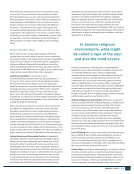
In the Muslim community,
particularly the Western
Muslim community, … the
allegations are often vague,
and a clear standard of
conduct is not established.
• Application: All drivers have a duty of care to other
drivers and pedestrians. The driver breached that duty
of care when he was using his mobile phone while
driving. However, according to established facts, the
driver’s breach did not cause the accident because
even if the driver had not been using his phone, his
window of reaction time was still so limited that,
when the child ran into the street, the driver would
still have hit the pedestrian.
• Conclusion: The driver is not liable for negligence to
the pedestrian because his use of the mobile device
did not cause him to hit the pedestrian.
You can use the same process of analysis with the issue of
whether the child’s parents were negligent, and again with
the pedestrian, for what is known as contributory negligence.
Most cases have multiple issues because each set of facts will
lend itself to multiple legal claims or differing questions to
accommodate the possible variances of the facts that would
ultimately be established.
Another tool of legal analysis is the legal defense. There are
two methods by which a defendant (the accused) can defeat
the claim of a plaintiff (the accuser) in the legal system.
A defendant can (a) demonstrate that a plaintiff cannot
prove all the elements of the claim, or (b) come forth with
affirmative defenses, by which a defendant admits to the claim
but presents a new set of facts that mitigates or defeats the
claim. For example, “Yes, I punched him in the face, but it was
in self-defense.” The defendant admits to punching, but not
the circumstances of the punch presented by the plaintiff.
Affirmative defenses will vary by the claim but generally,
examples include statute of limitations, self-defense, unclean
hands (that the plaintiff also acted unethically), and insanity.
Application of Legal Analysis in Cases of Spiritual
Abuse Outside the Legal System
In the Muslim community, particularly the Western Muslim
community, when cases of spiritual abuse come to the surface,
the allegations are often vague, and a clear standard of conduct
is not established. Allegations often are along the lines of
“inappropriate interactions,” “harassment,” or “violence.” In
turn, in their defense those accused refer to the accusers as
“feminists,” “modernists,” or “liberals.”
In a recent case in the Muslim community with which I am
familiar, several women alleged that they had been abused by
a very public religious figure. Community leaders referred on
social media to this religious leader having what they described
as inappropriate interactions with various women, which raises
the following questions: What is the definition of inappropriate?
What is the definition of interaction? Specifically, what facts and
evidence were used to determine whether an interaction was
inappropriate? Even if the accused engaged in inappropriate
interactions, do his actions fall within the framework of spiritual
abuse? In the case to which I refer, this analysis was, as of the
writing of this article, completely lacking. As a result of the
vagueness of the accusation, commentators conflated and
obfuscated issues and matched the wrong set of facts to the
claims of abuse.
The defenses of those accused are frequently equally lacking
and flawed. Two defenses I read in the case I have mentioned
were that the accused was getting to know the women
for marriage, and that the women bringing the accusation
consented (also known as the “it takes two to tango” defense).
Before one even entertains the factual question regarding
whether the accused was in fact getting to know the women
for marriage, one must consider whether that is even relevant.
Getting to know someone for marriage is not mutually
exclusive from abusing one’s authority and ultimately is a
nonissue when the question of abusing one’s authority is
present. As such, this is why it is important to state the elements
of each action upfront, to determine what is relevant as to the
exact issue at hand.
Although not everyone will fully understand the issues, and,
especially when the case involves a public figure, a segment of
the Muslim community will engage in mental gymnastics and
speculation to defend or indict the accused, it is still important
for those presenting the case to be as clear and accurate as
possible in their presentation of the issues and the particular
violations alleged. Whether or not public opinion matters, or
such cases should be tried in the court of public opinion are
separate issues and beyond the scope of this paper.
So what would a clear analysis look like in our context of
spiritual abuse in the Muslim community? First, it would be
essential to establish the elements of spiritual abuse. Doing this
would fulfill the rule portion of our IRAC analysis. One potential
definition of spiritual abuse is “the use of spiritual authority for
one’s personal gain.”1
Consider the following scenario: A woman alleges that a
shaykh who is already married also married her in secret as
a second wife. The woman in question is a student who has
managed the shaykh’s schedule and helped him write material
for lectures and classes. The shaykh is aware that the student
has a strong desire to study with scholars in a serious fashion.
The shaykh has proposed to this woman that she could have
this life of piety and get close to scholars if he marries her.
But the marriage must remain a secret for the first year of
their marriage. He also frequently flatters her and makes her
In the Muslim community,
particularly the Western
Muslim community, … the
allegations are often vague,
and a clear standard of
conduct is not established.