About ICSA Today
ICSA Today (IT) serves ICSA members by
providing information that enhances
understanding of all aspects of the cult
phenomenon, including how groups
function, how they affect members,
techniques of influence, dealing with
harmful effects, educational and legal
implications, and other subjects.
ICSA Today issues may include
• practical articles for former
members, families, helping
professionals, researchers,
and others
• opinion essays
• theoretical articles
• reports on research
• summaries of news reports on
groups
• information on books, articles, links
• information on ICSA members
• biographical profiles on selected
members
• personal accounts
• art work
• poetry
• short stories and other literary
articles
• special reports from correspondents
around the world
ICSA Today is published three times a
year.
Regular ICSA members receive the
print edition of ICSA Today and have
access to its Web edition. Students
and other special members gain
access to the online edition only.
Nonmember print subscriptions are
available. Submissions to the magazine
should be sent to the Editor-in-Chief,
Michael Langone, PhD:
mail@icsamail.com
We prefer Microsoft Word or a program
compatible with Word. Articles should
be no more than 2,500 words. Please
include a jpeg photo (no less than 360
dpi) and biographical sketch (less than
150 words) with your submission.
Appropriate submissions are reviewed
by the relevant section editor and,
when appropriate, editorial review
advisors.
International Cultic Studies Association
P.O. Box 2265 • Bonita Springs, FL 34133
Phone: 239.514.3081
Email: mail@icsamail.com
Website: icsahome.com
Rachel Bernstein, MSEd, LMFT, has been working with former cult members for 29 years. She
is a Licensed Marriage and Family Therapist and Educator who lives in Los Angeles, California.
She has been a member of ICSA for many years and has presented talks and moderated panels
at ICSA conferences. Rachel previously ran the Maynard Bernstein Resource Center on cults,
named after her father. She was the clinician at the former Cult Clinic in Los Angeles, as well as
the Cult Hotline and Clinic in Manhattan. She now treats former cult members and the families
and friends of those in cults in her private practice. Rachel has facilitated numerous support
groups for former cult members, for people who were in one-on-one cults, and for the families
of those in cults. Rachel has published many articles, made media appearances, consulted on
shows and movies about cults, and has been interviewed for podcasts and YouTube videos.
Rachel is the host of her weekly podcast, IndoctriNation. www.RachelBernsteinTherapy.com
bernsteinlmft@gmail.com@gmail.com 818-907-0036. n
Dear Friends,
Welcome to the first issue of ICSA Today of 2020! I am so pleased to be a part of the beginning
of a new year with you. It is beautifully symbolic because ICSA is devoted to helping people
begin anew.
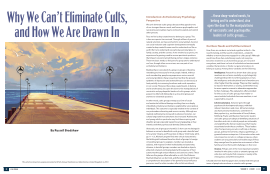
In his article in this issue, “Why We Can’t Eliminate Cults and How We Are Drawn In,” Russell
Bradshaw explores the psychological and sociological reasons we gravitate toward cultic
groups. They seemingly satisfy basic human instincts to belong and to have greater knowledge
and understanding. The author, a former sociology professor, comes to this field through
having lived it himself. He understands how it feels to be swept into a cultic system, and how
powerfully intoxicating the process can be.
In his article “When the Walking Wounded Walk Into Church,” Ken Garrett, a pastor and former
member of a cultic church, writes about the disorienting conflict I hear about daily in my office:
Being in a cultic group promotes the development of a false self but while the false self can
seem to take the place of the true self, it is important to remember there is a core identity that
remains. This is vital and insightful information for those who are leaving abusive situations
and those of us who are helping those who have left.
Esther Friedman, a former member of a cultic group, reflects on the pivotal 2018 ICSA
conference she attended on domestic abuse and coercive control, and how she is finding what
is heartening to all of us—that the world is becoming more informed about the dangers of this
type of control. Esther’s contribution to this issue highlights the power of ICSA conferences.
I’ve known Alan Scheflin, the subject of the profile by Mary O’Connell, for many years. An
attorney, Professor Emeritus, author, and past president of ICSA, Alan has worked tirelessly for
decades educating the public about undue influence, and has been a powerful advocate for
those who have not had their experiences taken seriously by the law. Mary’s profile captures
the strength and the compassion of this courageous pioneer.
Joe Szimhart, the recipient of the 2016 ICSA Lifetime Achievement Award and a treasure trove
of information, with whom I have worked, reviews I Will Disentangle Myself… and Leave, by the
teacher and historian Bob Williston. Williston exited a fundamentalist style of Christianity after
40 years of devotion. His book explores his increasing internal conflicts and moral dilemmas
before he exited, and his important quest since then to ascertain whether the teachings he
formerly believed were true or false. And Doug Duncan reviews Leaving the Witness: Exiting
a Religion and Finding a Life, by Amber Scorah, who endured many traumas after leaving
Jehovah’s Witnesses before thankfully and bravely finding her way again.
I hope 2020 proves to be a year of healing and happiness for all of you!
Be well!
Rachel Bernstein
The views expressed in ICSA Today are solely those of the authors and do not necessarily reflect
the views of ICSA Today’s editors or editorial boards or of ICSA’s directors, advisors, or staff. Groups
analyzed or mentioned in ICSA Today are not necessarily cults, nor are they necessarily harmful.
Note to our readers regarding website addresses (URLs): For all http website addresses, such as
http://www.icsahome.com, ICSA Today uses only the shortened address form (icsahome.com). In
all instances when the basic address is other than http, such as https or ftp, we give the full
address. Please keep this in mind when exploring sites mentioned in ICSA Today.
ICSA Today, Volume 11, No. 1, 2020
Editor-in-Chief
Michael D. Langone, PhD
Associate Editor
Ann Stamler, MA, MPhil
Family Editor
Lois Svoboda, MD, LMFT
Member Profiles Editor
Mary O’Connell
Mental Health Editor
Gillie Jenkinson, PhD
Research Coeditors
Linda Dubrow-Marshall, PhD
Rod Dubrow-Marshall, PhD
Point of View -Q&A
William Goldberg, MSW, LCSW
Correspondents
Austria/Germany
Friedrich Griess
Eastern Europe
Piotr T. Nowakowski, PhD
French-Speaking Countries
Catherine Perry, PhD
Italy
Dr. Cristina Caparesi
Nordic Countries
Joni Valkila, PhD
Håkan Järvå, MSc Psych
Spain and Latin America
Luis Santamaria, SThL
Erika Toren, MSEd
Paul Lennon
News Desk
Ana Rodriguez
Patrick Ryan
Writing Consultant
Sharon Hamm
Bios of ICSA Today editors can be found at
icsahome.com/elibrary/people-profiles
International Cultic Studies Association
P.O. Box 2265 • Bonita Springs, FL 34133
Website: icsahome.com
Email: mail@icsamail.com
Phone: 239.514.3081
Fax: 305.393.8193
ISSN: 2154-820X
Printed in the USA
Artists and poets retain copyright
of their works and grant ICSA permission
to reproduce them. Unless otherwise
indicated, all other material copyright
International Cultic Studies Association.
Table of Contents
24
News Desk
21
Profile On...
Alan Scheflin
8
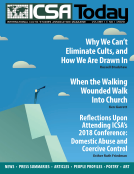
Why We Can’t Eliminate Cults,
and How We Are Drawn In
Russell Bradshaw
2
When the Walking Wounded
Walk Into Church
Ken Garrett
15
Reflections Upon Attending
ICSA’s 2018 Conference:
Domestic Abuse and
Coercive Control
Esther Ruth Friedman
18
Book Reviews
Doug Duncan and
Joseph Szimhart