10 20 ICSA TODAY
About the Reviewer
Joseph Szimhart began research into cultic
influence in 1980, after ending his 2-year devotion
to a New Age sect. He worked professionally as an
intervention specialist from 1986 through 1998.
He continues to assist people with cult-related
problems including consultations via phone
and Internet. In 2016 he received an ICSA Lifetime Achievement
Award at the Annual Conference in Dallas, Texas. Since 1998, he has
worked for an emergency psychiatric hospital as a crisis caseworker.
He maintains an art studio and exhibits professionally. His novel,
Mushroom Satori: The cult diary, was published in 2013, and his
memoir, Santa Fe, Bill Tate, and me: How an artist became a cult
interventionist, was published this year. n
with devotional buildings, a hierarchy soon developed, with
Overseers at the top regulating Workers around the world.
Before the Internet era, the ministry spread by word of mouth,
phone calls, and mail. A few critical books and articles about
the quiet movement appeared during the 20th century. For the
most part, Two-By-Twos, like Latter-Day Saints, blended well into
surrounding society and held common jobs, despite adherence
to some rigorous rules about having a plain appearance and
avoiding popular entertainment, television, and vices such as
drinking alcohol.
Williston was raised to believe that the Truth represented an
unbroken chain of Christian Workers since the Apostles. During
his struggle to resolve internal conflicts, he was shocked to
learn that the founder, Irvine, “died in the same year I was
born—1947” (p. 129). Although a moral dilemma sparked his
disgust with the Worker’s hypocrisies, Williston’s story mirrors a
much larger one: Fundamentalist reactions in all religions to the
emergence of Modernism, especially since the Enlightenment
or so-called Age of Reason. As science methods, inventions,
and theories expanded society’s views of time, space, history,
and culture, the “truth” in ancient, inspired scriptures came
into question. After his devotion shattered on moral grounds,
Williston was free to explore outside the Two-By-Two box—his
Bible became a work of literature and no longer a sacred object
inspired in English by an infallible deification, or a perfect idol,
of King James.
Williston turned to scholars such as Bart Ehrman to learn
how diverse Christianity had been from the very beginning.
He learned that there was no Bible until the 4th century,
under Emperor Constantine. All Christian arguments to find
prophecies for Jesus as Messiah in the Jewish Torah were either
highly flawed or downright mistaken. He turned to the Catholic
Encyclopedia to discover that the Jesus story attributed to St.
Luke, John, and others borrowed heavily from the ancient
Mithraic religion that Roman soldiers followed. Greek ideas
and Pagan rituals fed the formation of Christian theology and
praxis by the 1st century. He learned from Bible researcher
Bart Ehrman that seminarians learn to rationalize conflicts in
scripture and flaws in the Gospel tradition. Williston chose not
to rationalize he adopted an agnostic view and chose to live
with uncertainty. Modernism found another convert. The Two-
By-Twos may have been a comforting belief system as a guide
to his social life, but he could no longer abide by intellectual
hypocrisy. And at age 70, when he is writing this memoir, he
says he is happier for it.
As far as identifying the Truth of the Two-By-Twos as a cult is
concerned: Yes, it has some of the characteristics, he notes
but on page 309, he emphasizes: “The Truth is not a cult in the
newsworthy apocalyptic style. It is minimally cultic … as an
emotionally abusive and controlling cult.” My one criticism,
coming from my long career as a cult interventionist, is with
what he states on the next page, at the end of Chapter 24:
But one thing I will never do is encourage anyone
who is comfortable among the Friends and Workers
to leave. First of all, they’re comfortable and I don’t
believe they’re deceived into an eternity of damnation.
And pragmatically, you can’t convince a believer of
anything. (p. 310 italics are the author’s)
A true Modernist would avoid saying never in certain terms
when it comes to human choice in matters of the heart and
mind. The author might meet a truth Friend who could benefit
from a challenge someday, and thus be encouraged to step
aside from the group. In a way, Bob Williston has already done
enough to convince ambivalent believers to leave the Two-By-
Twos by writing this book. In my experience, believers in any
cult or religion have periods of ambivalence over time, just as
the author did. n
…his intent is to honestly clarify
his defection from a relatively
obscure new religious movement
when he “lost” his faith at age 56
after four decades of devotion.
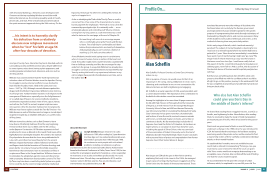
Alan Scheflin, Professor Emeritus at Santa Clara University,
makes me cry.
Not on purpose, of course. He would never do that. At an
imposing 6’2”, he is a big, strong, teddy bear of a man, warm,
charming, and considerate in one-on-one conversation. His
talks and lectures are both enlightening and engaging.
Mr. Scheflin is an early supporter of ICSA, a past president, and
a current board member. The importance of his contribution to
the field of cultic studies cannot be overstated.
Among the highlights in his more than 40-page resume are
his BA with High Honors in Philosophy from the University
of Virginia, a JD with Honors from the George Washington
University School of Law, an LLM from Harvard University
Law School, and an MA in Counseling Psychology from Santa
Clara University. He has given more than a hundred talks
and lectures all over the world, received numerous awards
and honors, contributed chapters to books, and written or
cowritten six books. His Bar memberships include the US
Supreme Court and the District of Columbia. He has been an
expert witness or consultant in more than forty-five cases,
including the appeal of Sirhan Sirhan, who was convicted
of the assassination of Robert F. Kennedy, and in the trial of
Oklahoma bomber Timothy McVeigh. Alan’s resume concludes
with a personal letter of praise and congratulation from former
Supreme Court Chief Justice Warren E. Burger.
• • • • • • • • • • • • • • • • • • • • • • • • • • • • • • • • • • • • • • • • • • • • • • • • • • • • • • • • • • • • • • • • • • • • • • • • • • •
Alan began an ICSA talk he gave in New York in 2018 by
explaining that, early in his career in the 1960s, he managed
to get copies of writings that had been smuggled out of the
Soviet Union into the hands of Amnesty International. These
translated documents were the writings of dissidents who
had been taken into custody by the Russian government
and imprisoned in Russian mental hospitals for the specific
purpose of reprogramming their minds through techniques of
brainwashing, thought reform, and coercive persuasion. Many
of the dissidents were public intellectuals and writers, so this
method of silencing them was particularly sadistic.
At this early stage of the talk, which I watched remotely, I
panicked. The subject of mental hospitals is daunting for me:
I was born in a mental hospital where my mother had been a
patient for 7 years. Taken from her immediately, I nevertheless
have spent most of my life fearing I might also “go crazy.” The
image I had of what it meant to go crazy was the lunatic in
the tower room from Jane Eyre. I could never really look at
this aspect of my life. I could risk only quick, furtive glances or
sidelong gazes, never full-on. And so, at first, this discussion of
the absolute horror of Russian mental hospitals paralyzed me
with fear.
But there was something about Alan Scheflin’s solid, calm
presence that filled me with the confidence that it would be
all right to go on this perilous journey to the underworld. I felt
he was completely trustworthy and would hold my hand and
bring me back safely.
He shared that reading these smuggled missives, so awful, so
horrific, was frightening for him. Nevertheless, after reading
them, he resolved to make the study of mind manipulation
an important part of his life, which it has been for the past 50
years.
Alan’s work on government attacks on mental freedom
underwent a change in the 1980s when he was introduced to
ICSA. He learned that the techniques he had been studying
were being used in the private sector, and he resolved to find
a way to help victims of these carefully coordinated, individual
attacks on their mental freedom.
He explained that “remedies were not available because
courts had no interest in brainwashing.” To bring a case, you
must have a cause of action for which the court can grant
relief. Since courts would not recognize brainwashing as an
acceptable cause of action, Alan set himself the task of finding
one that the courts would recognize.
He succeeded when he hit upon the concept of undue
influence, which, he explained to us, was 500 years old. The
1121
Profile On...
Edited by Mary O’Connell
Alan Scheflin
VOLUME 11 |ISSUE 1 |2020
Who else but Alan Scheflin
could give you Doris Day in
the middle of Dante’s inferno?
About the Reviewer
Joseph Szimhart began research into cultic
influence in 1980, after ending his 2-year devotion
to a New Age sect. He worked professionally as an
intervention specialist from 1986 through 1998.
He continues to assist people with cult-related
problems including consultations via phone
and Internet. In 2016 he received an ICSA Lifetime Achievement
Award at the Annual Conference in Dallas, Texas. Since 1998, he has
worked for an emergency psychiatric hospital as a crisis caseworker.
He maintains an art studio and exhibits professionally. His novel,
Mushroom Satori: The cult diary, was published in 2013, and his
memoir, Santa Fe, Bill Tate, and me: How an artist became a cult
interventionist, was published this year. n
with devotional buildings, a hierarchy soon developed, with
Overseers at the top regulating Workers around the world.
Before the Internet era, the ministry spread by word of mouth,
phone calls, and mail. A few critical books and articles about
the quiet movement appeared during the 20th century. For the
most part, Two-By-Twos, like Latter-Day Saints, blended well into
surrounding society and held common jobs, despite adherence
to some rigorous rules about having a plain appearance and
avoiding popular entertainment, television, and vices such as
drinking alcohol.
Williston was raised to believe that the Truth represented an
unbroken chain of Christian Workers since the Apostles. During
his struggle to resolve internal conflicts, he was shocked to
learn that the founder, Irvine, “died in the same year I was
born—1947” (p. 129). Although a moral dilemma sparked his
disgust with the Worker’s hypocrisies, Williston’s story mirrors a
much larger one: Fundamentalist reactions in all religions to the
emergence of Modernism, especially since the Enlightenment
or so-called Age of Reason. As science methods, inventions,
and theories expanded society’s views of time, space, history,
and culture, the “truth” in ancient, inspired scriptures came
into question. After his devotion shattered on moral grounds,
Williston was free to explore outside the Two-By-Two box—his
Bible became a work of literature and no longer a sacred object
inspired in English by an infallible deification, or a perfect idol,
of King James.
Williston turned to scholars such as Bart Ehrman to learn
how diverse Christianity had been from the very beginning.
He learned that there was no Bible until the 4th century,
under Emperor Constantine. All Christian arguments to find
prophecies for Jesus as Messiah in the Jewish Torah were either
highly flawed or downright mistaken. He turned to the Catholic
Encyclopedia to discover that the Jesus story attributed to St.
Luke, John, and others borrowed heavily from the ancient
Mithraic religion that Roman soldiers followed. Greek ideas
and Pagan rituals fed the formation of Christian theology and
praxis by the 1st century. He learned from Bible researcher
Bart Ehrman that seminarians learn to rationalize conflicts in
scripture and flaws in the Gospel tradition. Williston chose not
to rationalize he adopted an agnostic view and chose to live
with uncertainty. Modernism found another convert. The Two-
By-Twos may have been a comforting belief system as a guide
to his social life, but he could no longer abide by intellectual
hypocrisy. And at age 70, when he is writing this memoir, he
says he is happier for it.
As far as identifying the Truth of the Two-By-Twos as a cult is
concerned: Yes, it has some of the characteristics, he notes
but on page 309, he emphasizes: “The Truth is not a cult in the
newsworthy apocalyptic style. It is minimally cultic … as an
emotionally abusive and controlling cult.” My one criticism,
coming from my long career as a cult interventionist, is with
what he states on the next page, at the end of Chapter 24:
But one thing I will never do is encourage anyone
who is comfortable among the Friends and Workers
to leave. First of all, they’re comfortable and I don’t
believe they’re deceived into an eternity of damnation.
And pragmatically, you can’t convince a believer of
anything. (p. 310 italics are the author’s)
A true Modernist would avoid saying never in certain terms
when it comes to human choice in matters of the heart and
mind. The author might meet a truth Friend who could benefit
from a challenge someday, and thus be encouraged to step
aside from the group. In a way, Bob Williston has already done
enough to convince ambivalent believers to leave the Two-By-
Twos by writing this book. In my experience, believers in any
cult or religion have periods of ambivalence over time, just as
the author did. n
…his intent is to honestly clarify
his defection from a relatively
obscure new religious movement
when he “lost” his faith at age 56
after four decades of devotion.
Alan Scheflin, Professor Emeritus at Santa Clara University,
makes me cry.
Not on purpose, of course. He would never do that. At an
imposing 6’2”, he is a big, strong, teddy bear of a man, warm,
charming, and considerate in one-on-one conversation. His
talks and lectures are both enlightening and engaging.
Mr. Scheflin is an early supporter of ICSA, a past president, and
a current board member. The importance of his contribution to
the field of cultic studies cannot be overstated.
Among the highlights in his more than 40-page resume are
his BA with High Honors in Philosophy from the University
of Virginia, a JD with Honors from the George Washington
University School of Law, an LLM from Harvard University
Law School, and an MA in Counseling Psychology from Santa
Clara University. He has given more than a hundred talks
and lectures all over the world, received numerous awards
and honors, contributed chapters to books, and written or
cowritten six books. His Bar memberships include the US
Supreme Court and the District of Columbia. He has been an
expert witness or consultant in more than forty-five cases,
including the appeal of Sirhan Sirhan, who was convicted
of the assassination of Robert F. Kennedy, and in the trial of
Oklahoma bomber Timothy McVeigh. Alan’s resume concludes
with a personal letter of praise and congratulation from former
Supreme Court Chief Justice Warren E. Burger.
• • • • • • • • • • • • • • • • • • • • • • • • • • • • • • • • • • • • • • • • • • • • • • • • • • • • • • • • • • • • • • • • • • • • • • • • • • •
Alan began an ICSA talk he gave in New York in 2018 by
explaining that, early in his career in the 1960s, he managed
to get copies of writings that had been smuggled out of the
Soviet Union into the hands of Amnesty International. These
translated documents were the writings of dissidents who
had been taken into custody by the Russian government
and imprisoned in Russian mental hospitals for the specific
purpose of reprogramming their minds through techniques of
brainwashing, thought reform, and coercive persuasion. Many
of the dissidents were public intellectuals and writers, so this
method of silencing them was particularly sadistic.
At this early stage of the talk, which I watched remotely, I
panicked. The subject of mental hospitals is daunting for me:
I was born in a mental hospital where my mother had been a
patient for 7 years. Taken from her immediately, I nevertheless
have spent most of my life fearing I might also “go crazy.” The
image I had of what it meant to go crazy was the lunatic in
the tower room from Jane Eyre. I could never really look at
this aspect of my life. I could risk only quick, furtive glances or
sidelong gazes, never full-on. And so, at first, this discussion of
the absolute horror of Russian mental hospitals paralyzed me
with fear.
But there was something about Alan Scheflin’s solid, calm
presence that filled me with the confidence that it would be
all right to go on this perilous journey to the underworld. I felt
he was completely trustworthy and would hold my hand and
bring me back safely.
He shared that reading these smuggled missives, so awful, so
horrific, was frightening for him. Nevertheless, after reading
them, he resolved to make the study of mind manipulation
an important part of his life, which it has been for the past 50
years.
Alan’s work on government attacks on mental freedom
underwent a change in the 1980s when he was introduced to
ICSA. He learned that the techniques he had been studying
were being used in the private sector, and he resolved to find
a way to help victims of these carefully coordinated, individual
attacks on their mental freedom.
He explained that “remedies were not available because
courts had no interest in brainwashing.” To bring a case, you
must have a cause of action for which the court can grant
relief. Since courts would not recognize brainwashing as an
acceptable cause of action, Alan set himself the task of finding
one that the courts would recognize.
He succeeded when he hit upon the concept of undue
influence, which, he explained to us, was 500 years old. The
1121
Profile On...
Edited by Mary O’Connell
Alan Scheflin
VOLUME 11 |ISSUE 1 |2020
Who else but Alan Scheflin
could give you Doris Day in
the middle of Dante’s inferno?