VOLUME 2 |NUMBER 1 |2011 33
help other people who were dealing
with the same issues. Since that time,
he has worked tirelessly to educate the
public about the dangerous psycho-
logical mechanisms employed by cults.
Mr. Griess was educated as an electri-
cal engineer. From 2002 until 2005 he
was vice president of FECRIS, the Euro-
pean umbrella organization for groups
working to give support and spread
information about this subject. From
2005 until 2009 he was president of
FECRIS. He has been married to his
wife, Poldi, a high-school math and
physics teacher, since 1959 and has
four children: Wiltrud, Bernard, Gernot,
and Helge. Now 78 years old, Friedrich
Griess is news correspondent for ICSA,
covering Austria.
Mr. Griess’s advice to those trying to
help cultists is, “Be aware that the usual
education in theology, psychology, psy-
chiatry, sociology, or law is not sufficient
to understand cults.”He is very troubled
that the U.S. State Department pres-
sures other countries to “not discrimi-
nate against minority ‘religions,‘” no
matter how much harm these “reli-
gions” do to their members and society
in general. While deeply committed to
religious freedom, he believes that the
problem is complex, and that, while
individuals have the right to choose
their religious expression, cults do not
have the right to cause harm or behave
in a socially irresponsible way.
Mr. Griess is continually motivated by
the necessity to spread knowledge
about destructive groups and is
inspired by a feeling of responsibility:
“Our most important weapon is
information.”
During his tenure as president of
FECRIS, the Parliamentarian Assembly of
the Council of Europe adopted Recom-
mendation 1804, which states, in part:
“Such freedom is not unlimited, howev-
er: A religion whose doctrine or practice
ran counter to other fundamental rights
would be unacceptable....”
Clearly, it can be said, without any
exaggeration, that through his diligent
effort, Friedrich Griess has turned per-
sonal suffering into public good, and
in the process, transformed lead
into gold. ■
Raffaella di Marzio
"I believe that every problem
can be solved by love."
Dr. Raffaella di Marzio is a Renais-
sance woman. A complete list of
her accomplishments would proba-
bly take more than the space allot-
ted here. In addition to being a
wife, mother, teacher, and practic-
ing psychologist, Raffaella is the
founder of Counseling Center SRS
(Sectes, Religions, Spirituality), an
organization she set up to help
those negatively impacted by cults.
She has degrees in Religious
Science, Psychology, Educational
Science, and History of Religions.
She is a member of the managing
board of SIPR (Italian Society of Psy-
chology of Religion). She has writ-
ten 100s of articles on the subject
of cults, contributed Encyclopedia
entries, contributed to books, and
authored one herself. She is in
demand as a cult expert for TV and
radio shows and lectures widely.
Yet, none of this is the most impres-
sive thing about Doctor Di Marzio.
In her capacity as Italian co-corre-
spondent for ICSA Today, Doctor Di
Marzio investigates and reports on
destructive groups and individuals
who would prefer to keep their
activities in the shadows. Her work,
engaged in voluntarily, requires her
to be persistent, even dogged, in
her attempts to bring these activities
into the light.
This often results in hostility being
directed at Raffaella. More than once,
she has been threatened. "Our job is
dangerous." She mentions this in an
almost off-hand manner, as if this
type of extraordinary courage, lived
on a daily basis, were commonplace.
Asked why she continues under such
duress, Doctor Di Marzio answers,
simply, "I can't stop because this is a
moral duty, a moral obligation. I live
this choice as a moral obligation.
There are so many people suffering...
I cannot stop."
Raffaella Di Marzio was herself a
member of a destructive group for
about 10 years, along with her hus-
band and children. Driven by a sin-
cere spiritual desire to deepen her
Catholic faith, she joined a church led
by a Catholic priest. This priest, Raf-
faella recounts, abused the children
and young people.
Towards the end of her participation
in the group, the priest spread lies
about a close friend of Raffaella's,
which she knew to be untrue. "Some-
thing happened. I could see with my
(own) eyes. She and her family left,
and, some time after, she began her
study of cults.
Doctor Di Marzio's advice to ex-cult
members is to consider thinking
about their experience and trying to
solve the problems that drew them
into the cult. To those who try to help
ex-cultists, she advises that it is an
extremely complex undertaking, not
to be handled in a facile way. People
who wish to help have to be careful
that their actions are not too extreme
and certainly never violent.
Doctor Di Marzio and her husband
have three children: daughter Chiara,
26 son Michele, 24 and son Alessan-
dro, 18. Her husband and all three
children support her work whole-
heartedly. Doctor Di Marzio has
devoted herself to studying and
helping in this field for 16 years,
since 1994. ■
32 ICSA TODAY
Profiles On...
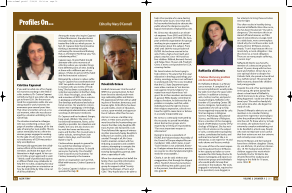
Cristina Caparesi
If you ask her what one of her happi-
est moments working in the field of
cultic studies is, Dr. Cristina Caparesi
will tell you that it was when she really
got to know ICSA. She first encoun-
tered the organization while she was
doing master’s work however, her
awareness grew several years later.
That closer encounter came at a cru-
cial moment, when she was discour-
aged by a situation unfolding in her
native Italy.
The situation involved a colleague
who was conducting a smear cam-
paign of another colleague, all for the
sake of raising her own profile. This sit-
uation eventually led to a rift in the
various groups engaged in working
for the sake of cult victims. So Cristi-
na's rediscovery of ICSA was particu-
larly serendipitous.
She especially appreciates the collab-
orative efforts of the international
members and holds this type of col-
laboration in high regard. At her cen-
ter in Udine a team approach is used.
“I think a staff of professional experts
in different fields may collaborate to
help the ex-cultist, analyzing his situa-
tion and giving him an orientation on
how he might little by little come out
of all his problems.”
Among the many who inspire Caparesi
is Maria Montessori, the educational
innovator who, unusual for her time,
treated the child as a whole person. In
fact, Dr. Caparesi feels that innovative
thinking is extremely valuable,
eschewing the conventional thinking
that, as Christianne Northrup says, “has
a deadening effect.”
Caparesi says, “A good habit should
alternate with some moments of
reflection where you consider things
from different points of view, looking
at them with a different pair of eye-
glasses. It helps to get out of the habit
and find innovative solutions.”
Motivated by a desire to relieve suffer-
ing, Dr. Caparesi has coordinated since
2007 two public centers that give aid
to workers who are victims of “mob-
bing.” She has been a consultant to a
volunteer association in Northern Italy,
S.O.S. Abusi Psicologici, since 2004,
and a member of SIPR. She is a doctor
in pedagogy and family mediation.
She develops professional and educa-
tional services. Her academic concen-
tration was in pedagogy, criminology,
criminalogical administration, and the
sociology of alternative medicines.
Dr. Caparesi and her husband, Giorgio,
have seven children. She returns to
her beloved hometown, Rome, as fre-
quently as possible. For relaxation and
health, she runs she also loves to tin-
ker with her home and decorate,
paint, and the like. Her musical taste is
rather eclectic, running from Joan
Baez to Alicia Keys, and from Bob
Dylan to Jay-Z.
Cristina advises people in general to
be careful that ideology serves to
make life better, not worse. “It should
serve your humanity. You shouldn't
have to sacrifice your humanity.” For
Cristina, humanity is the treasure.
And in an organization such as ICSA,
filled with treasure, Cristina Caparesi is
a jewel.
Dr. Cristina Caparesi is Italian co-corre-
spondent for Italy. ■
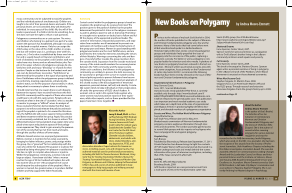
Friedrich Griess
Friedrich Griess was 13 at the end of
WWII. As a young Austrian, he had
been forced to attend youth meet-
ings celebrating Hitler and Nazism.
His experiences left him with an abid-
ing love of freedom, democracy, and
human rights. All his life he has been
an avid reader, a lover of education,
curious, open-minded, and apprecia-
tive of cultures other than his own.
And so it came as a terrible irony
when, in 1983, Griess and his wife
were forced to the heartrending con-
clusion that their only daughter, Wil-
trud, 20 years old, had joined a cult.
There followed the agony of witness-
ing their previously happy daughter’s
behavior turn violent, and at times
suicidal. Through it all, Mr. Griess
tried to maintain contact with her,
enduring accusations and condem-
nations, attempting to navigate the
extremely stormy waters of a rela-
tionship damaged by parental alien-
ation, a speciality of cults.
When the catastrophe first befell the
family, there was little information.
Mr. Griess and his wife joined a
group for support called "Society
Against the Dangers of Sects and
Cults." They hoped also to be able to
Edited by Mary O’Connell
ICSA_volume3_proof6 5/10/11 12:14 PM Page 34
help other people who were dealing
with the same issues. Since that time,
he has worked tirelessly to educate the
public about the dangerous psycho-
logical mechanisms employed by cults.
Mr. Griess was educated as an electri-
cal engineer. From 2002 until 2005 he
was vice president of FECRIS, the Euro-
pean umbrella organization for groups
working to give support and spread
information about this subject. From
2005 until 2009 he was president of
FECRIS. He has been married to his
wife, Poldi, a high-school math and
physics teacher, since 1959 and has
four children: Wiltrud, Bernard, Gernot,
and Helge. Now 78 years old, Friedrich
Griess is news correspondent for ICSA,
covering Austria.
Mr. Griess’s advice to those trying to
help cultists is, “Be aware that the usual
education in theology, psychology, psy-
chiatry, sociology, or law is not sufficient
to understand cults.”He is very troubled
that the U.S. State Department pres-
sures other countries to “not discrimi-
nate against minority ‘religions,‘” no
matter how much harm these “reli-
gions” do to their members and society
in general. While deeply committed to
religious freedom, he believes that the
problem is complex, and that, while
individuals have the right to choose
their religious expression, cults do not
have the right to cause harm or behave
in a socially irresponsible way.
Mr. Griess is continually motivated by
the necessity to spread knowledge
about destructive groups and is
inspired by a feeling of responsibility:
“Our most important weapon is
information.”
During his tenure as president of
FECRIS, the Parliamentarian Assembly of
the Council of Europe adopted Recom-
mendation 1804, which states, in part:
“Such freedom is not unlimited, howev-
er: A religion whose doctrine or practice
ran counter to other fundamental rights
would be unacceptable....”
Clearly, it can be said, without any
exaggeration, that through his diligent
effort, Friedrich Griess has turned per-
sonal suffering into public good, and
in the process, transformed lead
into gold. ■
Raffaella di Marzio
"I believe that every problem
can be solved by love."
Dr. Raffaella di Marzio is a Renais-
sance woman. A complete list of
her accomplishments would proba-
bly take more than the space allot-
ted here. In addition to being a
wife, mother, teacher, and practic-
ing psychologist, Raffaella is the
founder of Counseling Center SRS
(Sectes, Religions, Spirituality), an
organization she set up to help
those negatively impacted by cults.
She has degrees in Religious
Science, Psychology, Educational
Science, and History of Religions.
She is a member of the managing
board of SIPR (Italian Society of Psy-
chology of Religion). She has writ-
ten 100s of articles on the subject
of cults, contributed Encyclopedia
entries, contributed to books, and
authored one herself. She is in
demand as a cult expert for TV and
radio shows and lectures widely.
Yet, none of this is the most impres-
sive thing about Doctor Di Marzio.
In her capacity as Italian co-corre-
spondent for ICSA Today, Doctor Di
Marzio investigates and reports on
destructive groups and individuals
who would prefer to keep their
activities in the shadows. Her work,
engaged in voluntarily, requires her
to be persistent, even dogged, in
her attempts to bring these activities
into the light.
This often results in hostility being
directed at Raffaella. More than once,
she has been threatened. "Our job is
dangerous." She mentions this in an
almost off-hand manner, as if this
type of extraordinary courage, lived
on a daily basis, were commonplace.
Asked why she continues under such
duress, Doctor Di Marzio answers,
simply, "I can't stop because this is a
moral duty, a moral obligation. I live
this choice as a moral obligation.
There are so many people suffering...
I cannot stop."
Raffaella Di Marzio was herself a
member of a destructive group for
about 10 years, along with her hus-
band and children. Driven by a sin-
cere spiritual desire to deepen her
Catholic faith, she joined a church led
by a Catholic priest. This priest, Raf-
faella recounts, abused the children
and young people.
Towards the end of her participation
in the group, the priest spread lies
about a close friend of Raffaella's,
which she knew to be untrue. "Some-
thing happened. I could see with my
(own) eyes. She and her family left,
and, some time after, she began her
study of cults.
Doctor Di Marzio's advice to ex-cult
members is to consider thinking
about their experience and trying to
solve the problems that drew them
into the cult. To those who try to help
ex-cultists, she advises that it is an
extremely complex undertaking, not
to be handled in a facile way. People
who wish to help have to be careful
that their actions are not too extreme
and certainly never violent.
Doctor Di Marzio and her husband
have three children: daughter Chiara,
26 son Michele, 24 and son Alessan-
dro, 18. Her husband and all three
children support her work whole-
heartedly. Doctor Di Marzio has
devoted herself to studying and
helping in this field for 16 years,
since 1994. ■
32 ICSA TODAY
Profiles On...
Cristina Caparesi
If you ask her what one of her happi-
est moments working in the field of
cultic studies is, Dr. Cristina Caparesi
will tell you that it was when she really
got to know ICSA. She first encoun-
tered the organization while she was
doing master’s work however, her
awareness grew several years later.
That closer encounter came at a cru-
cial moment, when she was discour-
aged by a situation unfolding in her
native Italy.
The situation involved a colleague
who was conducting a smear cam-
paign of another colleague, all for the
sake of raising her own profile. This sit-
uation eventually led to a rift in the
various groups engaged in working
for the sake of cult victims. So Cristi-
na's rediscovery of ICSA was particu-
larly serendipitous.
She especially appreciates the collab-
orative efforts of the international
members and holds this type of col-
laboration in high regard. At her cen-
ter in Udine a team approach is used.
“I think a staff of professional experts
in different fields may collaborate to
help the ex-cultist, analyzing his situa-
tion and giving him an orientation on
how he might little by little come out
of all his problems.”
Among the many who inspire Caparesi
is Maria Montessori, the educational
innovator who, unusual for her time,
treated the child as a whole person. In
fact, Dr. Caparesi feels that innovative
thinking is extremely valuable,
eschewing the conventional thinking
that, as Christianne Northrup says, “has
a deadening effect.”
Caparesi says, “A good habit should
alternate with some moments of
reflection where you consider things
from different points of view, looking
at them with a different pair of eye-
glasses. It helps to get out of the habit
and find innovative solutions.”
Motivated by a desire to relieve suffer-
ing, Dr. Caparesi has coordinated since
2007 two public centers that give aid
to workers who are victims of “mob-
bing.” She has been a consultant to a
volunteer association in Northern Italy,
S.O.S. Abusi Psicologici, since 2004,
and a member of SIPR. She is a doctor
in pedagogy and family mediation.
She develops professional and educa-
tional services. Her academic concen-
tration was in pedagogy, criminology,
criminalogical administration, and the
sociology of alternative medicines.
Dr. Caparesi and her husband, Giorgio,
have seven children. She returns to
her beloved hometown, Rome, as fre-
quently as possible. For relaxation and
health, she runs she also loves to tin-
ker with her home and decorate,
paint, and the like. Her musical taste is
rather eclectic, running from Joan
Baez to Alicia Keys, and from Bob
Dylan to Jay-Z.
Cristina advises people in general to
be careful that ideology serves to
make life better, not worse. “It should
serve your humanity. You shouldn't
have to sacrifice your humanity.” For
Cristina, humanity is the treasure.
And in an organization such as ICSA,
filled with treasure, Cristina Caparesi is
a jewel.
Dr. Cristina Caparesi is Italian co-corre-
spondent for Italy. ■
Friedrich Griess
Friedrich Griess was 13 at the end of
WWII. As a young Austrian, he had
been forced to attend youth meet-
ings celebrating Hitler and Nazism.
His experiences left him with an abid-
ing love of freedom, democracy, and
human rights. All his life he has been
an avid reader, a lover of education,
curious, open-minded, and apprecia-
tive of cultures other than his own.
And so it came as a terrible irony
when, in 1983, Griess and his wife
were forced to the heartrending con-
clusion that their only daughter, Wil-
trud, 20 years old, had joined a cult.
There followed the agony of witness-
ing their previously happy daughter’s
behavior turn violent, and at times
suicidal. Through it all, Mr. Griess
tried to maintain contact with her,
enduring accusations and condem-
nations, attempting to navigate the
extremely stormy waters of a rela-
tionship damaged by parental alien-
ation, a speciality of cults.
When the catastrophe first befell the
family, there was little information.
Mr. Griess and his wife joined a
group for support called "Society
Against the Dangers of Sects and
Cults." They hoped also to be able to
Edited by Mary O’Connell
ICSA_volume3_proof6 5/10/11 12:14 PM Page 34