VOLUME 2 |NUMBER 1 |2011 25 24 ICSA TODAY
Book Review
by Joseph Szimhart
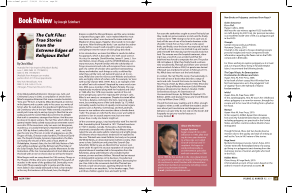
The Cult Files:
True Stories
from the
Extreme Edges of
Religious Belief
By Chris Mikul
Australia: Pier 9 (an Imprint of Murdoch Books),
June 1, 2009. ISBN-10: 174196041X
ISBN-13: 978-1741960419.
(Available from Amazon.com market
partners from $11.78 new) (paperback).
New York: MetroBooks, 2010.
ISBN 13: 978-1-4351-2257-4.
248 pages. Printed and bound in China.
Chris Mikul published Bizarrism: Strange Lives, Cults, and
Celebrated Lunacy in 2000, a compilation of articles from
Mikul’s magazine Bizarrism that some consider Australia’s
“best zine.” He lives in Sydney. Mikul developed an interest
in the bizarre and eccentric early in his career as a writer of
fiction after he read about the grandiose Englishman, Don-
ald Crowhurst, who in the late 1960s entered a round-the-
world yacht race only to end up trying to fake that he was
sailing around the world. Mikul discovered to his delight
that truth is sometimes stranger than fiction. And discover
he does in his latest venture, The Cult Files, which offers the
general reader finely crafted essays about seventeen notori-
ous cults. Of the seventeen, only two were not dangerous,
murderous, or suicidal enterprises: Mankind United, found-
ed in 1934 by Arthur Lowber Bell, and… and… well, that
was the only one. The rest, in order of appearance, are the
Thugee of India, Christian snake handlers, The Branch David-
ians, The People’s Temple, Synanon, Rajneeshism, the Man-
son Family, the Church of the Lamb of God, MOVE of
Philadelphia, Heaven’s Gate, the Ant Hill Kids, Nation of Yah-
weh, Jeffrey Lundgren and the Kirtland cult, The Order of
the Solar Temple, Aum Shinrikyo, and the Movement for the
Restoration of the Ten Commandments of God. Mikul wrote
this book with an eye on shock value as well as the bizarre.
Mikul begins with an essay about the 19th century Thugs, or
the Thugee of India, who were responsible for thousands of
murders in the name of the goddess Kali. Eventually, more
than 4,500 Thugs were brought to justice and the move-
ment faded. I was initially dismayed to find a clear mistake
in the very first sentence of the book here, the Mughal
Empire is called the Mongol Empire, and the same mistake
is repeated four pages later. I soon realized that this must
have been an editor’s error because the index indicated
Mughal on those pages. Happily, I discovered no more glar-
ing errors. After finishing the book, I can say that the author
clearly did his research well enough to give any reader a
solid glimpse into the nature of each group described.
In his introduction, we learn that Mikul is careful to define
his approach, which is basically in line with social science.
He cites, for example, David Bromley, James R. Lewis, J. Gor-
don Melton, Anson Shupe, and the CESNUR Website as pri-
mary resources. Anyone familiar with the scholarship on
fringe movements and cults will recognize those names as
part of a coterie of scholars who question brainwashing
theory and whether such things as cults, as defined by
what they call the “anti-cult network,” exist at all. In con-
trast, Mikul also cites the rickross.com Website and authors
who are highly critical of certain cults for example, Six Years
with God by Jeannie Mills (1979). Ross is an example of the
so-called “anti-cult network” despised by some social scien-
tists. Mills was a member of the People’s Temple. She was
mysteriously murdered along with her husband and child
in 1980 after the 1978 mass murder-suicide of the cult.
Some people pay a price for exposing the wrong in cults.
Mikul is not nearly as courageous. Despite his stated effort
“to strike a balance, sticking to the facts, reserving judg-
ment, but omitting none of the lurid details” (p.11), Mikul
noticeably avoids mention of equally controversial organi-
zations such as Ramtha, Scientology, and est/Landmark,
known to sue authors who mention them in books about
“cults.”The groups or cults that he does cover are hardly in
position to sue or assault anyone now, but one never
knows how or why one fanatic might act.
Of the seventeen groups, I was least familiar with The Ant Hill
Kids, founded by Roch Thériault in 1977. Thériault was born
in 1947 in Quebec, Canada. He became a hard-drinking,
charismatic storyteller who claimed he was Moses reincar-
nated. He was also quite sadistic, retaining only a tight group
of followers whose masochistic tendencies he exploited to
the max. Thériault was raised Catholic, but early on he joined
the White Berets, an ultraconservative Catholic society, then
came to hate Catholicism and joined the Seventh Day
Adventists. While he was an Adventist, four women soon
came under his spell. His raucous reputation of sexual and
physical abuse of members led to his expulsion from the
Adventists, along with followers who included twelve
women, six men and two children. Thériault had an interest
in doing painful surgeries on his devotees. He pulled out
eight teeth of one female member with pliers, destroying her
jaw. One child in the movement died after Thériault per-
formed a crude circumcision, squirting ethanol into the
baby’s mouth as an anesthetic. “In his drunken rages, Théri-
ault threw children against trees and walls” (p.169).
For years the authorities sought to arrest Thériault, but
they could not get accusations to stick until he finally
went too far in 1989. Going too far in his case was to
hack off the arm of one of his female devotees at the
shoulder. It took him an hour with a crude carpet
knife, and finally, once the bone was exposed, to hack
it off with a meat cleaver. He stitched it up and cauter-
ized it himself the next day, but the wound would not
heal. The woman went for hospital treatment, claim-
ing it was a result of a car accident and that her
boyfriend was forced to amputate her arm. The police
did not believe it. After they finally found a witness
who would testify, Thériault and others were arrested
and convicted. As late as 2002, his parole was denied
[Thériault was murdered in prison in February 2011.].
No, Mikul does not leave out the lurid details.
In context, The Cult Files fits nicely, if sensationally, in
line with a host of books that describe a range of
sects and cults. Several that come to mind are They
Have Found a Faith, by Marcus Bach (1946) These Also
Believe: A Study of Modern American Cults &Minority
Religious Movements, by Charles S. Braden (1949)
Extraordinary Groups: An Examination of
Unconventional Groups, by William M. Kephart (7th
Edition, 2000) and Spying in Guru Land: Inside Britain’s
Cults, by William Shaw (1995).
I found the book easy reading, and it offers enough
insight to whet as well as refresh the reader’s aware-
ness about just how bizarre and dangerous cult
behavior can get. Only do not rely on the book’s bib-
liography to get you very far because it
is very limited. ■
About the Reviewer
Joseph Szimhart
began research into cultic
influence in 1980, after end-
ing his two-year devotion
to a New Age sect called
Church Universal and Tri-
umphant. He began to
work professionally as
an intervention specialist
and exit counselor in 1986
Since 1998 he has worked in the crisis department
of a psychiatric emergency hospital in Pennsylvania.
He continues to assist families with interventions
and former members in recovery, including consul-
tations via phoneand Internet.
E-mail: jzimhart@windstream.net.
New Books on Polygamy, continued from Page 9
Stolen Innocence
Elissa Wall,
Harper Collins, 2008.
Wall was the star witness against FLDS leader War-
ren Jeffs during his 2007 trial. Her personal narrative
is an excellent inside view of life as a polygamist girl
in the FLDS.
Triumph
Carolyn Jessop and Laura Palmer,
Visionary Classics, 2010.
Triumph is the sequel to Escape detailing Jessop's
personal insights and much unreported inside
information regarding the Texas raid on the FLDS
compound in El Dorado.
For those wishing to explore polygamy as it is lived
and as it impacts those living in fundamentalist
Islam, I recommend the following books:
The Caged Virgin, An Emancipation
Proclamation for Women and Islam
Ayaan Hirsi Ali, Free Press, 2008.
In her book of short essays, Hirsi Ali writes from
first hand experience as to the polygamist “cult
of virginity” that is the hallmark of Islamic
fundamentalism.
Infidel
Ayaan Hirsi Ali, Free Press, 2007.
In this autobiography, Hirsi Ali traces her childhood,
where polygamy is a norm for women, through her
escape and to her new life in hiding from a jihad on
her head.
Nomad
Ayaan Hirsi Ali, Free Press, 2010.
In her sequel to Infidel, Ayaan Hirsi discusses
how and why fundamentalist Islamic traditions,
including polygamy, are practiced in the United
States and other countries where Muslims have
immigrated.
Though fictional, these last two books deserve
mention due to the quality and style of writing as
well as the “true to life” nature of the stories:
Keep Sweet
Michele Dominguez Greene, Simon Pulse, 2010.
Greene writes the fictionalized story of a young
girl living in a polygamist sect drawing from the
numerous stories of women and girls who lived
in the FLDS.
Hidden Wives
Claire Avery, A Forge Book, 2010.
A fictionalized account of two sisters based on the
author’s research of personal accounts. ■
ICSA_volume3_proof6 5/10/11 12:14 PM Page 26
Book Review
by Joseph Szimhart
The Cult Files:
True Stories
from the
Extreme Edges of
Religious Belief
By Chris Mikul
Australia: Pier 9 (an Imprint of Murdoch Books),
June 1, 2009. ISBN-10: 174196041X
ISBN-13: 978-1741960419.
(Available from Amazon.com market
partners from $11.78 new) (paperback).
New York: MetroBooks, 2010.
ISBN 13: 978-1-4351-2257-4.
248 pages. Printed and bound in China.
Chris Mikul published Bizarrism: Strange Lives, Cults, and
Celebrated Lunacy in 2000, a compilation of articles from
Mikul’s magazine Bizarrism that some consider Australia’s
“best zine.” He lives in Sydney. Mikul developed an interest
in the bizarre and eccentric early in his career as a writer of
fiction after he read about the grandiose Englishman, Don-
ald Crowhurst, who in the late 1960s entered a round-the-
world yacht race only to end up trying to fake that he was
sailing around the world. Mikul discovered to his delight
that truth is sometimes stranger than fiction. And discover
he does in his latest venture, The Cult Files, which offers the
general reader finely crafted essays about seventeen notori-
ous cults. Of the seventeen, only two were not dangerous,
murderous, or suicidal enterprises: Mankind United, found-
ed in 1934 by Arthur Lowber Bell, and… and… well, that
was the only one. The rest, in order of appearance, are the
Thugee of India, Christian snake handlers, The Branch David-
ians, The People’s Temple, Synanon, Rajneeshism, the Man-
son Family, the Church of the Lamb of God, MOVE of
Philadelphia, Heaven’s Gate, the Ant Hill Kids, Nation of Yah-
weh, Jeffrey Lundgren and the Kirtland cult, The Order of
the Solar Temple, Aum Shinrikyo, and the Movement for the
Restoration of the Ten Commandments of God. Mikul wrote
this book with an eye on shock value as well as the bizarre.
Mikul begins with an essay about the 19th century Thugs, or
the Thugee of India, who were responsible for thousands of
murders in the name of the goddess Kali. Eventually, more
than 4,500 Thugs were brought to justice and the move-
ment faded. I was initially dismayed to find a clear mistake
in the very first sentence of the book here, the Mughal
Empire is called the Mongol Empire, and the same mistake
is repeated four pages later. I soon realized that this must
have been an editor’s error because the index indicated
Mughal on those pages. Happily, I discovered no more glar-
ing errors. After finishing the book, I can say that the author
clearly did his research well enough to give any reader a
solid glimpse into the nature of each group described.
In his introduction, we learn that Mikul is careful to define
his approach, which is basically in line with social science.
He cites, for example, David Bromley, James R. Lewis, J. Gor-
don Melton, Anson Shupe, and the CESNUR Website as pri-
mary resources. Anyone familiar with the scholarship on
fringe movements and cults will recognize those names as
part of a coterie of scholars who question brainwashing
theory and whether such things as cults, as defined by
what they call the “anti-cult network,” exist at all. In con-
trast, Mikul also cites the rickross.com Website and authors
who are highly critical of certain cults for example, Six Years
with God by Jeannie Mills (1979). Ross is an example of the
so-called “anti-cult network” despised by some social scien-
tists. Mills was a member of the People’s Temple. She was
mysteriously murdered along with her husband and child
in 1980 after the 1978 mass murder-suicide of the cult.
Some people pay a price for exposing the wrong in cults.
Mikul is not nearly as courageous. Despite his stated effort
“to strike a balance, sticking to the facts, reserving judg-
ment, but omitting none of the lurid details” (p.11), Mikul
noticeably avoids mention of equally controversial organi-
zations such as Ramtha, Scientology, and est/Landmark,
known to sue authors who mention them in books about
“cults.”The groups or cults that he does cover are hardly in
position to sue or assault anyone now, but one never
knows how or why one fanatic might act.
Of the seventeen groups, I was least familiar with The Ant Hill
Kids, founded by Roch Thériault in 1977. Thériault was born
in 1947 in Quebec, Canada. He became a hard-drinking,
charismatic storyteller who claimed he was Moses reincar-
nated. He was also quite sadistic, retaining only a tight group
of followers whose masochistic tendencies he exploited to
the max. Thériault was raised Catholic, but early on he joined
the White Berets, an ultraconservative Catholic society, then
came to hate Catholicism and joined the Seventh Day
Adventists. While he was an Adventist, four women soon
came under his spell. His raucous reputation of sexual and
physical abuse of members led to his expulsion from the
Adventists, along with followers who included twelve
women, six men and two children. Thériault had an interest
in doing painful surgeries on his devotees. He pulled out
eight teeth of one female member with pliers, destroying her
jaw. One child in the movement died after Thériault per-
formed a crude circumcision, squirting ethanol into the
baby’s mouth as an anesthetic. “In his drunken rages, Théri-
ault threw children against trees and walls” (p.169).
For years the authorities sought to arrest Thériault, but
they could not get accusations to stick until he finally
went too far in 1989. Going too far in his case was to
hack off the arm of one of his female devotees at the
shoulder. It took him an hour with a crude carpet
knife, and finally, once the bone was exposed, to hack
it off with a meat cleaver. He stitched it up and cauter-
ized it himself the next day, but the wound would not
heal. The woman went for hospital treatment, claim-
ing it was a result of a car accident and that her
boyfriend was forced to amputate her arm. The police
did not believe it. After they finally found a witness
who would testify, Thériault and others were arrested
and convicted. As late as 2002, his parole was denied
[Thériault was murdered in prison in February 2011.].
No, Mikul does not leave out the lurid details.
In context, The Cult Files fits nicely, if sensationally, in
line with a host of books that describe a range of
sects and cults. Several that come to mind are They
Have Found a Faith, by Marcus Bach (1946) These Also
Believe: A Study of Modern American Cults &Minority
Religious Movements, by Charles S. Braden (1949)
Extraordinary Groups: An Examination of
Unconventional Groups, by William M. Kephart (7th
Edition, 2000) and Spying in Guru Land: Inside Britain’s
Cults, by William Shaw (1995).
I found the book easy reading, and it offers enough
insight to whet as well as refresh the reader’s aware-
ness about just how bizarre and dangerous cult
behavior can get. Only do not rely on the book’s bib-
liography to get you very far because it
is very limited. ■
About the Reviewer
Joseph Szimhart
began research into cultic
influence in 1980, after end-
ing his two-year devotion
to a New Age sect called
Church Universal and Tri-
umphant. He began to
work professionally as
an intervention specialist
and exit counselor in 1986
Since 1998 he has worked in the crisis department
of a psychiatric emergency hospital in Pennsylvania.
He continues to assist families with interventions
and former members in recovery, including consul-
tations via phoneand Internet.
E-mail: jzimhart@windstream.net.
New Books on Polygamy, continued from Page 9
Stolen Innocence
Elissa Wall,
Harper Collins, 2008.
Wall was the star witness against FLDS leader War-
ren Jeffs during his 2007 trial. Her personal narrative
is an excellent inside view of life as a polygamist girl
in the FLDS.
Triumph
Carolyn Jessop and Laura Palmer,
Visionary Classics, 2010.
Triumph is the sequel to Escape detailing Jessop's
personal insights and much unreported inside
information regarding the Texas raid on the FLDS
compound in El Dorado.
For those wishing to explore polygamy as it is lived
and as it impacts those living in fundamentalist
Islam, I recommend the following books:
The Caged Virgin, An Emancipation
Proclamation for Women and Islam
Ayaan Hirsi Ali, Free Press, 2008.
In her book of short essays, Hirsi Ali writes from
first hand experience as to the polygamist “cult
of virginity” that is the hallmark of Islamic
fundamentalism.
Infidel
Ayaan Hirsi Ali, Free Press, 2007.
In this autobiography, Hirsi Ali traces her childhood,
where polygamy is a norm for women, through her
escape and to her new life in hiding from a jihad on
her head.
Nomad
Ayaan Hirsi Ali, Free Press, 2010.
In her sequel to Infidel, Ayaan Hirsi discusses
how and why fundamentalist Islamic traditions,
including polygamy, are practiced in the United
States and other countries where Muslims have
immigrated.
Though fictional, these last two books deserve
mention due to the quality and style of writing as
well as the “true to life” nature of the stories:
Keep Sweet
Michele Dominguez Greene, Simon Pulse, 2010.
Greene writes the fictionalized story of a young
girl living in a polygamist sect drawing from the
numerous stories of women and girls who lived
in the FLDS.
Hidden Wives
Claire Avery, A Forge Book, 2010.
A fictionalized account of two sisters based on the
author’s research of personal accounts. ■
ICSA_volume3_proof6 5/10/11 12:14 PM Page 26