8 ICSA TODAY
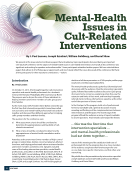
A Psychoanalytic Perspective
By Daniel Shaw
I am a psychoanalytically trained psychotherapist, and I am
also a former cult member. The beginning of my training
as a psychotherapist coincided, 20 years ago now, with my
final break with the cult in which I had been a full-time staff
member for more than a decade. The paper I wrote for the
completion of my Master’s in Social Work (MSW) degree was
entitled Traumatic Abuse in Cults, a paper I later amended,
and to which I added the subtitle A Psychoanalytic Perspective.
This paper was eventually published in the Cultic Studies
Journal. But before this official publication, I had put the
paper online, and that is how I became both a psychoanalytic
psychotherapist, my original intention, and also a counselor
of former members of cults, and of family and friends of cult-
involved loved ones.
a) What assessment criteria should be considered to
determine the appropriateness and feasibility of cult-
related interventions?
I greatly admire the work of the cult-intervention specialists
here today, and I am aware of how many people have
benefited immeasurably from intervention. Nevertheless,
when I am consulted by terrified and anxious parents or
relatives, suggesting a cult intervention is not typically my first
response. My basic approach is as follows:
• Hear the whole story. I want to know all about how the
son or husband or brother (or the female counterpart) got
involved what was going on before what has happened
since the involvement what other professionals or written
materials they have consulted before they decided to see
me.
• Assess the family. I want to know about this family, how
it functions, what its strengths and weaknesses are and
I ask direct questions about these things. I want to learn
what plans or ideas, if any, the family members have
been contemplating and I want to hear what any other
professional they have consulted has advised. I want to
get a sense of how psychologically aware, or not, they
might be—and what they think may have contributed to
their loved one’s recruitment. I want to see whether this
family would be capable on their own to strengthen their
relationship to the cultist: Do they need to backpedal, and
even apologize, for attacking the choice the cultist has
made? Do they need to respect the cultist’s wishes, and
be willing to have a relationship on the cultist’s terms?
What might be possible in terms of an approach that
focuses on strengthening family ties, and working slowly
and patiently toward gaining and keeping the trust of the
cultist?
• Suggest intervention if appropriate. At any point in
this kind of work with family, but especially when
the members seem desperate, I remind them that
intervention with a specialist is also an option
they can consider. In many cases, I have suggested
that they speak to an interventionist and educate
themselves about the process. If they choose to work
with the interventionist, I support their decision.
Sometimes they do make that choice—and when
they don’t, it’s usually because they don’t want to
risk being totally cut off by their loved one.
o In one case, I was consulted by multiple
members of a large family about one of the
siblings. As we reviewed all the options, it
became clear that there was urgency for various
reasons: Their brothers’ wife and children would
be abandoned, and their brother might be
suffering from a psychotic disorder. I identified
the strongest member of the group, the one
with the best chance of reaching the brother,
and I worked with her to assemble a team from
within her family. I then coached that small team
through various scenarios, and then they went
to where their brother was and succeeded in
bringing him home. All the coaching I did was
via conference calls—I never met the family in
person.
If I do an intervention, I do not practice or advise any
kind of deception or coercion.
• Assess whether the member is in danger. When
the member is in danger of physical harm—sexual
abuse, beatings, coerced felonies—or when
the safety of children is involved, I will advise
consultation with an interventionist and suggest
that the family consider legal or police action or
both. I consider these issues beyond the scope of my
practice.
• Assess whether the member is seriously ill, physically
or mentally. If I suspect psychosis, and not simply
ideological fervor, I speak openly about this to the
family. If I feel that I would not be capable of leading
the family in an intervention they themselves could
stage, I refer them to an interventionist and suggest
they work with that person to try to get the cultist
to a psychiatric evaluation, or to cult rehab. If they
succeed, on condition that the member complies
with psychiatric recommendations, and the family
is supportive, I may agree, if I am asked, to see this
person for psychotherapy in my practice after she
has completed cult rehab or has been appropriately
medicated.
I am a psychoanalytically trained
psychotherapist, and I am also a
former cult member.
A Psychoanalytic Perspective
By Daniel Shaw
I am a psychoanalytically trained psychotherapist, and I am
also a former cult member. The beginning of my training
as a psychotherapist coincided, 20 years ago now, with my
final break with the cult in which I had been a full-time staff
member for more than a decade. The paper I wrote for the
completion of my Master’s in Social Work (MSW) degree was
entitled Traumatic Abuse in Cults, a paper I later amended,
and to which I added the subtitle A Psychoanalytic Perspective.
This paper was eventually published in the Cultic Studies
Journal. But before this official publication, I had put the
paper online, and that is how I became both a psychoanalytic
psychotherapist, my original intention, and also a counselor
of former members of cults, and of family and friends of cult-
involved loved ones.
a) What assessment criteria should be considered to
determine the appropriateness and feasibility of cult-
related interventions?
I greatly admire the work of the cult-intervention specialists
here today, and I am aware of how many people have
benefited immeasurably from intervention. Nevertheless,
when I am consulted by terrified and anxious parents or
relatives, suggesting a cult intervention is not typically my first
response. My basic approach is as follows:
• Hear the whole story. I want to know all about how the
son or husband or brother (or the female counterpart) got
involved what was going on before what has happened
since the involvement what other professionals or written
materials they have consulted before they decided to see
me.
• Assess the family. I want to know about this family, how
it functions, what its strengths and weaknesses are and
I ask direct questions about these things. I want to learn
what plans or ideas, if any, the family members have
been contemplating and I want to hear what any other
professional they have consulted has advised. I want to
get a sense of how psychologically aware, or not, they
might be—and what they think may have contributed to
their loved one’s recruitment. I want to see whether this
family would be capable on their own to strengthen their
relationship to the cultist: Do they need to backpedal, and
even apologize, for attacking the choice the cultist has
made? Do they need to respect the cultist’s wishes, and
be willing to have a relationship on the cultist’s terms?
What might be possible in terms of an approach that
focuses on strengthening family ties, and working slowly
and patiently toward gaining and keeping the trust of the
cultist?
• Suggest intervention if appropriate. At any point in
this kind of work with family, but especially when
the members seem desperate, I remind them that
intervention with a specialist is also an option
they can consider. In many cases, I have suggested
that they speak to an interventionist and educate
themselves about the process. If they choose to work
with the interventionist, I support their decision.
Sometimes they do make that choice—and when
they don’t, it’s usually because they don’t want to
risk being totally cut off by their loved one.
o In one case, I was consulted by multiple
members of a large family about one of the
siblings. As we reviewed all the options, it
became clear that there was urgency for various
reasons: Their brothers’ wife and children would
be abandoned, and their brother might be
suffering from a psychotic disorder. I identified
the strongest member of the group, the one
with the best chance of reaching the brother,
and I worked with her to assemble a team from
within her family. I then coached that small team
through various scenarios, and then they went
to where their brother was and succeeded in
bringing him home. All the coaching I did was
via conference calls—I never met the family in
person.
If I do an intervention, I do not practice or advise any
kind of deception or coercion.
• Assess whether the member is in danger. When
the member is in danger of physical harm—sexual
abuse, beatings, coerced felonies—or when
the safety of children is involved, I will advise
consultation with an interventionist and suggest
that the family consider legal or police action or
both. I consider these issues beyond the scope of my
practice.
• Assess whether the member is seriously ill, physically
or mentally. If I suspect psychosis, and not simply
ideological fervor, I speak openly about this to the
family. If I feel that I would not be capable of leading
the family in an intervention they themselves could
stage, I refer them to an interventionist and suggest
they work with that person to try to get the cultist
to a psychiatric evaluation, or to cult rehab. If they
succeed, on condition that the member complies
with psychiatric recommendations, and the family
is supportive, I may agree, if I am asked, to see this
person for psychotherapy in my practice after she
has completed cult rehab or has been appropriately
medicated.
I am a psychoanalytically trained
psychotherapist, and I am also a
former cult member.