Dear Friends,
As a former cult member researching the question “What helps former cult members
recover from an abusive cult experience?,” and a trainer and therapist who offers Post Cult
CounselingHVC, I am familiar with the wide range of approaches in this complex field. This
issue of ICSA Today offers diverse and thought-provoking perspectives on the many stages of
involvement in cultic groups and relationships—how people are drawn into coercive groups,
what keeps them there, and how, if they are fortunate, they manage to leave.
Millard Melnyk’s surprising article challenges the assumption that critical thinking is the best
antidote to being drawn into a group. Raphaella Di Marzio brings her many years of experience
to bear on a discussion of mediation as a means of resolving conflict between parties in
cult-related situations. And Joseph Szimhart, William Goldberg, and Daniel Shaw, all widely
respected and published authors in their fields, speak from personal experience about what
psychotherapists and interventionists share and how they differ in helping families impacted by
cults.
In our Editor’s Corner, Linda Dubrow-Marshall comments on what attitudes are most useful to
the professional who is offering help to a cult survivor. These comments were first published in
Therapy Today, the flagship journal for the British Association for Counselling in Psychotherapy.
Publication of this article was the first time that former cult-member issues were explicitly
written about in that publication, an important milestone.
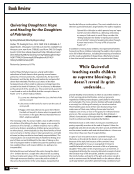
An inspiring story is told in the book Quivering Daughters: Hope and Healing for the Daughters of
Patriarchy by Hilary McFarland, reviewed here by Lawrence (Larry) Pile. Larry has worked with the
Wellspring Retreat and Resource Center in Ohio since its inception, and he helpfully illustrates
the Wellspring thought-reform model while reviewing the book. As an intern at Wellspring twice
(in 1999 and 2008), I learned this model, which is the basis of the Post Cult CounselingHVC I
offer, and I find it to be hugely effective with former members of most types of cults. McFarland
addresses issues of recovery, although these are not spelled out in the book review.
Enjoy the many varied perspectives illustrated in this edition—I have!
Sincerely,
Gillie Jenkinson, MA, Hope Valley Counselling Limited, United Kingdom
About ICSA Today
ICSA Today (IT) serves ICSA members by
providing information that enhances
understanding of all aspects of the cult
phenomenon, including how groups
function, how they affect members,
techniques of influence, dealing with
harmful effects, educational and legal
implications, and other subjects.
ICSA Today issues may include
• practical articles for former
members, families, helping
professionals, researchers,
and others
• opinion essays
• theoretical articles
• reports on research
• summaries of news reports on
groups
• information on books, articles, links
• information on ICSA members
• biographical profiles on selected
members
• personal accounts
• art work
• poetry
• short stories and other literary
articles
• special reports from correspondents
around the world
ICSA Today is published three times a
year.
Regular ICSA members receive the print
edition of ICSA Today and have access
to its Web edition. Students and other
special members gain access to the
online edition only.
Nonmember print subscriptions are
available. Submissions to the magazine
should be sent to the Editor-in-Chief,
Michael Langone, PhD:
mail@icsamail.com
We prefer Microsoft Word or a program
compatible with Word. Articles should
be no more than 2,500 words. Please
include a jpeg photo (less than 150 KB)
and biographical sketch (less than 150
words) with your submission.
Appropriate submissions are reviewed
by the relevant section editor and,
when appropriate, editorial review
advisors.
International Cultic Studies Association
P.O. Box 2265 • Bonita Springs, FL 34133
Phone: 239.514.3081
Email: mail@icsamail.com
Website: icsahome.com
Gillie Jenkinson, MA, Mental Health Editor for ICSA Today,
is a trained counselor and psychotherapist with an Advanced Diploma
in Pastoral Counselling and an MA in Gestalt Psychotherapy. She is
accredited with the United Kingdom Council for Psychotherapy (UKCP)
and is a registered member of the British Association for Counselling and
Psychotherapy (BACP). She served two internships at Wellspring Retreat
Center in Ohio.
Ms. Jenkinson has many years of experience working with survivors of
rape, sexual abuse, and cults, and also with clients with other issues. She
facilitates a former-member support and education group from her home in Grindleford, United
Kingdom, and regularly speaks and trains on recovery issues. She is an international speaker and
has presented at many ICSA conferences on various subjects.
She has two papers published in Cultic Studies Review: “An Investigation Into Cult Pseudo-
Personality: What Is It and How Does It Form?” (2008) and “Cult Pseudo-Creativity vs. Creativity
in Recovery” (2010). She has coauthored a chapter entitled “Pathological Spirituality” with Dr.
Nicola Crowley for a medical textbook entitled Spirituality and Psychiatry, published by RCPsych
Publications in the United Kingdom (2009). The BACP published her article “Working with Cult
Survivors” in Therapy Today in May 2013. Ms. Jenkinson is a doctoral candidate at the University
of Nottingham and is conducting research into “What helps former cult members recover from
an abusive cult experience?” hopevalleycounselling.com
As a former cult member researching the question “What helps former cult members
recover from an abusive cult experience?,” and a trainer and therapist who offers Post Cult
CounselingHVC, I am familiar with the wide range of approaches in this complex field. This
issue of ICSA Today offers diverse and thought-provoking perspectives on the many stages of
involvement in cultic groups and relationships—how people are drawn into coercive groups,
what keeps them there, and how, if they are fortunate, they manage to leave.
Millard Melnyk’s surprising article challenges the assumption that critical thinking is the best
antidote to being drawn into a group. Raphaella Di Marzio brings her many years of experience
to bear on a discussion of mediation as a means of resolving conflict between parties in
cult-related situations. And Joseph Szimhart, William Goldberg, and Daniel Shaw, all widely
respected and published authors in their fields, speak from personal experience about what
psychotherapists and interventionists share and how they differ in helping families impacted by
cults.
In our Editor’s Corner, Linda Dubrow-Marshall comments on what attitudes are most useful to
the professional who is offering help to a cult survivor. These comments were first published in
Therapy Today, the flagship journal for the British Association for Counselling in Psychotherapy.
Publication of this article was the first time that former cult-member issues were explicitly
written about in that publication, an important milestone.
An inspiring story is told in the book Quivering Daughters: Hope and Healing for the Daughters of
Patriarchy by Hilary McFarland, reviewed here by Lawrence (Larry) Pile. Larry has worked with the
Wellspring Retreat and Resource Center in Ohio since its inception, and he helpfully illustrates
the Wellspring thought-reform model while reviewing the book. As an intern at Wellspring twice
(in 1999 and 2008), I learned this model, which is the basis of the Post Cult CounselingHVC I
offer, and I find it to be hugely effective with former members of most types of cults. McFarland
addresses issues of recovery, although these are not spelled out in the book review.
Enjoy the many varied perspectives illustrated in this edition—I have!
Sincerely,
Gillie Jenkinson, MA, Hope Valley Counselling Limited, United Kingdom
About ICSA Today
ICSA Today (IT) serves ICSA members by
providing information that enhances
understanding of all aspects of the cult
phenomenon, including how groups
function, how they affect members,
techniques of influence, dealing with
harmful effects, educational and legal
implications, and other subjects.
ICSA Today issues may include
• practical articles for former
members, families, helping
professionals, researchers,
and others
• opinion essays
• theoretical articles
• reports on research
• summaries of news reports on
groups
• information on books, articles, links
• information on ICSA members
• biographical profiles on selected
members
• personal accounts
• art work
• poetry
• short stories and other literary
articles
• special reports from correspondents
around the world
ICSA Today is published three times a
year.
Regular ICSA members receive the print
edition of ICSA Today and have access
to its Web edition. Students and other
special members gain access to the
online edition only.
Nonmember print subscriptions are
available. Submissions to the magazine
should be sent to the Editor-in-Chief,
Michael Langone, PhD:
mail@icsamail.com
We prefer Microsoft Word or a program
compatible with Word. Articles should
be no more than 2,500 words. Please
include a jpeg photo (less than 150 KB)
and biographical sketch (less than 150
words) with your submission.
Appropriate submissions are reviewed
by the relevant section editor and,
when appropriate, editorial review
advisors.
International Cultic Studies Association
P.O. Box 2265 • Bonita Springs, FL 34133
Phone: 239.514.3081
Email: mail@icsamail.com
Website: icsahome.com
Gillie Jenkinson, MA, Mental Health Editor for ICSA Today,
is a trained counselor and psychotherapist with an Advanced Diploma
in Pastoral Counselling and an MA in Gestalt Psychotherapy. She is
accredited with the United Kingdom Council for Psychotherapy (UKCP)
and is a registered member of the British Association for Counselling and
Psychotherapy (BACP). She served two internships at Wellspring Retreat
Center in Ohio.
Ms. Jenkinson has many years of experience working with survivors of
rape, sexual abuse, and cults, and also with clients with other issues. She
facilitates a former-member support and education group from her home in Grindleford, United
Kingdom, and regularly speaks and trains on recovery issues. She is an international speaker and
has presented at many ICSA conferences on various subjects.
She has two papers published in Cultic Studies Review: “An Investigation Into Cult Pseudo-
Personality: What Is It and How Does It Form?” (2008) and “Cult Pseudo-Creativity vs. Creativity
in Recovery” (2010). She has coauthored a chapter entitled “Pathological Spirituality” with Dr.
Nicola Crowley for a medical textbook entitled Spirituality and Psychiatry, published by RCPsych
Publications in the United Kingdom (2009). The BACP published her article “Working with Cult
Survivors” in Therapy Today in May 2013. Ms. Jenkinson is a doctoral candidate at the University
of Nottingham and is conducting research into “What helps former cult members recover from
an abusive cult experience?” hopevalleycounselling.com