14 ICSA TODAY VOLUME 4 |NUMBER 2 |2013 15
Sometimes Rob works on the delivery trucks that bring Father’s
News World newspaper to newsstands all over New York. This is
important work, but Peggy worries about the way Rob talks about
the brothers he works with. No matter whom he mentions, he
always tries to show that he knows better. Even worse is the way
he talks about the sisters. It’s as though he thinks sisters exist only
to serve the brothers. When Peggy told him about her education,
he’d dismissed it as merely “intellectual”and “not useful to Father.”
True Father’s voice breaks into Peggy’s reveries he is asking the
couples to assent to the four vows of the Unification Church
Blessing. He will ask four questions, to which the brides and
grooms must shout in unison their assent. He will ask the
questions in Korean, but both Peggy and Rob have seen them
written down in English.
“Do you pledge to keep the heavenly law as original men and
women, and, should you fail, pledge to take responsibility for that?”
Rob joins in the general shout of “Yes!” to Father’s question.
Peggy, however, only sighs out the word, half-heartedly, though
Rob is too caught up to notice.
The Blessing had always seemed like it would be the answer to all
her troubles. Over and over, Peggy had been told that once she
received the Holy Wine at the ceremony following the Matching,
she would be spiritually changed. The Holy Wine Ceremony had
removed her Original Sin. But Peggy hadn’t noticed any change
since she took the Holy Wine. She remained as she’d always been:
often discouraged and prone to depression.
When she first joined the Unification Church, the Blessing—
which she’d learned about only after she’d been a member for a
couple of months—seemed like the perfect answer to the
troubles that had dogged her all her life. She had never known
how to be comfortable around men and had never been in a
long-term relationship with anyone. She was taught that Father
would find just the right brother to be her soul mate. With his
perfect insight into the spirit world, he would find someone with
just the right ancestors to match with hers, and together their
blood lineages would be removed from the dominion of Satan.
So why did she feel so miserable?
Father’s voice breaks into her thoughts and Peggy turns her
attention to the front of the arena. He is intoning the second
vow. Peggy recalls the English translation: “Do you pledge as
ideal husbands and wives to establish eternal families, with
which God can be happy?”
“Yes!” everyone shouts out in unison, louder than before—
except Peggy, who can manage only a half-hearted mumble.
Rob thrusts out his right arm and clenches his hand into a fist,
pumping it for emphasis as he yells out his “Yes!”The brothers
and sisters unite in their desire to please Father by pouring every
effort into the shouting of their vows.
But hadn’t there been one boy, once, back in college? She’d met
him in her third year of reading English at University of Leicester.
She’d been the quiet one who always sat at the back of the
lecture hall. This young man had been in her Restoration Drama
course. And now here he was again, seated nearby while her
professor talked about Wordsworth.
His name was Malcolm. He looked at her many times without
saying anything, but one day he approached her after class. It was
clear he was just as shy as Peggy. They went out a few times (the
first time they just went to Wimpy’s for hamburgers), but Malcolm
had never known how to put aside his own awkwardness around
her. Eventually he stopped trying. Peggy went back to believing
that she was too plain and ordinary for any man to want her.
Then she’d met the Unification Church, just a few months before
graduating from Leicester. She’d been on the way to the
chemist’s shop for some soap and other things, when she
chanced across a young German man and a young Japanese
woman standing on the street corner. They were selling a small
newspaper called the New Hope News for 10 pence and since
they were so friendly (though the woman spoke hardly any
English), Peggy bought one of their papers. Manfred told her
about a meeting of young people at a nearby house, and invited
her. He was so impressed with her university education and so
flattering that she almost laughed. But she told him she would
come, and then she almost hadn’t, thinking she would be out of
place. At the meeting she’d met a few English men and women,
as well as a French man, an Italian, three Germans, and a
Canadian. All of them had welcomed her and exclaimed about
how smart she was to have progressed so far in her studies.
There was one other guest, a young woman who worked as an
au pair, who’d met the New Hope News sellers while pushing her
young charges in a pram. But the au pair woman never returned.
Peggy came back several times. The church members gave
curious lectures about God and Jesus that made her think. But it
was really their friendliness that won her over. She wasn’t sure
whether she believed their ideas or not. After several visits they
told her that there was an important week-long lecture series
she must attend at Cleeve House in Wiltshire. It was some
distance away, and when she argued that she couldn’t go until
she was done with her studies, they insisted, saying it was the
most important thing she could be doing. Finally she relented,
and went away for a week. At that impressive house, she’d been
so overwhelmed by the intensity of the sense of mission of all
the brothers and sisters that she’d nearly agreed to quit her
studies. Fortunately, she hadn’t done that. Yet right after
graduating, she’d begun living with the Family members, much
to the anger and confusion of her parents. Did all this happen
only 4 years ago? It seemed so much longer.
Father’s voice pushes aside Peggy’s memories as he proclaims
the third vow: “Do you pledge to inherit heavenly tradition, and,
as external persons of goodness, raise up your children as
examples of this standard before your family and the universe?”
Again Rob pumps his right hand, formed into a determined fist,
emphatically as he joins with the others in shouting “Yes!” to
Father’s question. Peggy echoes them faintly.
At the Holy Wine Ceremony, an elderly Korean man had passed
them a tray containing small glasses of Holy Wine. She’d bowed to
him in the Oriental manner, and then taken one of the small
glasses, from which she drank half of the wine before passing the
remainder to Rob, who’d bowed to her and then finished it. He
then gave the glass back to her, and she’d bowed before giving
the cup back to the Korean elder. In that moment, her Original Sin
had been conditionally removed (provided she remained loyal to
Father throughout her life), and any children born of their
marriage would be sinless. But as they left the ballroom afterward,
Rob had whispered something surprising and unsettling to her.
“I think there was perfume in the Holy Wine. Anyway, I’d rather
drink beer.” And he’d chuckled.
Peggy had never touched a drop of alcohol since joining the
church, believing it was forbidden, so she was confused by his
remark and asked him to explain, but he shrugged it off. Later,
when they went by subway to Queens to see the place where he
worked, she noticed he’d hidden a case of beer in the closet
where he kept his overalls and work clothes. When she asked
him about it, he abruptly closed the closet door and told her
that sometimes his coworkers made him nervous so he needed
beer to relax. Do you do this often?, she’d wondered. He’d
admitted that he did it nearly every day. “There’s this hallway
upstairs in the back where nobody ever goes. I go up there and
set up six of them in a row, then just toss them down, all at once.
That’s how you get the best hit.”
“Don’t your central figures know?”
“They don’t hang around here much. I never do it if they’re
around.”
Did God choose her to be Rob’s wife so she could save him from
his drinking? Father had said that Blessed spouses were
supposed to be Messiahs to each other, but Peggy doubted she
was up to this task.
Peggy hears Father proclaiming the fourth and final vow now,
his voice booming out over the arena. “Do you pledge to be
centers of love before your societies, nations, the world, and the
universe, based upon the ideal family?”
“Yes!” all 2,075 couples roar, as one. Again Rob punches the air
with his right fist as he roars his assent, and again Peggy joins in,
though she feels her throat constricting, as though it wanted to
cut off the word.
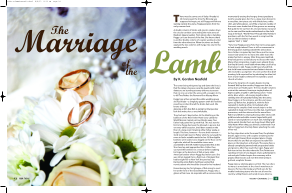
All the couples turn to face each other for the exchange of rings.
Rob reaches into his breast pocket and pulls out two gold
bands, each embossed with a symbol representing the Twelve
Gates of Heaven. Peggy extends her right hand to Rob and he
slides one of the gold bands over her middle finger. Rob then
hands Peggy the other ring, and she grasps his right hand in her
left and slides the gold band onto his middle finger. The
ceremony is almost complete.
Father closes the ceremony the way most church events end:
with three cheers of “Mansei!” (meaning “Victory for Ten
Thousand Years!”) Looking elated, the rotund, white-robed
Messiah crouches slightly and places his hands just above his
knees, like a football coach about to lead his team in a cheer. All
the brides and grooms follow his example. And then his voice
booms out, “Aboji!” (meaning “Father!”). The next instant all the
newlyweds rise to their full height and fling their hands above
their heads, shouting, “Mansei!”
Again Father squats while all the brides and grooms do likewise.
Again he gives the signal, “Aboji!”, and again the arena is filled
with arms flinging heavenward as their response rings through
the rafters: “Mansei!” And then a third time—first the crouch,
then the signal, “Aboji!”, followed by the uproarious cry, “Mansei!”
The True Parents are standing together now at the front of the
dais in their robes of white and gold, being presented with
elaborate floral bouquets as a symbol of thanks. They are the
only hope to save mankind. Their marriage in 1960 was the
fulfillment of the prophecy in Revelation about the Marriage of
the Lamb. On that holy occasion, Father surpassed the
accomplishments of Jesus Christ, who had been killed before he
was able to marry. The crucifixion of Jesus had foiled God’s plans
and postponed the arrival of the Kingdom of Heaven on Earth
for 2,000 years. Now, Father would complete his work.
But these thoughts were no comfort to Peggy. For a moment,
she had an impulse to push all the other couples aside and run
out of the arena, away from Rob. But she knew this was a
temptation from an evil spirit trying to stop her from receiving
God’s ultimate Blessing. In any case, there would be a wait of at
least three years before she had to start her family with Rob.
During those three years, they must live apart—Rob in America
and Peggy in England—and they must each recruit three new
members into the Unification Church. Would Rob change during
those three years, as a result of the Holy Wine Ceremony? Would
he become the kind of man that Peggy would want to marry?
Peggy realizes that in any case she has no choice: Father has
chosen Rob for her and expects her to live up to her vows.
Perhaps God wanted her to endure this difficult marriage so she
could pay indemnity for the sins of all mankind.
Just then the band strikes up the wedding march and the
couples begin filing out of the arena, two by two, with each
bride slipping her hand into the crook of each groom’s arm. The
band switches to a church hymn, “The Song of the Banquet,”
which was written specifically about the Blessing ceremony.
When it is their turn to leave, Peggy and Rob move to the exit.
An older couple, who had been Blessed in an earlier ceremony,
stand near the exit, loudly sighing in appreciation, as though
admiring the exquisiteness of Father’s matchmaking abilities.
They gasp with pleasure when Peggy and Rob pass by.
Suddenly they exit onto Eighth Avenue, where they are bathed
in the glare of the midday sun and blasted by hot July air.
Startled pedestrians stop to watch the surreal spectacle of
hundreds of brides and grooms strolling toward the corner of
33rd Street. A few bystanders ask to see the Blessing ring, and
Rob and Peggy hold out their hands for them to see.
“Very nice!” they tell her.
“Whew, I’m glad that’s over with,” Rob says over his shoulder to
her when they reach the next corner. “Let’s get something to eat.”
He jerks his head in the direction of the McDonald’s restaurant
across the street from the World Mission Center. Peggy follows
him through the door. Normally she never ate at fast food
places. But wasn’t this, after all, the way things would have to be
from now on? ■
About the Author
K. Gordon Neufeld, MFA,
is the author of Heartbreak and Rage: Ten
Years Under Sun Myung Moon, A Cult
Survivor's Memoir. He was a member of
the Unification Church from 1976 to 1986.
Following his departure from the group,
he graduated from the University of British
Columbia Master of Fine Arts program in
Creative Writing. His opinion piece about
the Reverend Sun Myung Moon’s mass
marriages appeared in First Things magazine in January 2003.
He has read from his work at ICSA conference Phoenix Project
exhibits. “Living Water”(a story read at ICSA’s 2010 annual
conference) was published in The Windsor Review in the Spring
2011 issue. He is working on a novel and a collection of short
stories. Mr. Neufeld lives with his wife and stepdaughter near
Schenectady, New York. ■
ICSA_volume4Issue2_Final 8/9/13 8:31 PM Page 16
Sometimes Rob works on the delivery trucks that bring Father’s
News World newspaper to newsstands all over New York. This is
important work, but Peggy worries about the way Rob talks about
the brothers he works with. No matter whom he mentions, he
always tries to show that he knows better. Even worse is the way
he talks about the sisters. It’s as though he thinks sisters exist only
to serve the brothers. When Peggy told him about her education,
he’d dismissed it as merely “intellectual”and “not useful to Father.”
True Father’s voice breaks into Peggy’s reveries he is asking the
couples to assent to the four vows of the Unification Church
Blessing. He will ask four questions, to which the brides and
grooms must shout in unison their assent. He will ask the
questions in Korean, but both Peggy and Rob have seen them
written down in English.
“Do you pledge to keep the heavenly law as original men and
women, and, should you fail, pledge to take responsibility for that?”
Rob joins in the general shout of “Yes!” to Father’s question.
Peggy, however, only sighs out the word, half-heartedly, though
Rob is too caught up to notice.
The Blessing had always seemed like it would be the answer to all
her troubles. Over and over, Peggy had been told that once she
received the Holy Wine at the ceremony following the Matching,
she would be spiritually changed. The Holy Wine Ceremony had
removed her Original Sin. But Peggy hadn’t noticed any change
since she took the Holy Wine. She remained as she’d always been:
often discouraged and prone to depression.
When she first joined the Unification Church, the Blessing—
which she’d learned about only after she’d been a member for a
couple of months—seemed like the perfect answer to the
troubles that had dogged her all her life. She had never known
how to be comfortable around men and had never been in a
long-term relationship with anyone. She was taught that Father
would find just the right brother to be her soul mate. With his
perfect insight into the spirit world, he would find someone with
just the right ancestors to match with hers, and together their
blood lineages would be removed from the dominion of Satan.
So why did she feel so miserable?
Father’s voice breaks into her thoughts and Peggy turns her
attention to the front of the arena. He is intoning the second
vow. Peggy recalls the English translation: “Do you pledge as
ideal husbands and wives to establish eternal families, with
which God can be happy?”
“Yes!” everyone shouts out in unison, louder than before—
except Peggy, who can manage only a half-hearted mumble.
Rob thrusts out his right arm and clenches his hand into a fist,
pumping it for emphasis as he yells out his “Yes!”The brothers
and sisters unite in their desire to please Father by pouring every
effort into the shouting of their vows.
But hadn’t there been one boy, once, back in college? She’d met
him in her third year of reading English at University of Leicester.
She’d been the quiet one who always sat at the back of the
lecture hall. This young man had been in her Restoration Drama
course. And now here he was again, seated nearby while her
professor talked about Wordsworth.
His name was Malcolm. He looked at her many times without
saying anything, but one day he approached her after class. It was
clear he was just as shy as Peggy. They went out a few times (the
first time they just went to Wimpy’s for hamburgers), but Malcolm
had never known how to put aside his own awkwardness around
her. Eventually he stopped trying. Peggy went back to believing
that she was too plain and ordinary for any man to want her.
Then she’d met the Unification Church, just a few months before
graduating from Leicester. She’d been on the way to the
chemist’s shop for some soap and other things, when she
chanced across a young German man and a young Japanese
woman standing on the street corner. They were selling a small
newspaper called the New Hope News for 10 pence and since
they were so friendly (though the woman spoke hardly any
English), Peggy bought one of their papers. Manfred told her
about a meeting of young people at a nearby house, and invited
her. He was so impressed with her university education and so
flattering that she almost laughed. But she told him she would
come, and then she almost hadn’t, thinking she would be out of
place. At the meeting she’d met a few English men and women,
as well as a French man, an Italian, three Germans, and a
Canadian. All of them had welcomed her and exclaimed about
how smart she was to have progressed so far in her studies.
There was one other guest, a young woman who worked as an
au pair, who’d met the New Hope News sellers while pushing her
young charges in a pram. But the au pair woman never returned.
Peggy came back several times. The church members gave
curious lectures about God and Jesus that made her think. But it
was really their friendliness that won her over. She wasn’t sure
whether she believed their ideas or not. After several visits they
told her that there was an important week-long lecture series
she must attend at Cleeve House in Wiltshire. It was some
distance away, and when she argued that she couldn’t go until
she was done with her studies, they insisted, saying it was the
most important thing she could be doing. Finally she relented,
and went away for a week. At that impressive house, she’d been
so overwhelmed by the intensity of the sense of mission of all
the brothers and sisters that she’d nearly agreed to quit her
studies. Fortunately, she hadn’t done that. Yet right after
graduating, she’d begun living with the Family members, much
to the anger and confusion of her parents. Did all this happen
only 4 years ago? It seemed so much longer.
Father’s voice pushes aside Peggy’s memories as he proclaims
the third vow: “Do you pledge to inherit heavenly tradition, and,
as external persons of goodness, raise up your children as
examples of this standard before your family and the universe?”
Again Rob pumps his right hand, formed into a determined fist,
emphatically as he joins with the others in shouting “Yes!” to
Father’s question. Peggy echoes them faintly.
At the Holy Wine Ceremony, an elderly Korean man had passed
them a tray containing small glasses of Holy Wine. She’d bowed to
him in the Oriental manner, and then taken one of the small
glasses, from which she drank half of the wine before passing the
remainder to Rob, who’d bowed to her and then finished it. He
then gave the glass back to her, and she’d bowed before giving
the cup back to the Korean elder. In that moment, her Original Sin
had been conditionally removed (provided she remained loyal to
Father throughout her life), and any children born of their
marriage would be sinless. But as they left the ballroom afterward,
Rob had whispered something surprising and unsettling to her.
“I think there was perfume in the Holy Wine. Anyway, I’d rather
drink beer.” And he’d chuckled.
Peggy had never touched a drop of alcohol since joining the
church, believing it was forbidden, so she was confused by his
remark and asked him to explain, but he shrugged it off. Later,
when they went by subway to Queens to see the place where he
worked, she noticed he’d hidden a case of beer in the closet
where he kept his overalls and work clothes. When she asked
him about it, he abruptly closed the closet door and told her
that sometimes his coworkers made him nervous so he needed
beer to relax. Do you do this often?, she’d wondered. He’d
admitted that he did it nearly every day. “There’s this hallway
upstairs in the back where nobody ever goes. I go up there and
set up six of them in a row, then just toss them down, all at once.
That’s how you get the best hit.”
“Don’t your central figures know?”
“They don’t hang around here much. I never do it if they’re
around.”
Did God choose her to be Rob’s wife so she could save him from
his drinking? Father had said that Blessed spouses were
supposed to be Messiahs to each other, but Peggy doubted she
was up to this task.
Peggy hears Father proclaiming the fourth and final vow now,
his voice booming out over the arena. “Do you pledge to be
centers of love before your societies, nations, the world, and the
universe, based upon the ideal family?”
“Yes!” all 2,075 couples roar, as one. Again Rob punches the air
with his right fist as he roars his assent, and again Peggy joins in,
though she feels her throat constricting, as though it wanted to
cut off the word.
All the couples turn to face each other for the exchange of rings.
Rob reaches into his breast pocket and pulls out two gold
bands, each embossed with a symbol representing the Twelve
Gates of Heaven. Peggy extends her right hand to Rob and he
slides one of the gold bands over her middle finger. Rob then
hands Peggy the other ring, and she grasps his right hand in her
left and slides the gold band onto his middle finger. The
ceremony is almost complete.
Father closes the ceremony the way most church events end:
with three cheers of “Mansei!” (meaning “Victory for Ten
Thousand Years!”) Looking elated, the rotund, white-robed
Messiah crouches slightly and places his hands just above his
knees, like a football coach about to lead his team in a cheer. All
the brides and grooms follow his example. And then his voice
booms out, “Aboji!” (meaning “Father!”). The next instant all the
newlyweds rise to their full height and fling their hands above
their heads, shouting, “Mansei!”
Again Father squats while all the brides and grooms do likewise.
Again he gives the signal, “Aboji!”, and again the arena is filled
with arms flinging heavenward as their response rings through
the rafters: “Mansei!” And then a third time—first the crouch,
then the signal, “Aboji!”, followed by the uproarious cry, “Mansei!”
The True Parents are standing together now at the front of the
dais in their robes of white and gold, being presented with
elaborate floral bouquets as a symbol of thanks. They are the
only hope to save mankind. Their marriage in 1960 was the
fulfillment of the prophecy in Revelation about the Marriage of
the Lamb. On that holy occasion, Father surpassed the
accomplishments of Jesus Christ, who had been killed before he
was able to marry. The crucifixion of Jesus had foiled God’s plans
and postponed the arrival of the Kingdom of Heaven on Earth
for 2,000 years. Now, Father would complete his work.
But these thoughts were no comfort to Peggy. For a moment,
she had an impulse to push all the other couples aside and run
out of the arena, away from Rob. But she knew this was a
temptation from an evil spirit trying to stop her from receiving
God’s ultimate Blessing. In any case, there would be a wait of at
least three years before she had to start her family with Rob.
During those three years, they must live apart—Rob in America
and Peggy in England—and they must each recruit three new
members into the Unification Church. Would Rob change during
those three years, as a result of the Holy Wine Ceremony? Would
he become the kind of man that Peggy would want to marry?
Peggy realizes that in any case she has no choice: Father has
chosen Rob for her and expects her to live up to her vows.
Perhaps God wanted her to endure this difficult marriage so she
could pay indemnity for the sins of all mankind.
Just then the band strikes up the wedding march and the
couples begin filing out of the arena, two by two, with each
bride slipping her hand into the crook of each groom’s arm. The
band switches to a church hymn, “The Song of the Banquet,”
which was written specifically about the Blessing ceremony.
When it is their turn to leave, Peggy and Rob move to the exit.
An older couple, who had been Blessed in an earlier ceremony,
stand near the exit, loudly sighing in appreciation, as though
admiring the exquisiteness of Father’s matchmaking abilities.
They gasp with pleasure when Peggy and Rob pass by.
Suddenly they exit onto Eighth Avenue, where they are bathed
in the glare of the midday sun and blasted by hot July air.
Startled pedestrians stop to watch the surreal spectacle of
hundreds of brides and grooms strolling toward the corner of
33rd Street. A few bystanders ask to see the Blessing ring, and
Rob and Peggy hold out their hands for them to see.
“Very nice!” they tell her.
“Whew, I’m glad that’s over with,” Rob says over his shoulder to
her when they reach the next corner. “Let’s get something to eat.”
He jerks his head in the direction of the McDonald’s restaurant
across the street from the World Mission Center. Peggy follows
him through the door. Normally she never ate at fast food
places. But wasn’t this, after all, the way things would have to be
from now on? ■
About the Author
K. Gordon Neufeld, MFA,
is the author of Heartbreak and Rage: Ten
Years Under Sun Myung Moon, A Cult
Survivor's Memoir. He was a member of
the Unification Church from 1976 to 1986.
Following his departure from the group,
he graduated from the University of British
Columbia Master of Fine Arts program in
Creative Writing. His opinion piece about
the Reverend Sun Myung Moon’s mass
marriages appeared in First Things magazine in January 2003.
He has read from his work at ICSA conference Phoenix Project
exhibits. “Living Water”(a story read at ICSA’s 2010 annual
conference) was published in The Windsor Review in the Spring
2011 issue. He is working on a novel and a collection of short
stories. Mr. Neufeld lives with his wife and stepdaughter near
Schenectady, New York. ■
ICSA_volume4Issue2_Final 8/9/13 8:31 PM Page 16