Table of Contents
The views expressed in ICSA Today are solely those of the authors and do not necessarily reflect the views
of ICSA Today’s editors or editorial boards or of ICSA’s directors, advisors, or staff. Groups analyzed or
mentioned in ICSA Today are not necessarily cults, nor are they necessarily harmful.
ICSA Today, Volume 4, No. 2, 2013
Editor-in-Chief
Michael D. Langone, PhD
Associate Editor
Ann Stamler, MA, MPhil
Arts Editor
Diana Pletts, MA
Book Review Editor
Livia Bardin, MSW
Family Editor
Lois Svoboda, MD, LMFT
Member Profiles Editor
Mary O’Connell
Mental Health Editor
Gillie Jenkinson, MA
News Desk Editor
Joseph F. Kelly
Research Coeditors
Linda Dubrow-Marshall, PhD
Rod Dubrow-Marshall, PhD
Point of View -Q&A
William Goldberg, MSW, LCSW
Correspondents
Australia
Helen Pomery
Austria/Germany
Friedrich Griess
Eastern Europe
Piotr T. Nowakowski, PhD
French-Speaking Countries
Guillaume Garih, BA, LLL, JD
Italy
Dr. Cristina Caparesi
Dr. Raffaella Di Marzio
Scandinavia
Arthur Buchman, MA
Spain and Latin America
Luis Santamaria, SThL
Erika Toren
Writing Consultants
Sharon Hamm
Robert E. Schecter, PhD
Bios of ICSA Today editors can be found at
http://icsahome.com/infoserv_respond/
by_profile.asp
International Cultic Studies Association
P.O. Box 2265 • Bonita Springs, FL 34133
Web: icsahome.com
Email: mail@icsamail.com
Phone: 239.514.3081 Fax: 305.393.8193
ISSN: 2154-820X
Printed in the USA
Artists and poets retain copyright of their
works and grant ICSA permission to
reproduce them. Unless otherwise
indicated, all other material copyright
International Cultic Studies Association.
Dear Friends,
“No person steps into the same river twice,” said the Greek philosopher Heraclitus, “for it is not the same water and you are not the
same person.”The world around us is full of change, sometimes predictable, like night to day, but often unexpected. We change,
and our institutions, since they are made up of people, also change—even those isolated, authoritarian groups often called cults.
For many years, ICSA researchers on cults and cult involvement have studied the changes people—and their relationships—
undergo as they enter and leave cults. In this issue of ICSA Today, Lorna Goldberg, in “Marriage After the Cult,” writes about the
shifting challenges faced by couples who are married within a group and then leave as a couple.
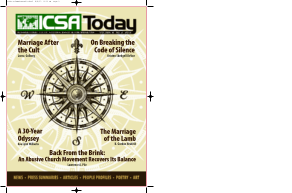
Kristen DeVoe's “On Breaking the Code of Silence” is about the importance to recovery of speaking out about sexual abuse. And
K. Gordon Neufeld's story “The Marriage of the Lamb” conveys a young woman’s hopes and fears in the moments before, during,
and after a group wedding ceremony in the Unification Church.
While it acknowledges that changes in cults are often for the worse, ICSA has consistently accepted the possibility that groups
can change for the better—a position that says much about our organization’s thoughtfulness and integrity. Lawrence Pile
describes this kind of change in his article “Back from the Brink,” about how an abusive organization (Great Commission Churches)
has reformed its practices—unusual in the world of cultic movements.
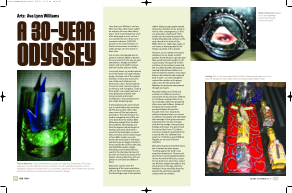
”A 30-Year Odyssey” tells the profoundly inspiring story of a woman who was raised, and who raised more than twelve children, in a
polygamous, sexually abusive fundamentalist Christian movement how she broke free of that environment and how the art she
began creating as part of her recovery helped her to find herself and build a new life.
Sincerely,
Livia Bardin, MSW
Book Review Editor
About ICSA Today
ICSA Today (IT) serves ICSA members by providing information
that enhances understanding of all aspects of the cult
phenomenon, including how groups function, how they affect
members, techniques of influence, dealing with harmful
effects, educational and legal implications, and other subjects.
IT issues may include
• practical articles for former members, families,
helping professionals, researchers, and others
• opinion essays
• theoretical articles
• reports on research
• summaries of news reports on groups
• information on books, articles, links
• information on ICSA members
• biographical profiles on selected members
• personal accounts
• art work
• poetry
• short stories and other literary articles
• special reports from correspondents around the world
ICSA Today is published three times a year.
Regular ICSA members receive the print editionof ICSA
Today and have access to its Web edition. Students and
other special members gain access to the online edition
only. Nonmember print subscriptions are available.
Submissions to the magazine should be sent
to the Editor-in-Chief, Michael Langone, PhD:
mail@icsamail.com We prefer Microsoft Word
or a program compatible with Word. Articles
should be no more than 2,500 words. Please
include a jpeg photo (less than 150 KB, please)
and biographical sketch (less than 150 words)
with your submission. Appropriate submissions
are reviewed by the relevant section editor and,
when appropriate, editorial review advisors.
International Cultic Studies Association
P.O. Box 2265 • Bonita Springs, FL 34133
239.514.3081 mail@icsamail.com
icsahome.com
2
Marriage After the Cult
Lorna Goldberg
6
On Breaking the Code of
Silence
Kristen Skedgell DeVoe
8
Back From the Brink
Lawrence A. Pile
12
The Marriage of the Lamb
K. Gordon Neufeld
16
Arts: A 30-Year Odyssey
Ava Lynn Williams
24
Profile On...
Marie-Andree Pelland
25
Point of View -Q&A
26
Correspondents’ Reports
27
News Desk
ICSA_volume4Issue2_Final 8/9/13 8:31 PM Page 2
The views expressed in ICSA Today are solely those of the authors and do not necessarily reflect the views
of ICSA Today’s editors or editorial boards or of ICSA’s directors, advisors, or staff. Groups analyzed or
mentioned in ICSA Today are not necessarily cults, nor are they necessarily harmful.
ICSA Today, Volume 4, No. 2, 2013
Editor-in-Chief
Michael D. Langone, PhD
Associate Editor
Ann Stamler, MA, MPhil
Arts Editor
Diana Pletts, MA
Book Review Editor
Livia Bardin, MSW
Family Editor
Lois Svoboda, MD, LMFT
Member Profiles Editor
Mary O’Connell
Mental Health Editor
Gillie Jenkinson, MA
News Desk Editor
Joseph F. Kelly
Research Coeditors
Linda Dubrow-Marshall, PhD
Rod Dubrow-Marshall, PhD
Point of View -Q&A
William Goldberg, MSW, LCSW
Correspondents
Australia
Helen Pomery
Austria/Germany
Friedrich Griess
Eastern Europe
Piotr T. Nowakowski, PhD
French-Speaking Countries
Guillaume Garih, BA, LLL, JD
Italy
Dr. Cristina Caparesi
Dr. Raffaella Di Marzio
Scandinavia
Arthur Buchman, MA
Spain and Latin America
Luis Santamaria, SThL
Erika Toren
Writing Consultants
Sharon Hamm
Robert E. Schecter, PhD
Bios of ICSA Today editors can be found at
http://icsahome.com/infoserv_respond/
by_profile.asp
International Cultic Studies Association
P.O. Box 2265 • Bonita Springs, FL 34133
Web: icsahome.com
Email: mail@icsamail.com
Phone: 239.514.3081 Fax: 305.393.8193
ISSN: 2154-820X
Printed in the USA
Artists and poets retain copyright of their
works and grant ICSA permission to
reproduce them. Unless otherwise
indicated, all other material copyright
International Cultic Studies Association.
Dear Friends,
“No person steps into the same river twice,” said the Greek philosopher Heraclitus, “for it is not the same water and you are not the
same person.”The world around us is full of change, sometimes predictable, like night to day, but often unexpected. We change,
and our institutions, since they are made up of people, also change—even those isolated, authoritarian groups often called cults.
For many years, ICSA researchers on cults and cult involvement have studied the changes people—and their relationships—
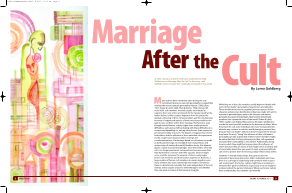
undergo as they enter and leave cults. In this issue of ICSA Today, Lorna Goldberg, in “Marriage After the Cult,” writes about the
shifting challenges faced by couples who are married within a group and then leave as a couple.
Kristen DeVoe's “On Breaking the Code of Silence” is about the importance to recovery of speaking out about sexual abuse. And
K. Gordon Neufeld's story “The Marriage of the Lamb” conveys a young woman’s hopes and fears in the moments before, during,
and after a group wedding ceremony in the Unification Church.
While it acknowledges that changes in cults are often for the worse, ICSA has consistently accepted the possibility that groups
can change for the better—a position that says much about our organization’s thoughtfulness and integrity. Lawrence Pile
describes this kind of change in his article “Back from the Brink,” about how an abusive organization (Great Commission Churches)
has reformed its practices—unusual in the world of cultic movements.
”A 30-Year Odyssey” tells the profoundly inspiring story of a woman who was raised, and who raised more than twelve children, in a
polygamous, sexually abusive fundamentalist Christian movement how she broke free of that environment and how the art she
began creating as part of her recovery helped her to find herself and build a new life.
Sincerely,
Livia Bardin, MSW
Book Review Editor
About ICSA Today
ICSA Today (IT) serves ICSA members by providing information
that enhances understanding of all aspects of the cult
phenomenon, including how groups function, how they affect
members, techniques of influence, dealing with harmful
effects, educational and legal implications, and other subjects.
IT issues may include
• practical articles for former members, families,
helping professionals, researchers, and others
• opinion essays
• theoretical articles
• reports on research
• summaries of news reports on groups
• information on books, articles, links
• information on ICSA members
• biographical profiles on selected members
• personal accounts
• art work
• poetry
• short stories and other literary articles
• special reports from correspondents around the world
ICSA Today is published three times a year.
Regular ICSA members receive the print editionof ICSA
Today and have access to its Web edition. Students and
other special members gain access to the online edition
only. Nonmember print subscriptions are available.
Submissions to the magazine should be sent
to the Editor-in-Chief, Michael Langone, PhD:
mail@icsamail.com We prefer Microsoft Word
or a program compatible with Word. Articles
should be no more than 2,500 words. Please
include a jpeg photo (less than 150 KB, please)
and biographical sketch (less than 150 words)
with your submission. Appropriate submissions
are reviewed by the relevant section editor and,
when appropriate, editorial review advisors.
International Cultic Studies Association
P.O. Box 2265 • Bonita Springs, FL 34133
239.514.3081 mail@icsamail.com
icsahome.com
2
Marriage After the Cult
Lorna Goldberg
6
On Breaking the Code of
Silence
Kristen Skedgell DeVoe
8
Back From the Brink
Lawrence A. Pile
12
The Marriage of the Lamb
K. Gordon Neufeld
16
Arts: A 30-Year Odyssey
Ava Lynn Williams
24
Profile On...
Marie-Andree Pelland
25
Point of View -Q&A
26
Correspondents’ Reports
27
News Desk
ICSA_volume4Issue2_Final 8/9/13 8:31 PM Page 2