Cultic Studies Journal, Vol. 5, No. 1 1988 Page 23
To constitute a comparison sample, Caucasian families with offspring between the ages of 18 and
30 were randomly selected from the membership lists of two Jewish Community Centers, a
Catholic Church, a Lutheran Church, a Congregational Church, and a Unitarian Church. All of
these organizations are located in the New York Metropolitan Area. Research packets containing
the information instruments and a self-addressed stamped envelope were mailed to all of these
families. Each packet also included one of six different letters. In order to ensure that the parents
would choose children of different ordinal positions and focus on one specific child, one child was
pre-selected. The letters asked the parents to either focus on the eldest, a middle, or the
youngest child. Thirty-five families, representing 25% of those to whom the packets were mailed,
followed all of the instructions and returned all of the instruments and were therefore usable
respondents for the research.
The comparison sample thus consisted of 35 intact middle income ($25,000 -$30,000) Caucasian
families, one of whose children was between the ages of 18 and 30. The average age of the
offspring focused on was 26.2 at the time of testing, the average number of siblings was 3.1. In
20 families a mate member was focused on and in 15 families a female was focused on. Ten
Catholic families, 16 Jewish, and 9 Protestant families comprised this sample.
Measures
Family Environment Scale Form R
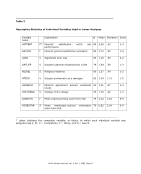
The FES, a scale developed by Moos and his associates, was chosen because the FES is a multi-
dimensional measure of family life. In addition, it was reported by Dreyer (1971) to be ―biased
towards a middle-class, Anglo-Saxon nuclear family with two parents.‖ These types of families
comprise the research sample The FES presents family members with 90 true/false statements
dealing with 11 substantive dimensions of the family social environment. A family score is
achieved by averaging the parents' scores in each subscale.
The scale was adapted specifically for the present study. The parents were instructed to respond
to the questions retrospectively rather than in the present in view of the underlying assumption of
normal distribution and the likely distortions resulting from using the FES retrospectively, it
seemed advisable t( use raw scores in this study. The FES had been used retrospectively by Penk
Robinowitz, Kidd, and Nisle (1979), and Pringle (1976). However, they relied on standard scores.
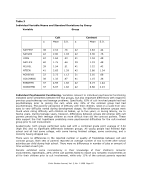
The enmeshed family is assumed to have a high level of cohesiveness and a low level of individual
decision-making, which are represented in a high score on the cohesion scale and a low score on
the independence scale of the FES. Thus, enmeshment was measured by averaging the parent
score for the cohesion and independence scales.
Family Questionnaire (Cult Families)
This questionnaire, developed in conjunction with the Jewish Board of Family and Children's
Services Research Team on Cults, is a 32-item questionnaire requiring either short answers or
forced-choice responses. The parents were asked to discuss each question with one another and
to formulate one answer together.
The items cover specific information on the cult member's background, including: present age,
age at recruitment, number of siblings and their ages, and school, social, and health history. It
also asks specific questions about the cult member's family's health history, religious affiliation
and level of observance, and demographics (marital status, education, vocation and income). In
addition, the parents were asked if, to the best of their knowledge, in the twelve months prior to
cult membership the cult member experienced any of the following events: death of a close
friend, sickness of a close relative or friend, broken romantic relationship, loss of a job, frustration
in finding a job, failure at school, extensive travel in the United States/overseas and/or abrupt
personality change. 'Me parents were asked to check all of the experiences that occurred.
To constitute a comparison sample, Caucasian families with offspring between the ages of 18 and
30 were randomly selected from the membership lists of two Jewish Community Centers, a
Catholic Church, a Lutheran Church, a Congregational Church, and a Unitarian Church. All of
these organizations are located in the New York Metropolitan Area. Research packets containing
the information instruments and a self-addressed stamped envelope were mailed to all of these
families. Each packet also included one of six different letters. In order to ensure that the parents
would choose children of different ordinal positions and focus on one specific child, one child was
pre-selected. The letters asked the parents to either focus on the eldest, a middle, or the
youngest child. Thirty-five families, representing 25% of those to whom the packets were mailed,
followed all of the instructions and returned all of the instruments and were therefore usable
respondents for the research.
The comparison sample thus consisted of 35 intact middle income ($25,000 -$30,000) Caucasian
families, one of whose children was between the ages of 18 and 30. The average age of the
offspring focused on was 26.2 at the time of testing, the average number of siblings was 3.1. In
20 families a mate member was focused on and in 15 families a female was focused on. Ten
Catholic families, 16 Jewish, and 9 Protestant families comprised this sample.
Measures
Family Environment Scale Form R
The FES, a scale developed by Moos and his associates, was chosen because the FES is a multi-
dimensional measure of family life. In addition, it was reported by Dreyer (1971) to be ―biased
towards a middle-class, Anglo-Saxon nuclear family with two parents.‖ These types of families
comprise the research sample The FES presents family members with 90 true/false statements
dealing with 11 substantive dimensions of the family social environment. A family score is
achieved by averaging the parents' scores in each subscale.
The scale was adapted specifically for the present study. The parents were instructed to respond
to the questions retrospectively rather than in the present in view of the underlying assumption of
normal distribution and the likely distortions resulting from using the FES retrospectively, it
seemed advisable t( use raw scores in this study. The FES had been used retrospectively by Penk
Robinowitz, Kidd, and Nisle (1979), and Pringle (1976). However, they relied on standard scores.
The enmeshed family is assumed to have a high level of cohesiveness and a low level of individual
decision-making, which are represented in a high score on the cohesion scale and a low score on
the independence scale of the FES. Thus, enmeshment was measured by averaging the parent
score for the cohesion and independence scales.
Family Questionnaire (Cult Families)
This questionnaire, developed in conjunction with the Jewish Board of Family and Children's
Services Research Team on Cults, is a 32-item questionnaire requiring either short answers or
forced-choice responses. The parents were asked to discuss each question with one another and
to formulate one answer together.
The items cover specific information on the cult member's background, including: present age,
age at recruitment, number of siblings and their ages, and school, social, and health history. It
also asks specific questions about the cult member's family's health history, religious affiliation
and level of observance, and demographics (marital status, education, vocation and income). In
addition, the parents were asked if, to the best of their knowledge, in the twelve months prior to
cult membership the cult member experienced any of the following events: death of a close
friend, sickness of a close relative or friend, broken romantic relationship, loss of a job, frustration
in finding a job, failure at school, extensive travel in the United States/overseas and/or abrupt
personality change. 'Me parents were asked to check all of the experiences that occurred.