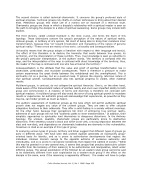
Cultic Studies Journal, Vol. 5, No. 1 1988 Page 100
Book Review
Unmasking the New Age. by Douglas R. Groothius. Inter-Varsity Press. Downers Grove, EL.
1986. 200 pages. $6.95.
Unholy Spirits: Occultism and New Age Humanism. By Gary North. Dominion Press. Ft.
Worth, TX. $19.95.
Reviewed by Herbert Schlossberg
Reenchanting the World*
―Do not seek to become a god.‖ -Pindar
Once we begin to see that we are all God, that we all have the attributes of God,
then I think the whole purpose of human life is to re-own the Godlikeness within
us the perfect love, the perfect wisdom, the perfect understanding, the perfect
intelligence, and when we do that, we create back to that old, that essential
oneness which is consciousness.
This is the religious philosophy being taught to students in the Los Angeles public schools, as part
of a federally funded project. Where is the ACLU now that we need it?
Kant has few readers outside of university philosophy departments, but his influence obviously
extends to Los Angeles. Part of Kant‘s legacy to the modem world is the iron curtain that seals off
all reality into two compartments: that which can be known by the senses -phenomena -and
that which cannot be known by the senses -noumena. The latter includes the objects we
normally associate with the religious: God, spirit, immortal soul, and so on. One of the
unintended effects of this effort was to provide an excuse for ignoring the noumenal world. What
modem man cannot know through the senses, he feels safe in dismissing from further
consideration. One of the first and most notable casualties of this reasoning is the idea of
purpose. The senses are silent on such topics. The response of Nietzsche and the existentialists
was a sometimes stoical despair. The naive managed to keep up the cheerful scientism that
characterizes the work of scientific publicists Eke Isaac Asimov and Carl Sagan, but the official
grin of 19th-century optimism is beginning to resemble the rictus of a corpse.
Coexisting with such thinking throughout much of the last century-and-a-half, especially in
Europe, was the philosophy of Hegel. His all-pervading spirit was a sophisticated contra-Kantian
development of what Aldous Huxley called the ―perennial philosophy.‖ Thus pantheism was the
religion -often unacknowledged -of a great many of those in the 19th-century intellectual classes
who did not subscribe to scientism. Ernst Troeltsch, early in this century, surveyed the German
Protestant church and found it to be largely pantheist in orientation.
This suggests that a simple-minded scientism, artificially and naively extended in time by the
Asiniovs and the Sagans, was only a passing phase that its inherent instability was such that it
had to give way before long. It is remarkable that it lasted as long as it did, but that long life was
largely a phenomenon of the English-speaking world. Writing in The Idea of Nature (1945), British
philosopher R.G. Collingwood contended that its passing marked the end of a temporary
aberration in intellectual history and a return to the mainstream of European thought
There were prophets early in the century, who, observing the single-minded mania of the science-
boosters, could see that it had to come to an end. Oswald Spengler, in his massive two-volume
tome The Decline of the West, predicted that the prevalent materialism would become unbearable
and that people would be impelled to toy with weird cults as a means of escape. Max Weber, in
his three-volume Economy and Society, prophesied that phenomenal man would collapse into
Book Review
Unmasking the New Age. by Douglas R. Groothius. Inter-Varsity Press. Downers Grove, EL.
1986. 200 pages. $6.95.
Unholy Spirits: Occultism and New Age Humanism. By Gary North. Dominion Press. Ft.
Worth, TX. $19.95.
Reviewed by Herbert Schlossberg
Reenchanting the World*
―Do not seek to become a god.‖ -Pindar
Once we begin to see that we are all God, that we all have the attributes of God,
then I think the whole purpose of human life is to re-own the Godlikeness within
us the perfect love, the perfect wisdom, the perfect understanding, the perfect
intelligence, and when we do that, we create back to that old, that essential
oneness which is consciousness.
This is the religious philosophy being taught to students in the Los Angeles public schools, as part
of a federally funded project. Where is the ACLU now that we need it?
Kant has few readers outside of university philosophy departments, but his influence obviously
extends to Los Angeles. Part of Kant‘s legacy to the modem world is the iron curtain that seals off
all reality into two compartments: that which can be known by the senses -phenomena -and
that which cannot be known by the senses -noumena. The latter includes the objects we
normally associate with the religious: God, spirit, immortal soul, and so on. One of the
unintended effects of this effort was to provide an excuse for ignoring the noumenal world. What
modem man cannot know through the senses, he feels safe in dismissing from further
consideration. One of the first and most notable casualties of this reasoning is the idea of
purpose. The senses are silent on such topics. The response of Nietzsche and the existentialists
was a sometimes stoical despair. The naive managed to keep up the cheerful scientism that
characterizes the work of scientific publicists Eke Isaac Asimov and Carl Sagan, but the official
grin of 19th-century optimism is beginning to resemble the rictus of a corpse.
Coexisting with such thinking throughout much of the last century-and-a-half, especially in
Europe, was the philosophy of Hegel. His all-pervading spirit was a sophisticated contra-Kantian
development of what Aldous Huxley called the ―perennial philosophy.‖ Thus pantheism was the
religion -often unacknowledged -of a great many of those in the 19th-century intellectual classes
who did not subscribe to scientism. Ernst Troeltsch, early in this century, surveyed the German
Protestant church and found it to be largely pantheist in orientation.
This suggests that a simple-minded scientism, artificially and naively extended in time by the
Asiniovs and the Sagans, was only a passing phase that its inherent instability was such that it
had to give way before long. It is remarkable that it lasted as long as it did, but that long life was
largely a phenomenon of the English-speaking world. Writing in The Idea of Nature (1945), British
philosopher R.G. Collingwood contended that its passing marked the end of a temporary
aberration in intellectual history and a return to the mainstream of European thought
There were prophets early in the century, who, observing the single-minded mania of the science-
boosters, could see that it had to come to an end. Oswald Spengler, in his massive two-volume
tome The Decline of the West, predicted that the prevalent materialism would become unbearable
and that people would be impelled to toy with weird cults as a means of escape. Max Weber, in
his three-volume Economy and Society, prophesied that phenomenal man would collapse into